AI Benchmarks
Benchmark scores from Stanford's AI Index Report 2026 on what AI models can and cannot yet do, from science questions and coding to agents, images, video, finance and law, with human baselines where they exist.
AI Progress · 41 charts · 14 topics
- Source
- Stanford AI Index Report 2026
- Charts
- 41 with CSV data
- Last checked
- 20 Oct 2026
- Data
- All CSVs (zip)
98.7%Best SWE-bench Verified score as a share of the human baseline, 2025View chart →93%Best GPQA Diamond accuracy in 2025, against 81.2% for expert validatorsView chart →38.3%Best accuracy on Humanity's Last Exam in 2025 (Gemini 3 Pro), up from 8% in 2024View chart →31.3%FrontierMath Tier 4 problems solved by GPT-5.2 Pro in 2025, up from 0% in 2024View chart →77.3%Top Terminal-Bench 2.0 accuracy, February 2026, up from 18.4% a year earlierView chart →66.3%Best AI agent on OSWorld computer tasks in 2025; people complete 72.4%View chart →
AI models moved closer to human baselines on most of the benchmarks the AI Index tracks, but unevenly. On SWE-bench Verified, a test of fixing real software issues, the best score reached 98.7% of the human baseline in 2025, up from 64.3% in 2024. On GPQA Diamond's graduate-level science questions, the best mean accuracy in Epoch AI's evaluations rose from 36% in 2023 to 93% in 2025, above the 81.2% scored by expert validators. Harder tests moved too: the best score on Humanity's Last Exam rose from 8% to 38.3%, and the best model solved 31.3% of FrontierMath's hardest tier, up from 0% a year earlier.
Read the full overview
Agent benchmarks show some of the largest changes. The best unguided solve rate on Cybench's capture-the-flag security tasks rose from 17.5% in 2024 to 93% in early 2026, and the top Terminal-Bench 2.0 accuracy rose from 18.4% to 77.3% in a year. People still lead on several tests: the best agent completed 66.3% of OSWorld computer tasks against 72.4% for people, and the best GAIA score was 74.5% against a 92% human baseline. Some tasks that are simple for people remain weak points: the best model read 50.6% of ClockBench clocks correctly, against about 90% for humans.
The charts are grouped into AI versus human performance, the Chatbot Arena leaderboard, knowledge, reasoning, maths and coding benchmarks, agent benchmarks, multilingual tests, text embeddings, image and video understanding, video generation, and professional tasks in finance and law. At the top of many leaderboards the margins are narrow: the top 15 models on MMLU-Pro sit within 4.2 points, and on TaxEval v2 within 2.9 percentage points.
All figures come from Stanford's AI Index Report 2026 and the leaderboards it draws on, including Epoch AI's evaluations, the Arena, Vals.ai, the ARC Prize and Stanford CRFM's HELM. Most leaderboard results are snapshots from early 2026 and change often. Scores depend on the model version, settings and agent used, Arena ratings reflect user preference rather than accuracy, and a benchmark score measures performance on that test, not general ability.
AI Adoption · 2026AI Statistics: the pocket guide83Free for subscribersAll 83 key numbers on two pages, with sources.Every hub's headline numbers in one PDF, ready for a board paper or a slide.Get the guide
01
AI vs Human Performance
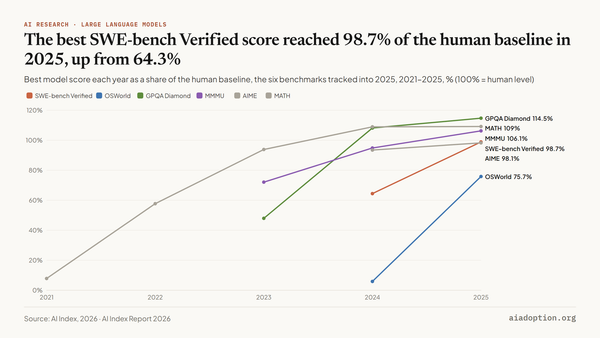
The best AI score on SWE-bench Verified reached 98.7% of the human baseline in 2025, up from 64.3% in 2024. On OSWorld computer use, the best score rose from 5.7% to 75.7% of the human baseline, and on GPQA Diamond it reached 114.5%, above human level. The AI Index tracks six benchmarks against human baselines into 2025.
02
Chatbot Arena Leaderboard
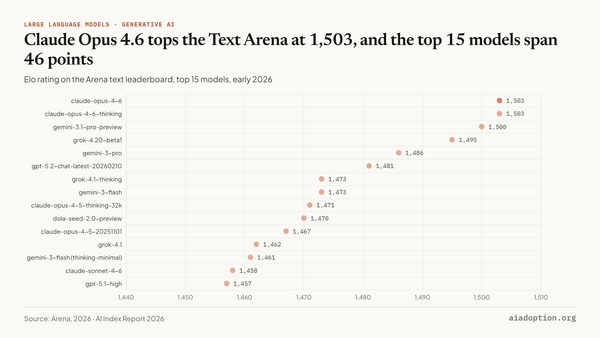
Claude Opus 4.6 tops the Arena text leaderboard at 1,503 in early 2026, tied with its thinking variant and three points ahead of gemini-3.1-pro-preview at 1,500. The top 15 models span 46 points: the 15th, gpt-5.1-high, scored 1,457. Arena ratings reflect user preference in head-to-head comparisons, not accuracy on a fixed test.
03
AI Knowledge Benchmarks
Gemini-3.1-Pro leads MMLU-Pro at 91.2% in early 2026, and the top 15 models sit within 4.2 points of each other. Harder tests leave more room: the best score on Humanity's Last Exam reached 38.3% in 2025, while the best GPQA Diamond score, 93%, passed the 81.2% expert baseline.
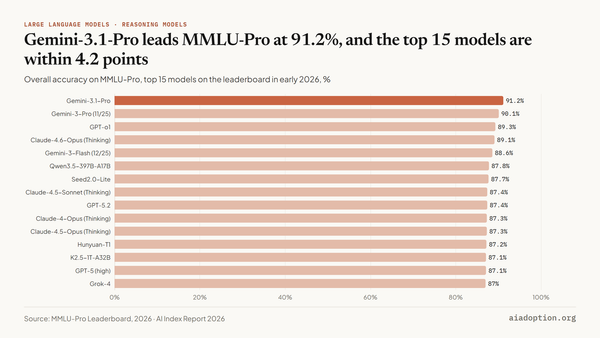 AI Knowledge Benchmarks91.2%MMLU-Pro accuracy of Gemini-3.1-Pro, the highest of the top 15 in early 2026; Gemini-3-Pro 90.1%, GPT-o1 89.3%Gemini-3.1-Pro leads MMLU-Pro at 91.2%, and the top 15 models are within 4.2 pointsChart · CSVView →
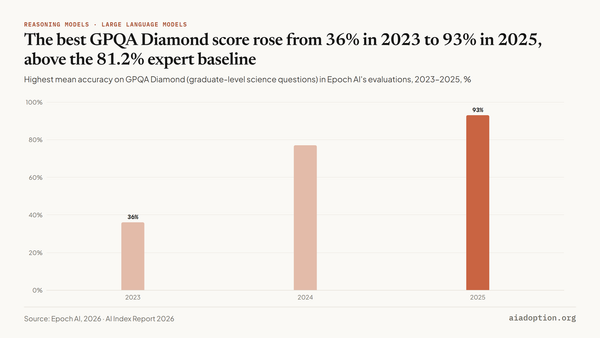 AI Knowledge Benchmarks93%Best mean accuracy on GPQA Diamond in 2025 (gemini-3-pro-preview), against 81.2% for expert human validatorsThe best GPQA Diamond score rose from 36% in 2023 to 93% in 2025, above the 81.2% expert baselineChart · CSVView →
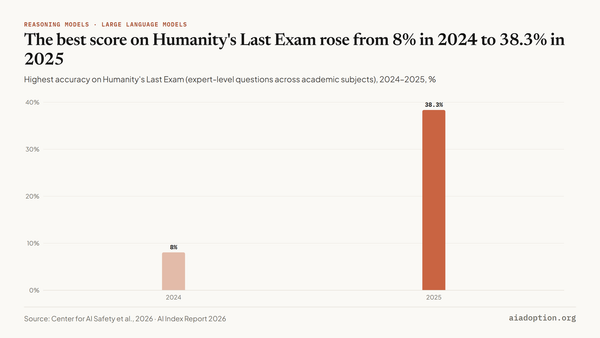 AI Knowledge Benchmarks38.3%Best accuracy on Humanity's Last Exam in 2025 (Gemini 3 Pro), up from 8% for o1 in 2024The best score on Humanity's Last Exam rose from 8% in 2024 to 38.3% in 2025Chart · CSVView →
04
AI Reasoning Benchmarks
Gemini 3 Deep Think scored 84.6% on ARC-AGI-2's abstract reasoning puzzles in February 2026, 7.5 points ahead of Gemini 3.1 Pro at 77.1%. On PlanBench, GPT-5 solved 205 planning tasks and the classical planner LAMA 204, but with disguised task descriptions GPT-5 fell to 152 and DeepSeek R1 from 157 to 93.
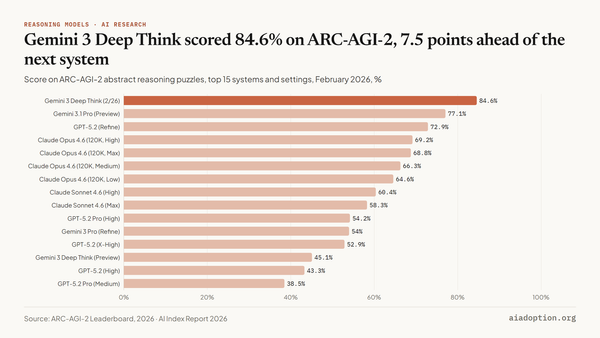 AI Reasoning Benchmarks84.6%ARC-AGI-2 score of Gemini 3 Deep Think (2/26), the top system in February 2026; Gemini 3.1 Pro (Preview) 77.1%Gemini 3 Deep Think scored 84.6% on ARC-AGI-2, 7.5 points ahead of the next systemChart · CSVView →
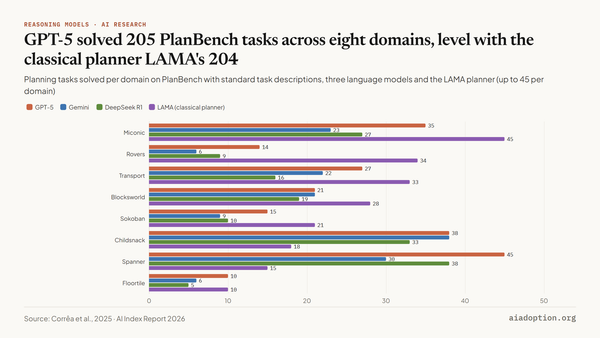 AI Reasoning Benchmarks205PlanBench tasks GPT-5 solved across eight domains with standard descriptions; LAMA 204, DeepSeek R1 157, Gemini 155GPT-5 solved 205 PlanBench tasks across eight domains, level with the classical planner LAMA's 204Chart · CSVView →
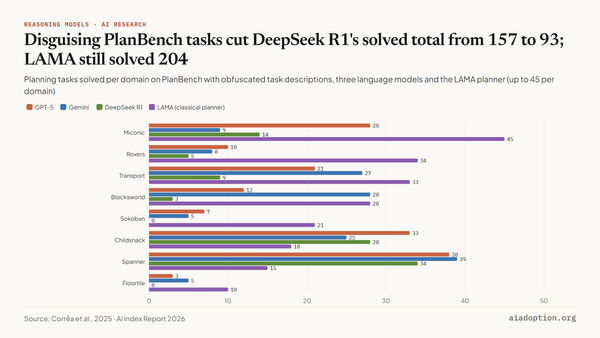 AI Reasoning Benchmarks93PlanBench tasks DeepSeek R1 solved across eight domains with obfuscated descriptions, down from 157 with standard onesDisguising PlanBench tasks cut DeepSeek R1's solved total from 157 to 93; LAMA still solved 204Chart · CSVView →
05
AI Maths Benchmarks
GPT-5.2 Pro solved 31.3% of FrontierMath Tier 4, Epoch AI's hardest tier of original maths problems, in 2025, up from 0% for the best 2024 model. On MathArena's fresh competition problems GPT-5.2 (high) scored 97%, and on IMO-ProofBench olympiad proofs Aletheia scored 91.9% against 7.1% for GPT-5.1.
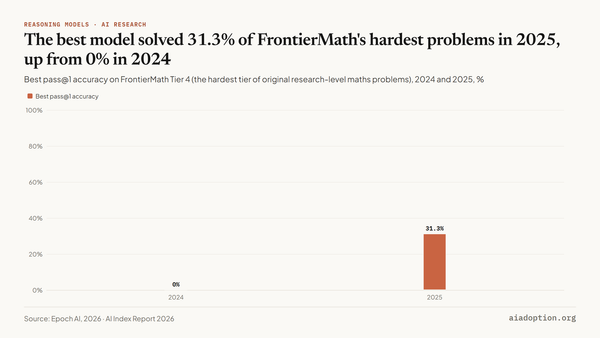 AI Maths Benchmarks31.3%Of FrontierMath Tier 4 problems solved at the first attempt by GPT-5.2 Pro, 2025The best model solved 31.3% of FrontierMath's hardest problems in 2025, up from 0% in 2024Chart · CSVView →
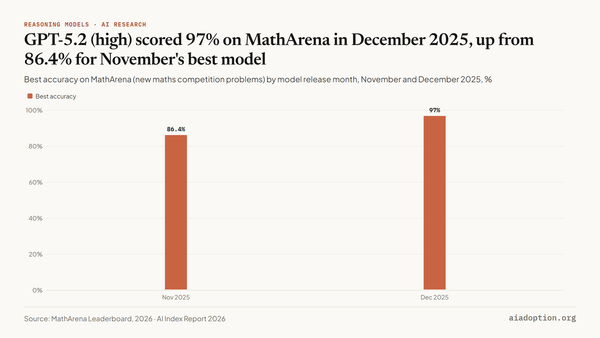 AI Maths Benchmarks97%MathArena accuracy of GPT-5.2 (high), released December 2025; Grok 4.1 Fast (Reasoning), November 2025: 86.4%GPT-5.2 (high) scored 97% on MathArena in December 2025, up from 86.4% for November's best modelChart · CSVView →
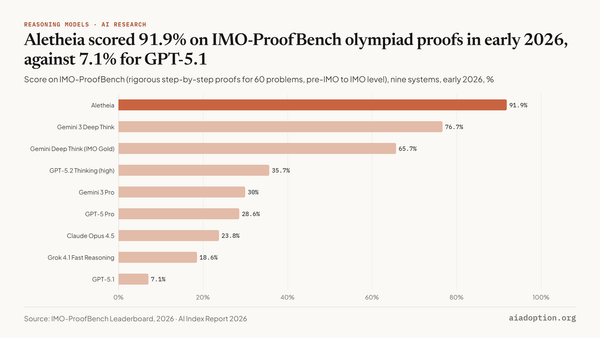 AI Maths Benchmarks91.9%IMO-ProofBench score of Aletheia, the highest of nine systems; Gemini 3 Deep Think scored 76.7%Aletheia scored 91.9% on IMO-ProofBench olympiad proofs in early 2026, against 7.1% for GPT-5.1Chart · CSVView →
06
AI Coding Benchmarks
Claude 4.5 Opus resolved 76.8% of SWE-bench Verified's real GitHub issues in February 2026, with the top 10 models within 6 percentage points. The best Terminal-Bench 2.0 accuracy rose from 18.4% to 77.3% between February 2025 and February 2026, while on Vibe Code Bench's complete web applications the leader scored 57.6%.
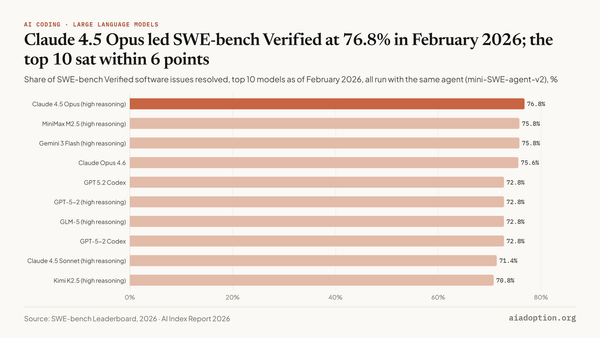 AI Coding Benchmarks76.8%Of SWE-bench Verified issues resolved by Claude 4.5 Opus (high reasoning), February 2026; the tenth-placed model resolved 70.8%Claude 4.5 Opus led SWE-bench Verified at 76.8% in February 2026; the top 10 sat within 6 pointsChart · CSVView →
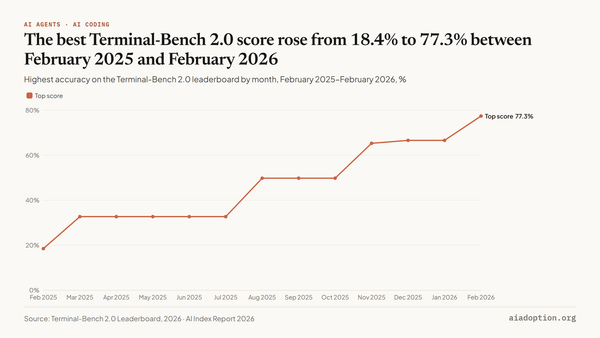 AI Coding Benchmarks77.3%Top Terminal-Bench 2.0 accuracy, February 2026, up from 18.4% in February 2025The best Terminal-Bench 2.0 score rose from 18.4% to 77.3% between February 2025 and February 2026Chart · CSVView →
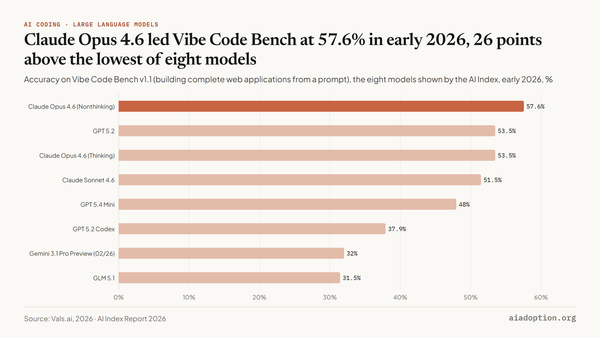 AI Coding Benchmarks57.6%Vibe Code Bench accuracy of Claude Opus 4.6 (Nonthinking), the highest of the eight models shown; GPT 5.2 scored 53.5%Claude Opus 4.6 led Vibe Code Bench at 57.6% in early 2026, 26 points above the lowest of eight modelsChart · CSVView →
07
AI Agent Benchmarks
The best AI agent completed 66.3% of OSWorld computer tasks in 2025, against 72.4% for people, and the best GAIA score reached 74.5% against a 92% human baseline. On Cybench's professional security challenges, the best unguided solve rate rose from 17.5% in 2024 to 93% in early 2026, achieved by Claude Opus 4.6.
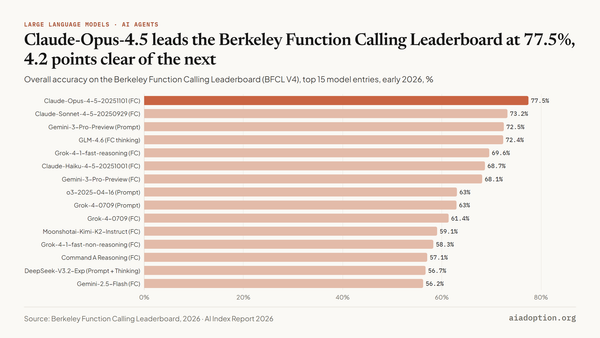 AI Agent Benchmarks77.5%Overall BFCL accuracy of Claude-Opus-4.5 in function-calling mode, early 2026; Claude-Sonnet-4.5 73.2%Claude-Opus-4.5 leads the Berkeley Function Calling Leaderboard at 77.5%, 4.2 points clear of the nextChart · CSVView →
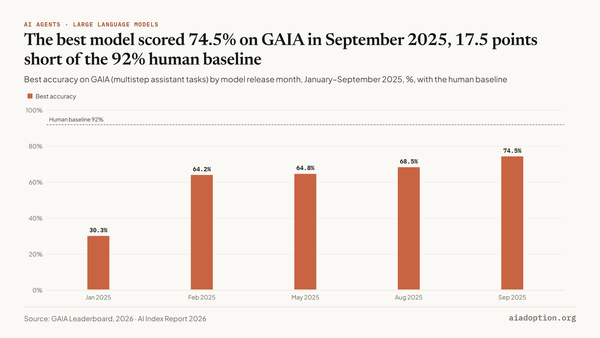 AI Agent Benchmarks74.5%GAIA accuracy of Claude Sonnet 4.5 (September 2025), against 92% for peopleThe best model scored 74.5% on GAIA in September 2025, 17.5 points short of the 92% human baselineChart · CSVView →
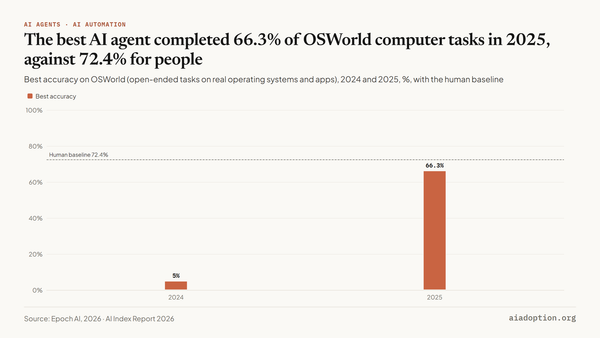 AI Agent Benchmarks66.3%OSWorld accuracy of Claude Opus 4.5 (no thinking), 2025; human baseline 72.4%The best AI agent completed 66.3% of OSWorld computer tasks in 2025, against 72.4% for peopleChart · CSVView →
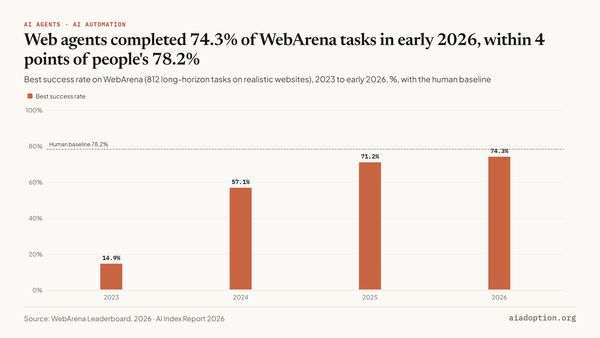 AI Agent Benchmarks74.3%WebArena success rate of the best entry (Deepseek v3.2), early 2026; human baseline 78.2%Web agents completed 74.3% of WebArena tasks in early 2026, within 4 points of people's 78.2%Chart · CSVView →
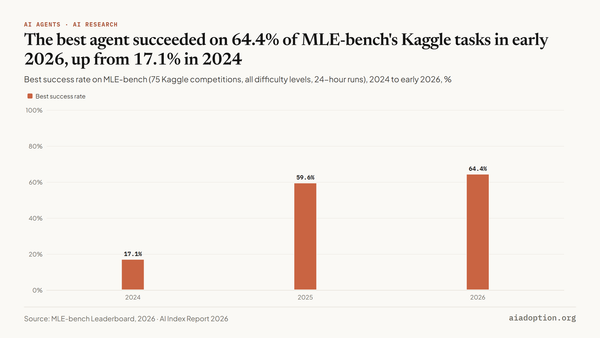 AI Agent Benchmarks64.4%MLE-bench success rate of Famou-Agent 2.0 with Gemini-3-Pro-Preview, early 2026The best agent succeeded on 64.4% of MLE-bench's Kaggle tasks in early 2026, up from 17.1% in 2024Chart · CSVView →
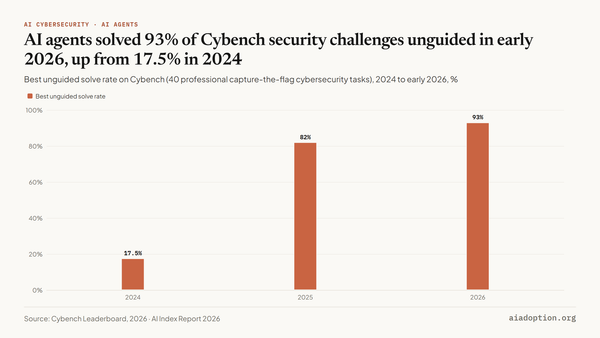 AI Agent Benchmarks93%Of Cybench tasks solved unguided by Claude Opus 4.6, early 2026, up from 17.5% in 2024AI agents solved 93% of Cybench security challenges unguided in early 2026, up from 17.5% in 2024Chart · CSVView →
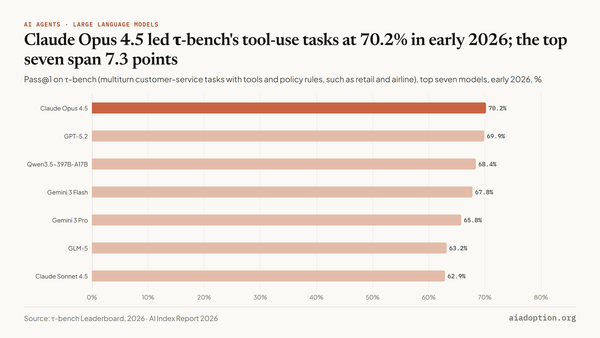 AI Agent Benchmarks70.2%Τ-bench pass@1 of Claude Opus 4.5, the highest of the top seven; GPT-5.2 scored 69.9%Claude Opus 4.5 led τ-bench's tool-use tasks at 70.2% in early 2026; the top seven span 7.3 pointsChart · CSVView →
08
Multilingual AI Benchmarks
GPT-5.2 leads the Indic LLM Arena with 1,314 across more than 20 Indian languages, and Arabic.AI's LLM-X tops HELM Arabic with a mean score of 0.86. Dialects remain harder: all 12 models tested scored lower on Slovenia's Cerkno dialect than on standard Slovenian, with GPT-5 falling from 99.8% to 88.6%.
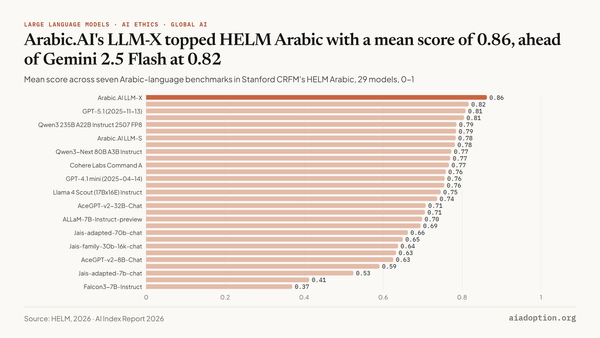 Multilingual AI Benchmarks0.86Mean HELM Arabic score of Arabic.AI's LLM-X, the highest of 29 models; Gemini 2.5 Flash 0.82, GPT-5.1 0.81Arabic.AI's LLM-X topped HELM Arabic with a mean score of 0.86, ahead of Gemini 2.5 Flash at 0.82Chart · CSVView →
 Multilingual AI Benchmarks1,314GPT-5.2's Indic LLM Arena score, the highest of 27 models; GPT-5.1 1,298, Gemini 3 Flash 1,288GPT-5.2 leads the Indic LLM Arena with 1,314, ahead of GPT-5.1 (1,298) and Gemini 3 Flash (1,288)Chart · CSVView →
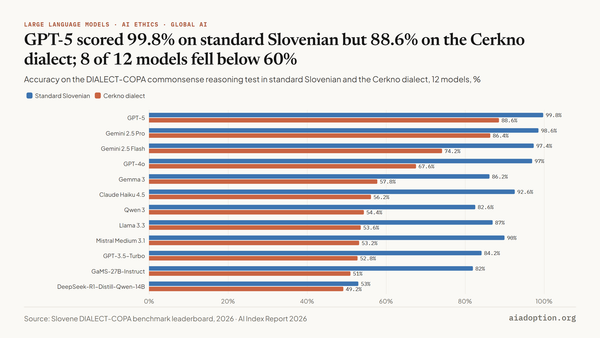 Multilingual AI Benchmarks88.6%GPT-5's accuracy on the Cerkno dialect, the highest of 12 models, against 99.8% on standard SlovenianGPT-5 scored 99.8% on standard Slovenian but 88.6% on the Cerkno dialect; 8 of 12 models fell below 60%Chart · CSVView →
09
Text Embedding Benchmarks
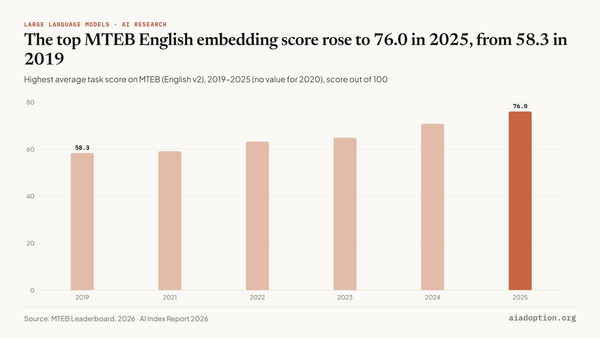
The best text-embedding model on MTEB (English v2) averaged 76.0 across its tasks in 2025, up 11.2 points from 64.8 in 2023 and from 58.3 in 2019. The score averages different metrics across MTEB's English tasks on a scale out of 100, and the chart has no value for 2020.
10
AI Image Understanding
Gemini 3.1 Pro Preview scored 88.2% on the MMMU multimodal test in February 2026, 0.4 points below the best human expert at 88.6%. Reading clocks remains hard for AI: the best model read 50.6% of ClockBench clocks correctly in March 2026, against about 90% for humans.
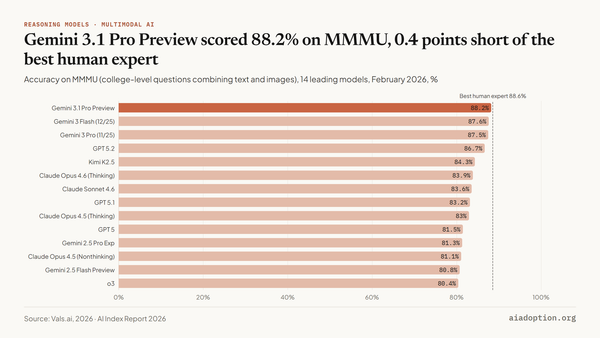 AI Image Understanding88.2%MMMU accuracy of Gemini 3.1 Pro Preview in February 2026, the highest of 14 models; the best human expert scored 88.6%Gemini 3.1 Pro Preview scored 88.2% on MMMU, 0.4 points short of the best human expertChart · CSVView →
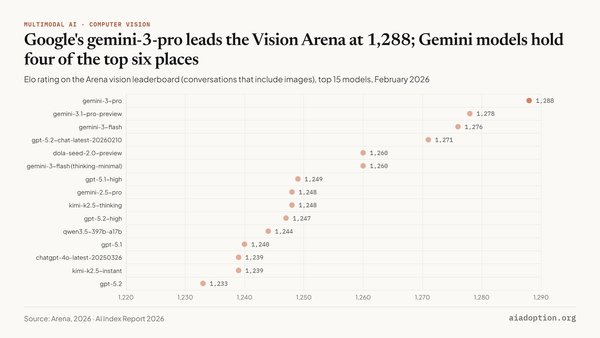 AI Image Understanding1,288Vision Arena rating of gemini-3-pro in February 2026, 10 points ahead of gemini-3.1-pro-preview (1,278)Google's gemini-3-pro leads the Vision Arena at 1,288; Gemini models hold four of the top six placesChart · CSVView →
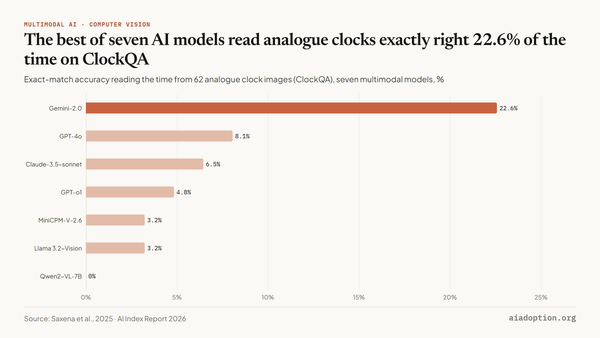 AI Image Understanding22.6%Share of ClockQA clocks Gemini-2.0 read exactly right, the best of seven models; GPT-4o managed 8.1%The best of seven AI models read analogue clocks exactly right 22.6% of the time on ClockQAChart · CSVView →
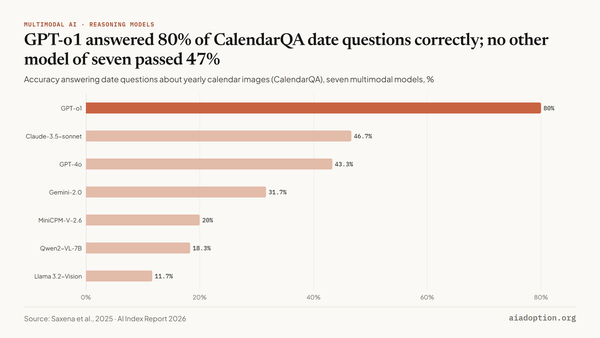 AI Image Understanding80%CalendarQA accuracy of GPT-o1, the best of seven models; Claude-3.5-sonnet scored 46.7%GPT-o1 answered 80% of CalendarQA date questions correctly; no other model of seven passed 47%Chart · CSVView →
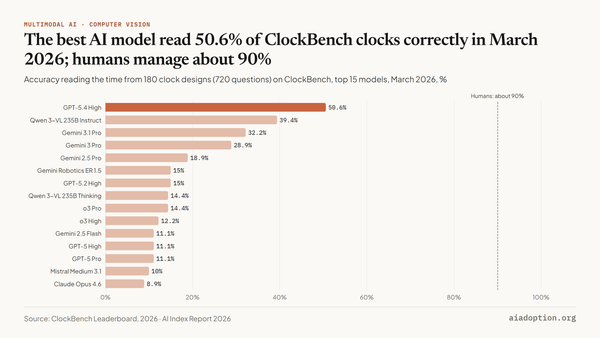 AI Image Understanding50.6%ClockBench accuracy of GPT-5.4 High in March 2026, the best of the top 15; humans score about 90%The best AI model read 50.6% of ClockBench clocks correctly in March 2026; humans manage about 90%Chart · CSVView →
11
AI Video Understanding
No model reached the 74.4% human baseline on Video-MMMU, which tests learning from expert lecture videos; the best, Keye-VL-1.5-8B, scored 66%. On its knowledge-gain measure, human experts score 33.1% and the best model, GPT-4o, 15.6%. JT3.5 and JT-VL-Chat tie for first on MVBench at 74.1%.
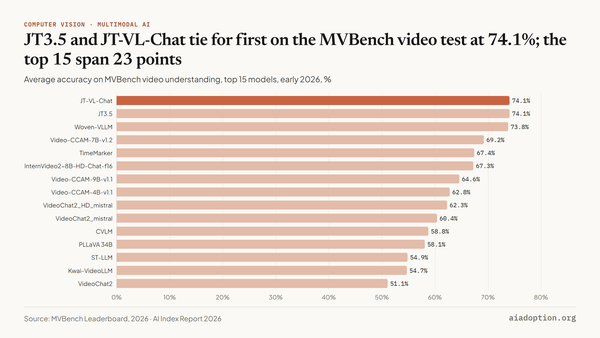 AI Video Understanding74.1%MVBench average accuracy of JT-VL-Chat and JT3.5, tied first in early 2026; Woven-VLLM 73.8%JT3.5 and JT-VL-Chat tie for first on the MVBench video test at 74.1%; the top 15 span 23 pointsChart · CSVView →
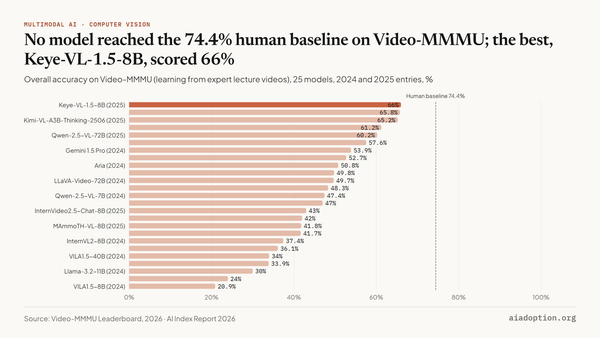 AI Video Understanding66%Video-MMMU accuracy of Keye-VL-1.5-8B (2025), the highest of 25 models; the human baseline is 74.4%No model reached the 74.4% human baseline on Video-MMMU; the best, Keye-VL-1.5-8B, scored 66%Chart · CSVView →
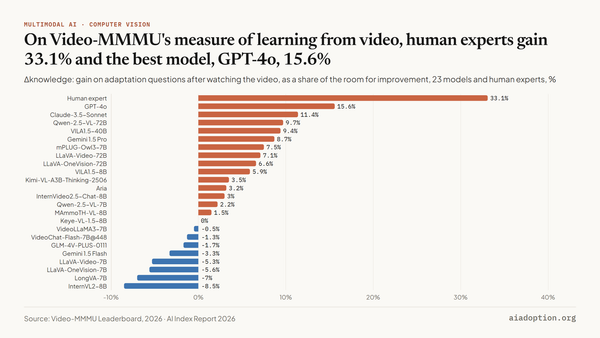 AI Video Understanding15.6%Δknowledge of GPT-4o on Video-MMMU, the highest of 23 models, against 33.1% for human expertsOn Video-MMMU's measure of learning from video, human experts gain 33.1% and the best model, GPT-4o, 15.6%Chart · CSVView →
12
AI Video Generation
Veo 3 leads the VBench-2.0 video generation test at 66.7% in early 2026, 4.0 points ahead of Vidu Q1, and none of the 10 models reached 67%. On Video-Bench's four video-quality measures, Gen3 scores highest on all four, and motion effects is every model's weakest measure.
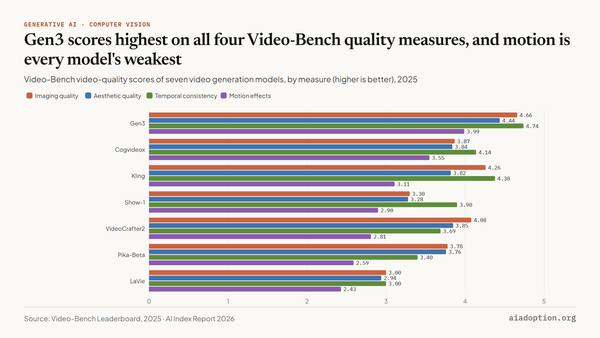 AI Video Generation4.74Gen3's temporal consistency score on Video-Bench, its best of four measures; its motion effects score is 3.99Gen3 scores highest on all four Video-Bench quality measures, and motion is every model's weakestChart · CSVView →
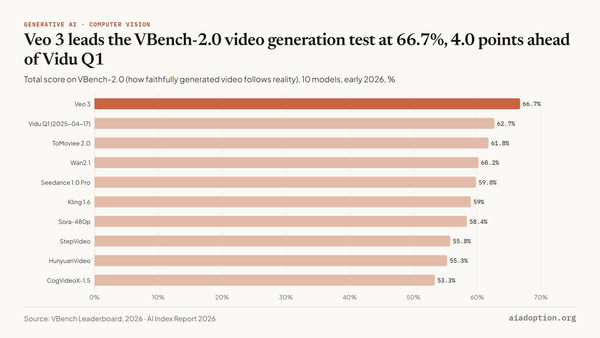 AI Video Generation66.7%VBench-2.0 total score of Veo 3, the highest of 10 models in early 2026; Vidu Q1 62.7%Veo 3 leads the VBench-2.0 video generation test at 66.7%, 4.0 points ahead of Vidu Q1Chart · CSVView →
13
AI Finance Benchmarks
Claude Sonnet 4.6 led Finance Agent v1.1, a set of entry-level financial analyst tasks, at 63.3% in early 2026, and no model reached two-thirds. Scores on tax and document tests cluster tightly: the top 15 models on TaxEval v2 sit within 2.9 percentage points, and none reached 70% on MortgageTax or CorpFin v2.
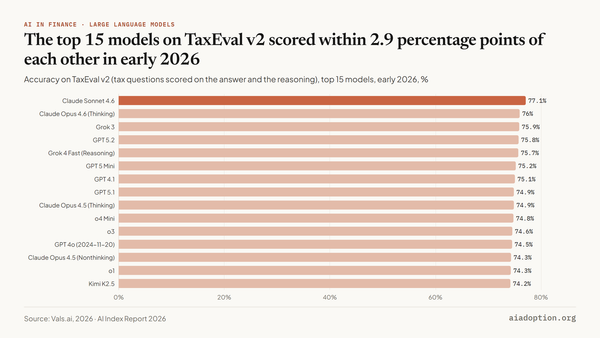 AI Finance Benchmarks2.9 ptsGap between the best (Claude Sonnet 4.6, 77.1%) and 15th-placed (Kimi K2.5, 74.2%) models on TaxEval v2The top 15 models on TaxEval v2 scored within 2.9 percentage points of each other in early 2026Chart · CSVView →
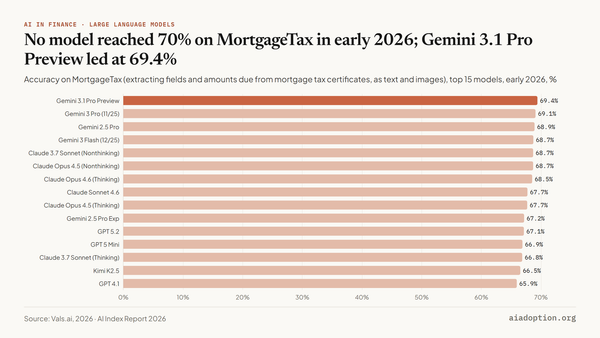 AI Finance Benchmarks69.4%MortgageTax accuracy of Gemini 3.1 Pro Preview, the highest of the top 15; GPT 4.1 was 15th at 65.9%No model reached 70% on MortgageTax in early 2026; Gemini 3.1 Pro Preview led at 69.4%Chart · CSVView →
 AI Finance Benchmarks68.3%CorpFin v2 accuracy of Kimi K2.5, the highest of the top 15; Qwen 3 Max Thinking scored 68%Kimi K2.5 led CorpFin v2's credit-agreement questions at 68.3% in early 2026; none reached 70%Chart · CSVView →
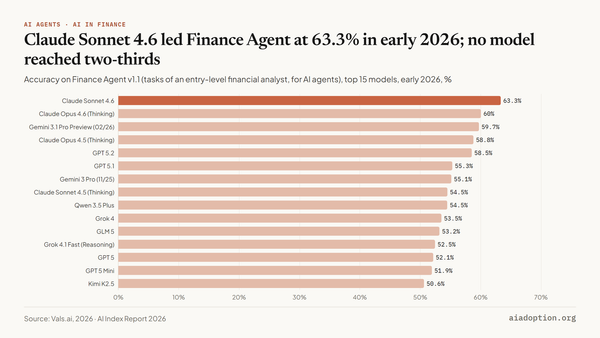 AI Finance Benchmarks63.3%Finance Agent v1.1 accuracy of Claude Sonnet 4.6, the highest of the top 15; Kimi K2.5 was 15th at 50.6%Claude Sonnet 4.6 led Finance Agent at 63.3% in early 2026; no model reached two-thirdsChart · CSVView →
14
AI Legal Benchmarks
GPT 5.1 led CaseLaw v2, a legal research test built from recent US and Canadian court decisions, at 73.4% in early 2026, 3.5 points ahead of GPT 4.1. On LegalBench's legal reasoning tasks, Gemini 3.1 Pro Preview led at 87.4%, and all top 15 models scored above 83%.
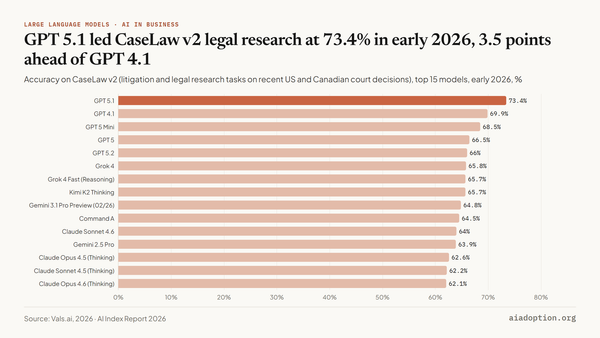 AI Legal Benchmarks73.4%CaseLaw v2 accuracy of GPT 5.1, the highest of the top 15; GPT 4.1 scored 69.9%GPT 5.1 led CaseLaw v2 legal research at 73.4% in early 2026, 3.5 points ahead of GPT 4.1Chart · CSVView →
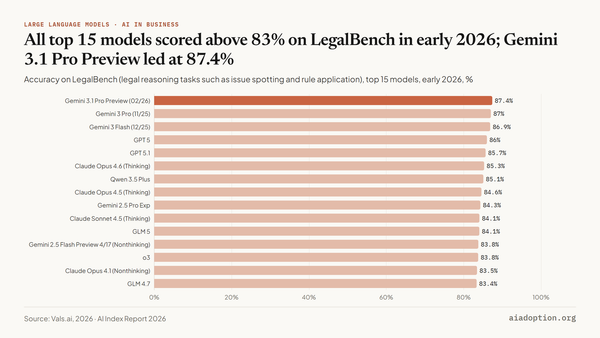 AI Legal Benchmarks87.4%LegalBench accuracy of Gemini 3.1 Pro Preview, the highest of the top 15; GLM 4.7 was 15th at 83.4%All top 15 models scored above 83% on LegalBench in early 2026; Gemini 3.1 Pro Preview led at 87.4%Chart · CSVView →
Related hubs
All 13 hubs →About the data: 41 interactive charts from the AI Index Report 2026 (Stanford HAI), using data from research partners credited on each chart. Each chart page explains what the chart shows, lists its key numbers, cites its source and links to the data as a CSV.