AI Jobs
How many job postings ask for AI skills, which skills employers name, where AI talent lives and moves, and early evidence on young workers in AI-exposed jobs, from Stanford's AI Index Report 2026.
Work & Society · 37 charts · 9 topics
- Source
- Stanford AI Index Report 2026
- Charts
- 37 with CSV data
- Last checked
- 20 Oct 2026
- Data
- All CSVs (zip)
4.7%Share of job postings in Singapore asking for AI skills in 2025, highest of 22 countriesView chart →170,881AI job postings in California in 2025, 17.2% of the US totalView chart →16,541US AI job postings listing agentic AI as a skill in 2025, up from 151 in 2024View chart →2.1%Share of LinkedIn members in Israel who count as AI talent, 2025, the highest trackedView chart →34.3%Women's share of AI talent on LinkedIn in the US, 2025View chart →32%McKinsey respondents expecting AI to shrink their organisation's workforce next yearView chart →
Demand for AI skills in job postings reached new highs in 2025. In all 22 countries Lightcast tracks, the share of online job postings asking for at least one AI skill set a record, led by Singapore at 4.7%, up from 2.8% in 2024; the US share was 2.6%. Within the US, 13.2% of information-sector postings asked for AI skills, and California had 170,881 AI job postings, 17.2% of the national total.
Read the full overview
The skills employers name are changing quickly. US AI job postings listing agentic AI rose from 151 in 2024 to 16,541 in 2025, and those naming generative AI as a skill more than doubled to 138,188. Python remained the most-listed specialised skill, in 258,674 postings. Employment data for some young workers shows declines: headcount of US software developers aged 22–25 was 22% below its 2022 peak by December 2025, and 32% of McKinsey survey respondents expect AI to reduce their organisation's workforce over the next year.
The page covers AI job postings by country, AI jobs by US state, in-demand AI skills, the AI hiring rate, AI talent by country, AI talent migration, women in AI, AI skills by country, and the evidence on whether AI is replacing jobs. On LinkedIn, Israel had the highest AI talent concentration in 2025, at 2.1% of members, while the US net inflow of top AI authors and inventors fell from 323.5 in mid-2022 to 26.0 in September 2025.
The figures come from Stanford's AI Index Report 2026, which draws on Lightcast job postings, LinkedIn member data, Zeki's records of top AI authors and inventors, McKinsey's State of AI survey and employment research by Brynjolfsson and colleagues. LinkedIn measures cover only its members, so they partly reflect how widely the platform is used in each country. Zeki does not cover China, and the McKinsey figures are shares of survey respondents, not of companies.
AI Adoption · 2026AI Statistics: the pocket guide83Free for subscribersAll 83 key numbers on two pages, with sources.Every hub's headline numbers in one PDF, ready for a board paper or a slide.Get the guide
01
AI Job Postings
In 2025, 4.7% of job postings in Singapore asked for AI skills, the highest of the 22 countries Lightcast tracks and up from 2.8% in 2024. The US share was 2.6% and Germany's 1.1%, and all 22 countries set a record. Among US sectors, information led at 13.2% of postings.
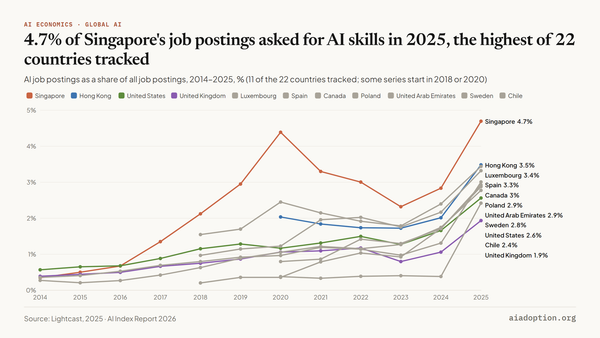 AI Job Postings4.7%Share of job postings in Singapore that asked for AI skills in 2025, up from 2.8% in 20244.7% of Singapore's job postings asked for AI skills in 2025, the highest of 22 countries trackedChart · CSVView →
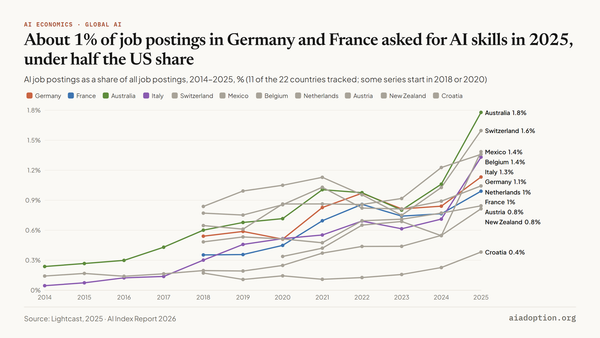 AI Job Postings1.1%Share of job postings in Germany that asked for AI skills in 2025, up from 0.8% in 2024About 1% of job postings in Germany and France asked for AI skills in 2025, under half the US shareChart · CSVView →
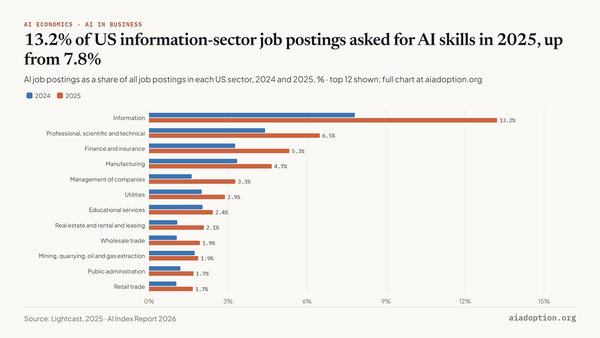 AI Job Postings13.2%Share of US information-sector job postings asking for AI skills in 2025, up from 7.8% in 202413.2% of US information-sector job postings asked for AI skills in 2025, up from 7.8%Chart · CSVView →
02
AI Jobs by US State
California had 170,881 AI job postings in 2025, 17.2% of the US total and more than twice Texas (80,547), though its share is down from 26.6% in 2012. As a share of each state's own postings, Washington, DC led at 6.2%, ahead of Delaware (4.4%) and California (4.3%), against 2.6% nationally.
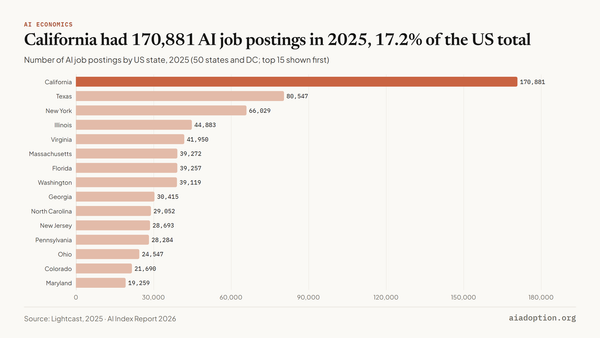 AI Jobs by US State17.2%California's share of US AI job postings in 2025: 170,881 of 994,372California had 170,881 AI job postings in 2025, 17.2% of the US totalChart · CSVView →
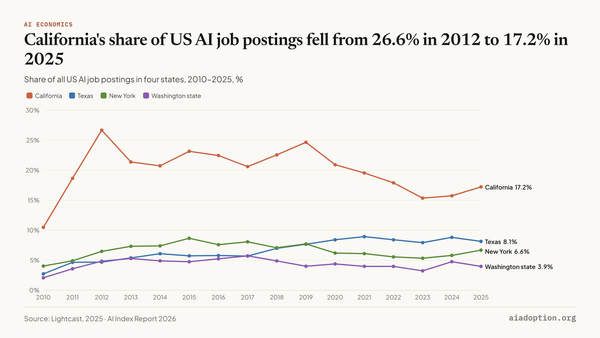 AI Jobs by US State17.2%California's share of US AI job postings in 2025, down from 26.6% in 2012California's share of US AI job postings fell from 26.6% in 2012 to 17.2% in 2025Chart · CSVView →
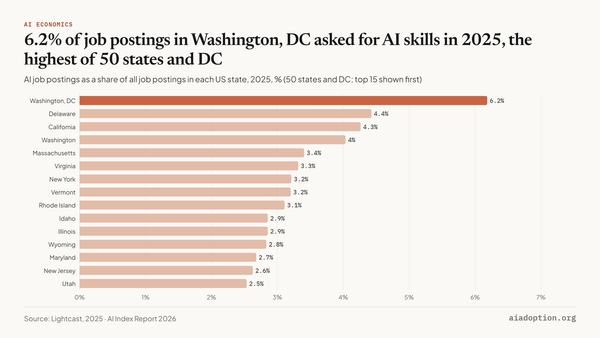 AI Jobs by US State6.2%Share of job postings in Washington, DC asking for AI skills in 2025, the highest of 50 states and DC (US: 2.6%)6.2% of job postings in Washington, DC asked for AI skills in 2025, the highest of 50 states and DCChart · CSVView →
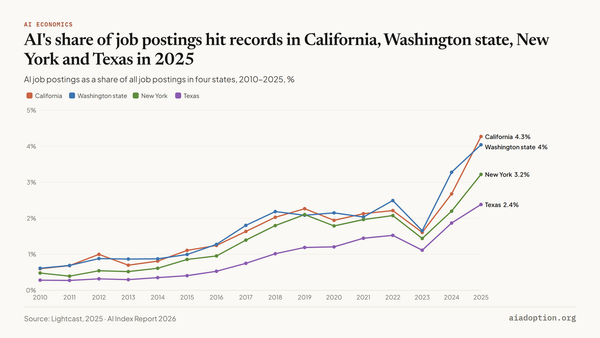 AI Jobs by US State4.3%Share of California's job postings asking for AI skills in 2025, up from 2.7% in 2024AI's share of job postings hit records in California, Washington state, New York and Texas in 2025Chart · CSVView →
03
In-Demand AI Skills
US AI job postings listing agentic AI as a skill rose from 151 in 2024 to 16,541 in 2025, and agentic AI overtook ChatGPT as the most-cited AI agent skill, at 18.9% of mentions. Python remained the most-listed specialised skill, in 258,674 postings, while postings naming generative AI more than doubled to 138,188.
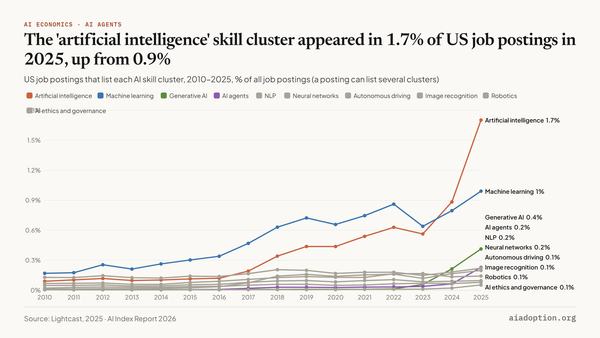 In-Demand AI Skills1.7%Share of US job postings listing skills in the artificial intelligence cluster in 2025, up from 0.9% in 2024The 'artificial intelligence' skill cluster appeared in 1.7% of US job postings in 2025, up from 0.9%Chart · CSVView →
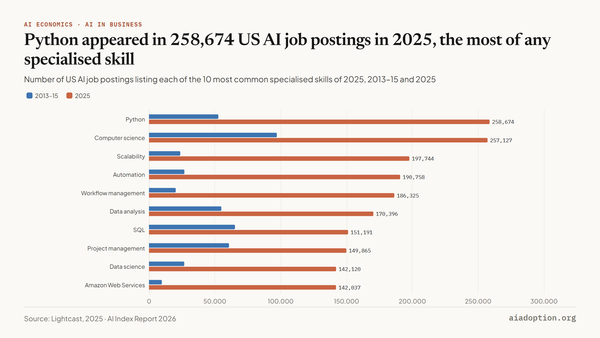 In-Demand AI Skills258,674US AI job postings listing Python in 2025, against 52,678 in 2013–15Python appeared in 258,674 US AI job postings in 2025, the most of any specialised skillChart · CSVView →
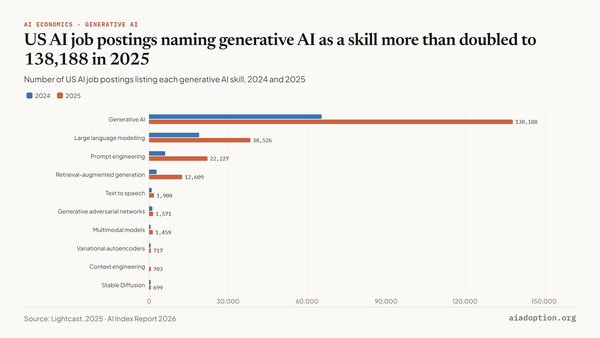 In-Demand AI Skills138,188US AI job postings listing the skill generative AI in 2025, up from 65,557 in 2024US AI job postings naming generative AI as a skill more than doubled to 138,188 in 2025Chart · CSVView →
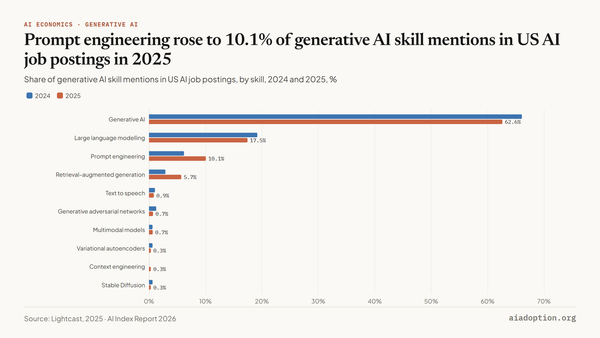 In-Demand AI Skills10.1%Prompt engineering's share of generative AI skill mentions in US AI job postings in 2025, up from 6.2% in 2024Prompt engineering rose to 10.1% of generative AI skill mentions in US AI job postings in 2025Chart · CSVView →
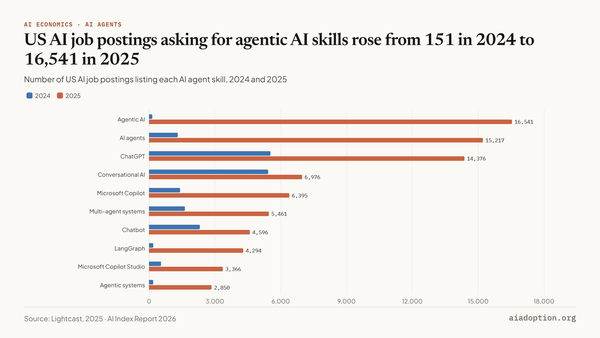 In-Demand AI Skills16,541US AI job postings listing agentic AI in 2025, about 110 times the 151 of 2024US AI job postings asking for agentic AI skills rose from 151 in 2024 to 16,541 in 2025Chart · CSVView →
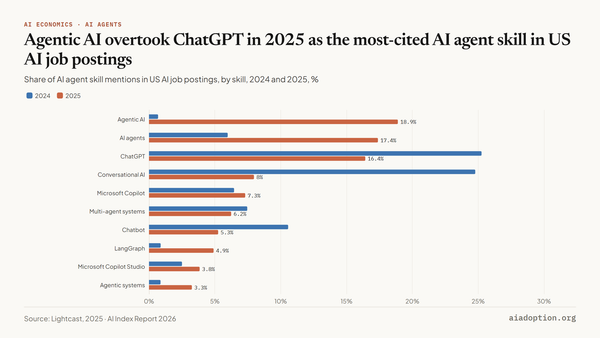 In-Demand AI Skills18.9%Agentic AI's share of AI agent skill mentions in US AI job postings in 2025, up from 0.7% in 2024Agentic AI overtook ChatGPT in 2025 as the most-cited AI agent skill in US AI job postingsChart · CSVView →
04
AI Hiring Rate
On LinkedIn, Indonesia's ratio of AI hiring to overall hiring was 31.7% higher in December 2025 than a year earlier, the largest rise of 46 countries. AI hiring grew faster than overall hiring in 40 of the 46; it fell behind in six, most in Estonia (−20.3%). The US figure was 9.0%.
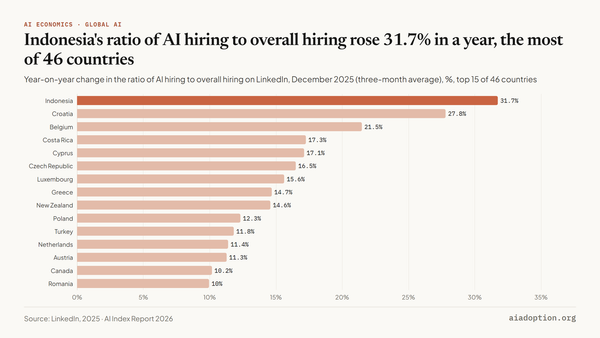 AI Hiring Rate31.7%Year-on-year rise in Indonesia's ratio of AI hiring to overall hiring, December 2025, the highest of 46 countriesIndonesia's ratio of AI hiring to overall hiring rose 31.7% in a year, the most of 46 countriesChart · CSVView →
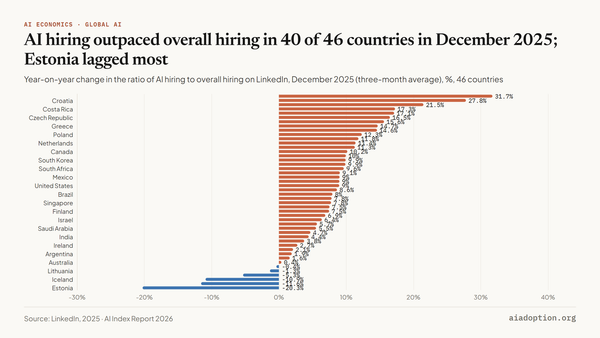 AI Hiring Rate−20.3%Change in Estonia's ratio of AI hiring to overall hiring, December 2025 year on year, the lowest of 46 countriesAI hiring outpaced overall hiring in 40 of 46 countries in December 2025; Estonia lagged mostChart · CSVView →
05
AI Talent by Country
Israel had the highest concentration of AI talent on LinkedIn in 2025, at 2.1% of members, ahead of Singapore (1.8%) and Luxembourg (1.6%). On a different measure, Zeki's count of top AI authors and inventors, the US leads with 220,500, 42% of the 21 countries tracked and 4.4 times India.
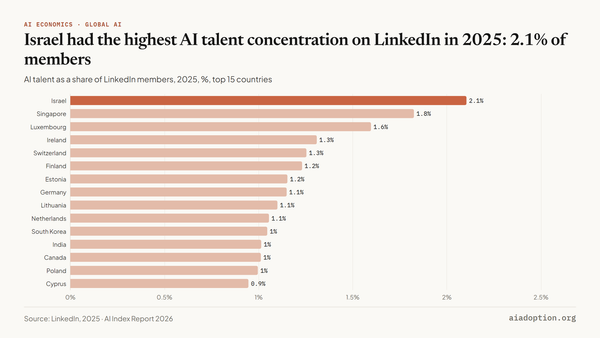 AI Talent by Country2.1%Share of LinkedIn members in Israel who count as AI talent, 2025, the highest of any country trackedIsrael had the highest AI talent concentration on LinkedIn in 2025: 2.1% of membersChart · CSVView →
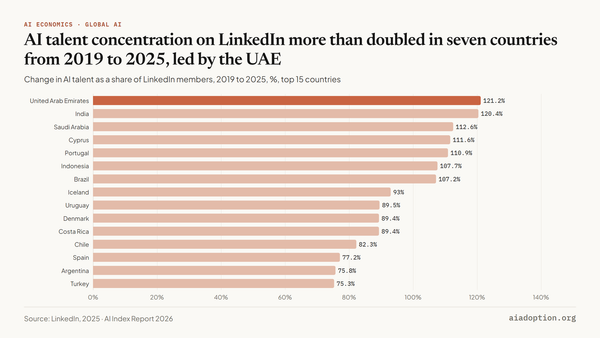 AI Talent by Country121.2%Rise in the share of LinkedIn members in the UAE who count as AI talent, 2019 to 2025, the fastest of any country trackedAI talent concentration on LinkedIn more than doubled in seven countries from 2019 to 2025, led by the UAEChart · CSVView →
 AI Talent by Country42%US share of the 523,000 top AI authors and inventors identified across the 21 countries Zeki tracks, 2025The US has 220,500 top AI authors and inventors, more than four times India, the next largestChart · CSVView →
 AI Talent by Country110.4Top AI authors and inventors per 100,000 people in Switzerland in 2025; Singapore 109.5, US 64.8Switzerland and Singapore each have about 110 top AI authors and inventors per 100,000 peopleChart · CSVView →
 AI Talent by Country51.1%Share of top AI authors and inventors in the UK with a PhD in 2025, the highest of 21 countries; Australia 50.5%, US 42.0%Half of top AI authors and inventors in the UK and Australia hold a PhD; in India and Brazil fewer than one in fiveChart · CSVView →
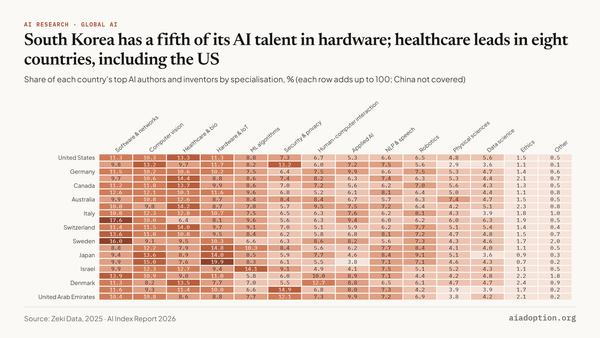 AI Talent by Country19.9%Share of South Korea's top AI authors and inventors who specialise in hardware, VLSI and IoT, the highest share of any area in any countrySouth Korea has a fifth of its AI talent in hardware; healthcare leads in eight countries, including the USChart · CSVView →
06
AI Talent Migration
The US net inflow of top AI authors and inventors, as a 12-month rolling average, fell from a peak of 323.5 in 2022 to 26.0 by September 2025. On LinkedIn, Luxembourg had the highest net AI talent inflow in 2025, 7.76 per 10,000 members, against 0.92 for the US; Hungary lost the most (−2.74).
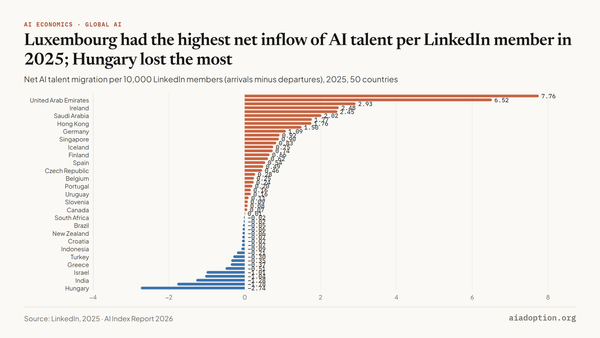 AI Talent Migration7.76Luxembourg's net AI talent migration per 10,000 LinkedIn members in 2025, the highest of 50 countries (US: 0.92)Luxembourg had the highest net inflow of AI talent per LinkedIn member in 2025; Hungary lost the mostChart · CSVView →
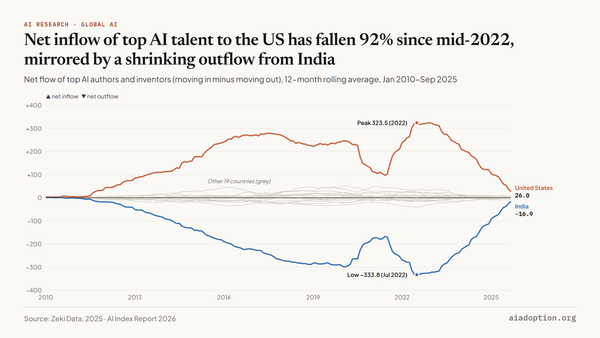 AI Talent Migration26.0US net inflow of top AI authors and inventors in September 2025 (12-month rolling average), down from 323.5 in mid-2022Net inflow of top AI talent to the US has fallen 92% since mid-2022, mirrored by a shrinking outflow from IndiaChart · CSVView →
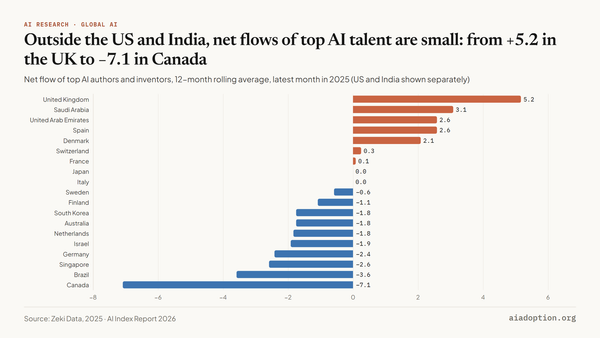 AI Talent Migration−7.1Canada's net flow of top AI authors and inventors in September 2025, the largest outflow outside India; it peaked at +50.6 in February 2020Outside the US and India, net flows of top AI talent are small: from +5.2 in the UK to −7.1 in CanadaChart · CSVView →
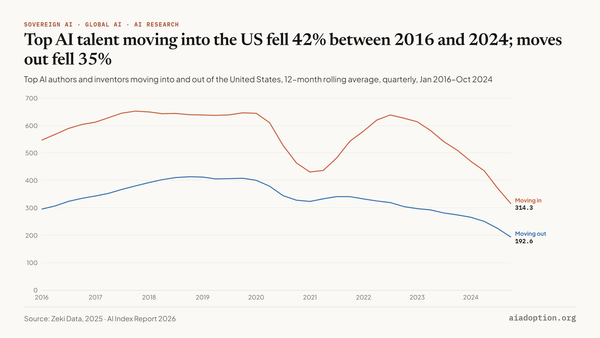 AI Talent Migration314.3Top AI authors and inventors moving into the US in October 2024 (12-month rolling average), down from a peak of 652.3 in October 2017Top AI talent moving into the US fell 42% between 2016 and 2024; moves out fell 35%Chart · CSVView →
07
Women in AI
Women made up 34.3% of AI talent on LinkedIn in the US in 2025, ninth of 41 countries; Romania was highest at 42.0% and Brazil lowest at 23.4%. Among top AI authors and inventors identified by Zeki, women's share ranges from 17.5% in Japan to 32.3% in Saudi Arabia.
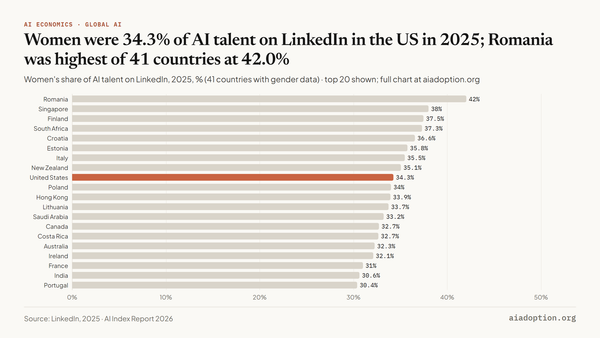 Women in AI34.3%Women's share of AI talent on LinkedIn in the US in 2025Women were 34.3% of AI talent on LinkedIn in the US in 2025; Romania was highest of 41 countries at 42.0%Chart · CSVView →
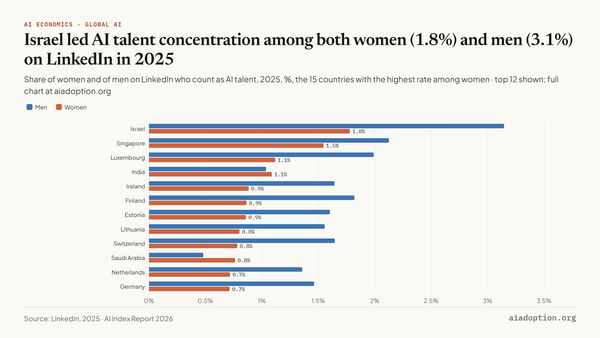 Women in AI1.8%Share of women on LinkedIn in Israel who count as AI talent, 2025, against 3.1% of menIsrael led AI talent concentration among both women (1.8%) and men (3.1%) on LinkedIn in 2025Chart · CSVView →
 Women in AI32.3%Women's share of top AI authors and inventors in Saudi Arabia in 2025, the highest of 21 countries; Japan is lowest at 17.5%Women are under a third of top AI authors and inventors in every country tracked, and gains since 2010 are smallChart · CSVView →
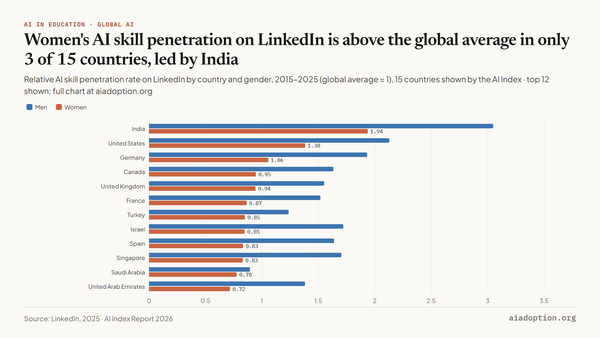 Women in AI1.94Relative AI skill penetration rate for women in India, the highest of 15 countries; men in India 3.05Women's AI skill penetration on LinkedIn is above the global average in only 3 of 15 countries, led by IndiaChart · CSVView →
08
AI Skills by Country
AI skills appear on LinkedIn profiles in India at 2.95 times the global average, the highest of 15 countries, ahead of the US (2.02) and Germany (1.83). On growth in AI literacy skills from each country's own baseline, the US led LinkedIn's diffusion index in 2025 at 458.1, ahead of India at 382.0.
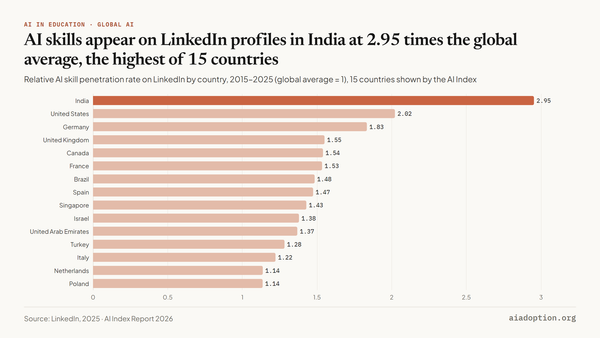 AI Skills by Country2.95India's relative AI skill penetration rate on LinkedIn, 2015–2025; United States 2.02, Germany 1.83AI skills appear on LinkedIn profiles in India at 2.95 times the global average, the highest of 15 countriesChart · CSVView →
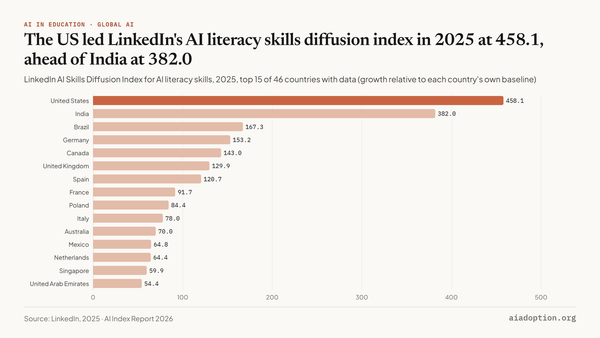 AI Skills by Country458.1US AI literacy skills diffusion index on LinkedIn in 2025, the highest of 46 countries; India 382.0, Brazil 167.3The US led LinkedIn's AI literacy skills diffusion index in 2025 at 458.1, ahead of India at 382.0Chart · CSVView →
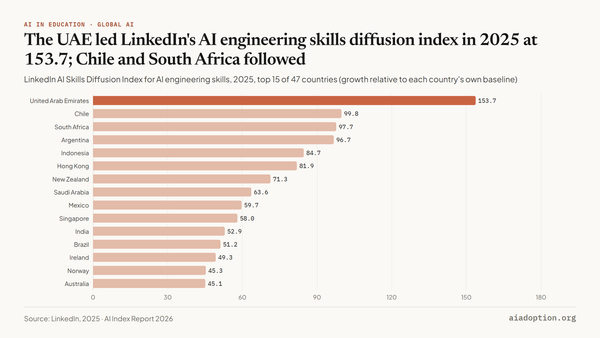 AI Skills by Country153.7UAE AI engineering skills diffusion index on LinkedIn in 2025, the highest of 47 countries; United States 31.9The UAE led LinkedIn's AI engineering skills diffusion index in 2025 at 153.7; Chile and South Africa followedChart · CSVView →
09
Is AI Replacing Jobs?
Headcount of US software developers aged 22–25 was 22% below its September 2022 peak by December 2025, while older developers grew. In the most AI-exposed US occupations, employment of 22–25-year-olds fell an estimated 15.7% relative to the least exposed. 32% of McKinsey survey respondents expect AI to shrink their organisation's workforce next year.
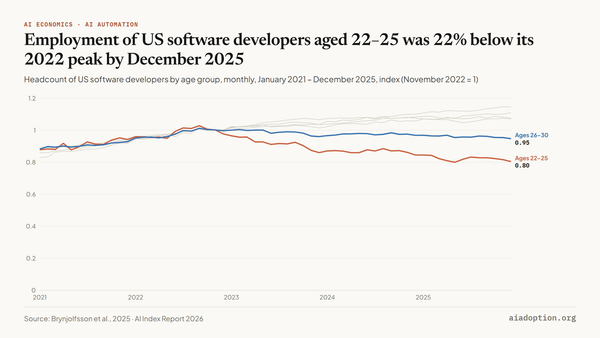 Is AI Replacing Jobs?0.80Headcount of US software developers aged 22–25 in December 2025, against 1.03 at the September 2022 peak (November 2022 = 1)Employment of US software developers aged 22–25 was 22% below its 2022 peak by December 2025Chart · CSVView →
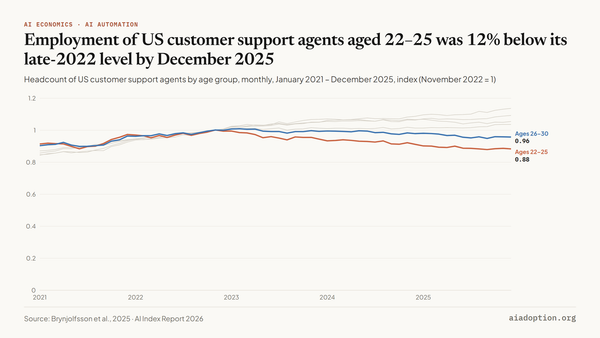 Is AI Replacing Jobs?0.88Headcount of US customer support agents aged 22–25 in December 2025, against 1.00 at the November 2022 peakEmployment of US customer support agents aged 22–25 was 12% below its late-2022 level by December 2025Chart · CSVView →
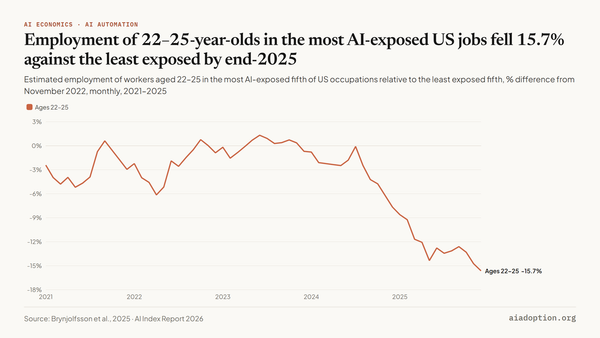 Is AI Replacing Jobs?−15.7%Estimated employment of workers aged 22–25 in the most AI-exposed occupations relative to the least exposed, December 2025, against November 2022Employment of 22–25-year-olds in the most AI-exposed US jobs fell 15.7% against the least exposed by end-2025Chart · CSVView →
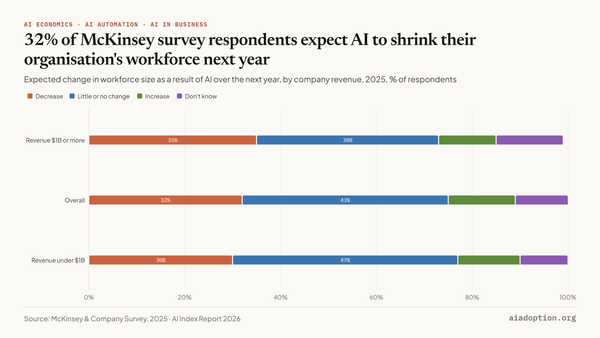 Is AI Replacing Jobs?32%Of respondents expect AI to decrease their organisation's workforce over the next year; 43% expect little or no change and 14% an increase32% of McKinsey survey respondents expect AI to shrink their organisation's workforce next yearChart · CSVView →
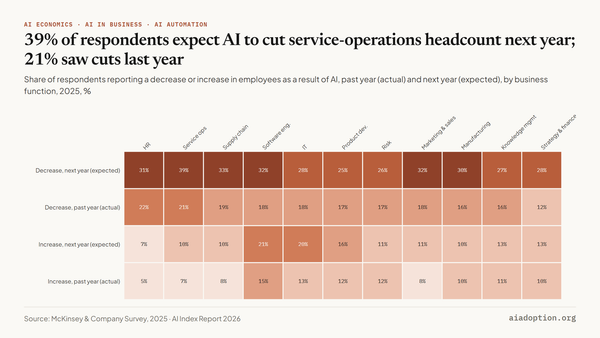 Is AI Replacing Jobs?39%Respondents expecting AI to reduce headcount in service operations over the next year, against 21% who saw a decrease in the past year39% of respondents expect AI to cut service-operations headcount next year; 21% saw cuts last yearChart · CSVView →
Related hubs
All 13 hubs →About the data: 37 interactive charts from the AI Index Report 2026 (Stanford HAI), using data from research partners credited on each chart. Each chart page explains what the chart shows, lists its key numbers, cites its source and links to the data as a CSV.