AI Research
How much AI research is published and where it comes from, who attends AI conferences, who is granted AI patents and how AI is used in the natural sciences, from Stanford's AI Index Report 2026.
AI Progress · 19 charts · 5 topics
- Source
- Stanford AI Index Report 2026
- Charts
- 19 with CSV data
- Last checked
- 20 Oct 2026
- Data
- All CSVs (zip)
258KAI publications worldwide in 2024, 40.9% of all computer science publicationsView chart →34.2KGenerative AI publications in 2024, up from 13.1K in 2023View chart →74.2%China's share of AI patents granted worldwide in 2024; US 12.1%View chart →101KAttendance at the 16 major AI conferences tracked by the AI Index, 2025View chart →80,150AI-related natural science publications in 2025, up from 63,547 in 2024View chart →
Researchers published about 258,000 AI papers in 2024, 2.5 times as many as in 2013, and AI now accounts for 40.9% of all computer science publications. Generative AI papers rose 2.6 times in a year, from 13,100 in 2023 to 34,200 in 2024, although machine learning remains the largest topic with 195,900 papers. Academia produced 68.1% of AI publications in 2024, followed by government at 12.4% and industry at 11.5%.
Read the full overview
China leads on volume. It has published the largest share of AI research of any country or region every year since 2021, and it was granted 74.2% of the world's AI patents in 2024, against 12.1% for the US. Chinese inventors received 97,988 AI patents that year, six times the 15,920 granted to US inventors. Adjusted for population, South Korea leads with 14.3 AI patents per 100,000 people. Worldwide, 131,121 AI patents were granted in 2024, up 8.2% on 2023.
The charts cover AI research papers, research by country, AI conferences, AI patents and AI in science. Attendance at the 16 major AI conferences the AI Index tracks passed 100,000 in 2025, and NeurIPS alone drew about 26,400 people. AI-related publications in the natural sciences rose 26% to about 80,150 in 2025, and in Earth science they made up 8.8% of all publications. Tests of AI research agents are also included: on AstaBench, the best agent scored 0.53 out of 1.
The figures come from Stanford's AI Index Report 2026 and the sources it draws on: OpenAlex for publications, PATSTAT Global for patents, the Web of Science for the natural sciences, and conference organisers for attendance. Country shares need care: 39% of 2024 AI papers have no identified country, so shares of all publications understate every country's output. Publication counts measure activity, not quality, and patent laws differ between offices, so counts are not strictly comparable.
AI Adoption · 2026AI Statistics: the pocket guide83Free for subscribersAll 83 key numbers on two pages, with sources.Every hub's headline numbers in one PDF, ready for a board paper or a slide.Get the guide
01
AI Research Papers
Researchers published about 258,000 AI papers in 2024, 2.5 times as many as in 2013, and AI accounted for 40.9% of all computer science publications. Generative AI papers rose 2.6 times in a year to 34,200. Journals carried 47% of AI publications, while conferences' share fell to 23.5% from 36.7% in 2013.
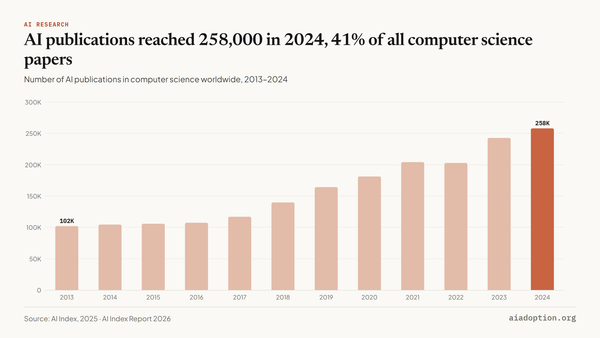 AI Research Papers258KAI publications in 2024, up 6.3% on 2023 and 2.5 times 2013; 40.9% of all computer science publicationsAI publications reached 258,000 in 2024, 41% of all computer science papersChart · CSVView →
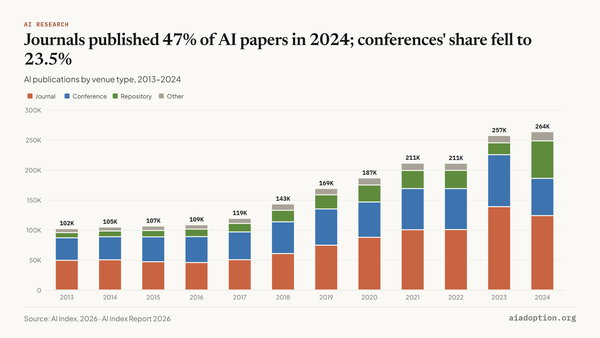 AI Research Papers47%Share of 2024's AI publications in journals; conferences 23.5%, down from 36.7% in 2013Journals published 47% of AI papers in 2024; conferences' share fell to 23.5%Chart · CSVView →
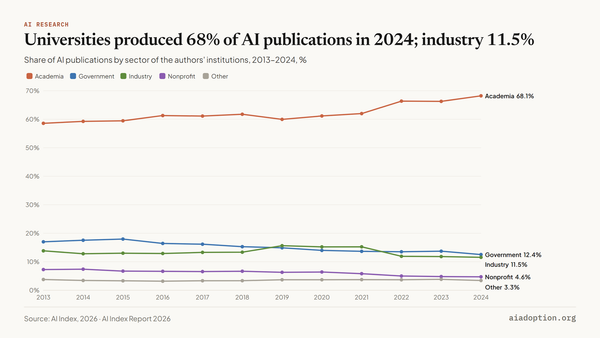 AI Research Papers68.1%Academia's share of 2024 AI publications, up from 58.5% in 2013Universities produced 68% of AI publications in 2024; industry 11.5%Chart · CSVView →
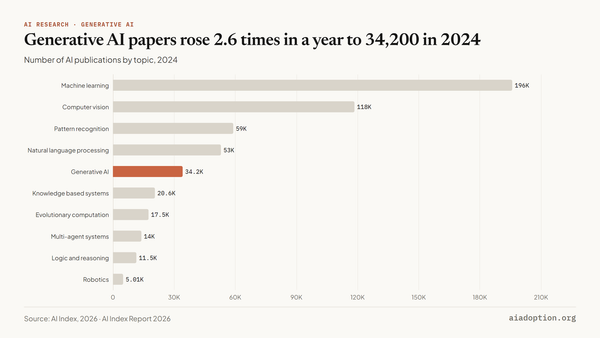 AI Research Papers34.2KGenerative AI publications in 2024, up from 13.1K in 2023 and 390 in 2013Generative AI papers rose 2.6 times in a year to 34,200 in 2024Chart · CSVView →
02
AI Research by Country
China has published the largest share of AI research of any country or region every year since 2021, with 17.8% of all 2024 AI publications, or 29% of those with a known country. India's share (7.6%) edged past the US (7.3%) in 2024. By world region, East Asia and the Pacific produced 26.4%.
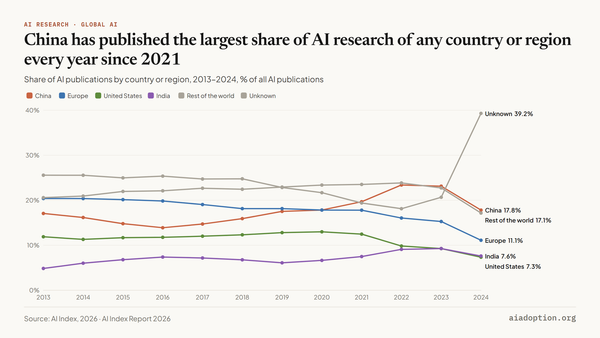 AI Research by Country29%China's share of 2024 AI publications with a known country (17.8% of all, with 39% of papers unattributed)China has published the largest share of AI research of any country or region every year since 2021Chart · CSVView →
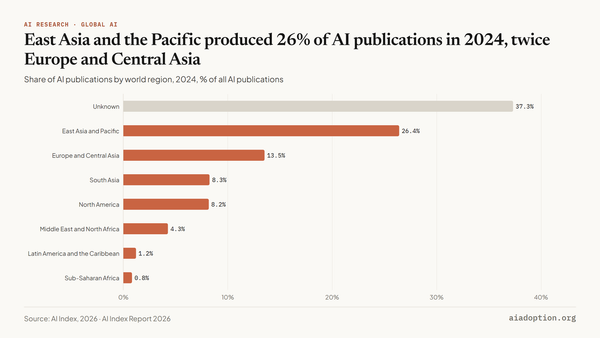 AI Research by Country26.4%East Asia and Pacific's share of 2024 AI publications; Sub-Saharan Africa 0.8%East Asia and the Pacific produced 26% of AI publications in 2024, twice Europe and Central AsiaChart · CSVView →
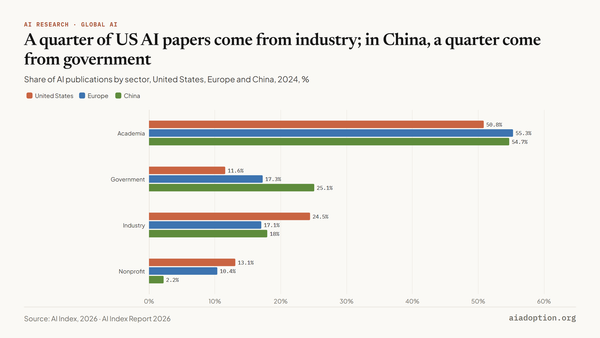 AI Research by Country24.5%Industry's share of US AI publications in 2024, against 18.0% in China and 17.1% in EuropeA quarter of US AI papers come from industry; in China, a quarter come from governmentChart · CSVView →
03
AI Conferences
Attendance at the 16 major AI conferences the AI Index tracks reached about 101,000 in 2025, up 29% from 78,600 in 2024 and above the 2020 virtual-era peak. NeurIPS drew about 26,400 attendees, more than twice ICLR's 11,000. Smaller conferences held steady, with FAccT at about 626.
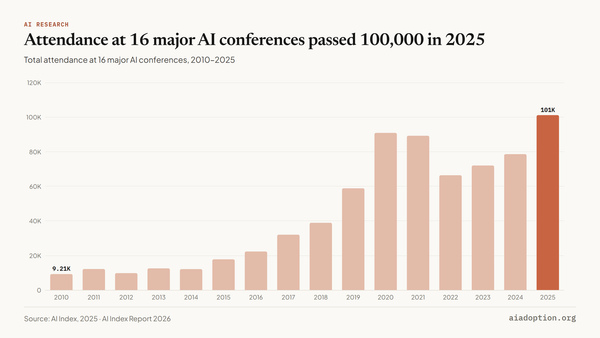 AI Conferences101KPeople attended the 16 conferences tracked in 2025, up 29% from 78,600 in 2024Attendance at 16 major AI conferences passed 100,000 in 2025Chart · CSVView →
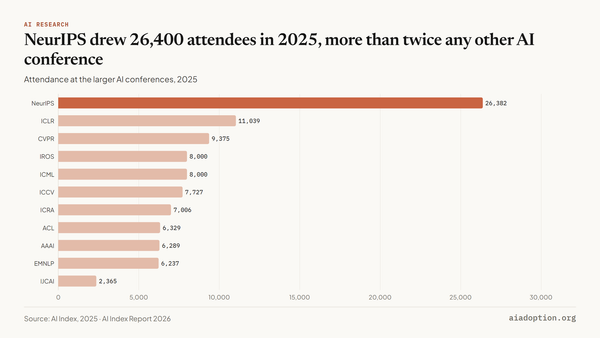 AI Conferences26.4KNeurIPS attendance in 2025, up 34% from 19,800 in 2024; ICLR was second with 11,000NeurIPS drew 26,400 attendees in 2025, more than twice any other AI conferenceChart · CSVView →
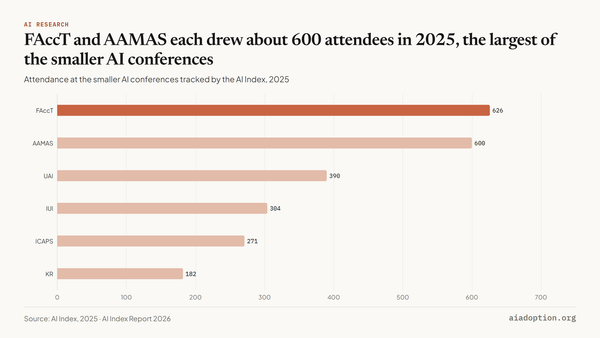 AI Conferences626FAccT attendance in 2025 (AAMAS 600, UAI 390); smaller conferences held steadyFAccT and AAMAS each drew about 600 attendees in 2025, the largest of the smaller AI conferencesChart · CSVView →
04
AI Patents
China was granted 74.2% of the world's AI patents in 2024, up from 13.3% in 2010, while the US share fell to 12.1%. In total, 131,121 AI patents were granted worldwide in 2024, up 8.2% on 2023. Adjusted for population, South Korea leads with 14.3 AI patents per 100,000 people.
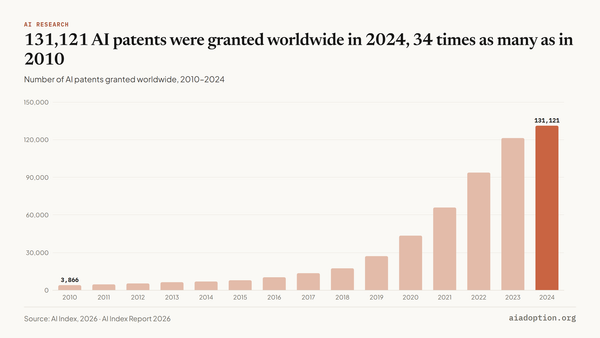 AI Patents131,121AI patents granted worldwide in 2024, up 8.2% from 121,218 in 2023 and from 3,866 in 2010131,121 AI patents were granted worldwide in 2024, 34 times as many as in 2010Chart · CSVView →
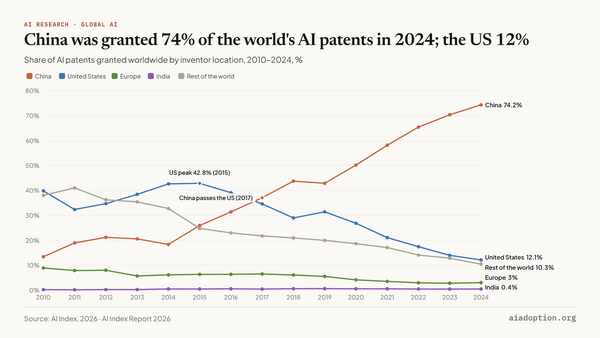 AI Patents74.2%China's share of AI patents granted worldwide in 2024, up from 13.3% in 2010; US 12.1%China was granted 74% of the world's AI patents in 2024; the US 12%Chart · CSVView →
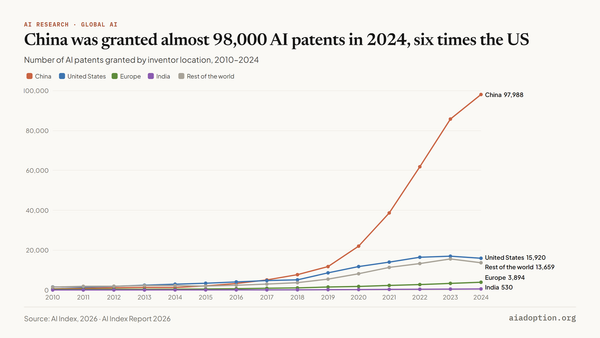 AI Patents97,988AI patents granted to Chinese inventors in 2024, against 15,920 to US inventorsChina was granted almost 98,000 AI patents in 2024, six times the USChart · CSVView →
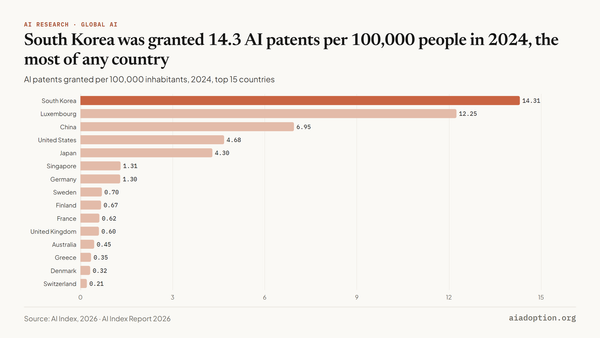 AI Patents14.3AI patents granted per 100,000 people in South Korea in 2024; Luxembourg 12.2, China 7.0, US 4.7South Korea was granted 14.3 AI patents per 100,000 people in 2024, the most of any countryChart · CSVView →
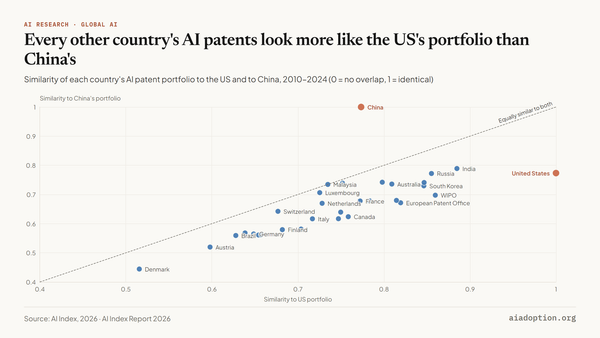 AI Patents30 of 31Countries and patent offices whose AI patent portfolios are closer to the US's than to China's (the exception is China itself)Every other country's AI patents look more like the US's portfolio than China'sChart · CSVView →
05
AI in Science
AI-related natural science publications rose 26% to about 80,150 in 2025, from 63,547 in 2024. Earth science has the highest AI share of the fields tracked, at 8.8% of its publications. On AstaBench, a test of end-to-end scientific research, Ai2's Asta v0 agent scored 0.53 at $3.40 a problem.
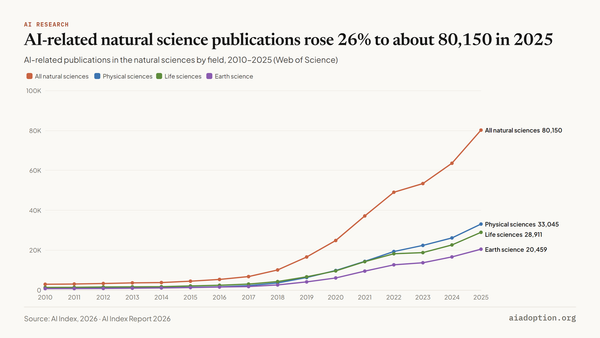 AI in Science80,150AI-related natural science publications in 2025, up from 63,547 in 2024AI-related natural science publications rose 26% to about 80,150 in 2025Chart · CSVView →
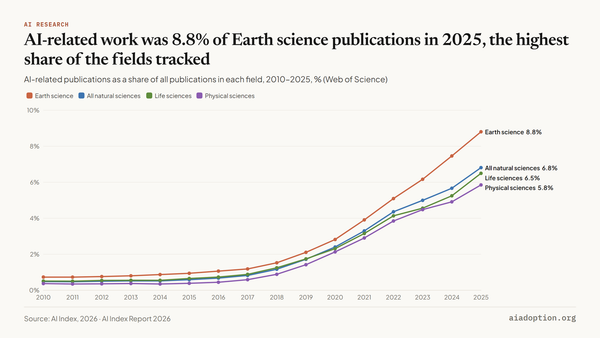 AI in Science8.8%Share of Earth science publications that were AI-related in 2025, up from 0.7% in 2010AI-related work was 8.8% of Earth science publications in 2025, the highest share of the fields trackedChart · CSVView →
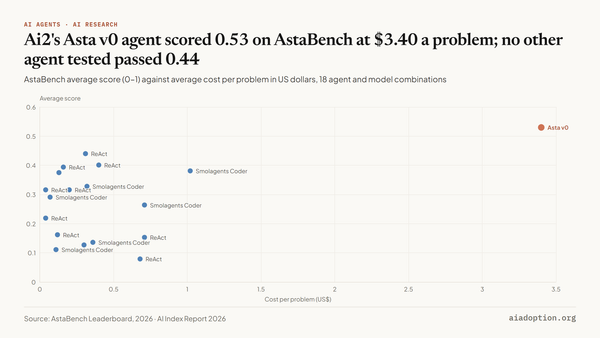 AI in Science0.53AstaBench average score of Asta v0 (Claude Sonnet 4 plus six other models) at $3.40 per problem; ReAct with o3 scored 0.39 for $0.16Ai2's Asta v0 agent scored 0.53 on AstaBench at $3.40 a problem; no other agent tested passed 0.44Chart · CSVView →
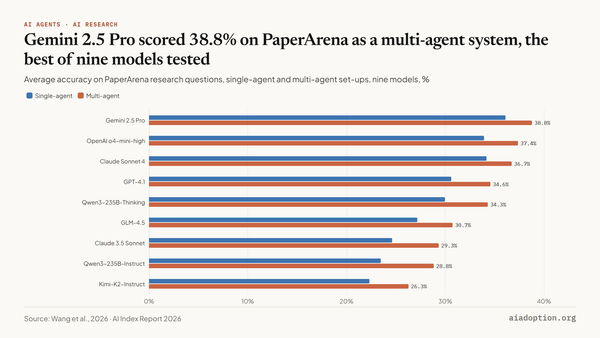 AI in Science38.8%Gemini 2.5 Pro's PaperArena accuracy as a multi-agent system, 36.1% as a single agent; the AI Index reports a PhD expert baseline of 83.5%Gemini 2.5 Pro scored 38.8% on PaperArena as a multi-agent system, the best of nine models testedChart · CSVView →
Related hubs
All 13 hubs →About the data: 19 interactive charts from the AI Index Report 2026 (Stanford HAI), using data from AstaBench Leaderboard and Wang et al.. Each chart page explains what the chart shows, lists its key numbers, cites its source and links to the data as a CSV.