AI Infrastructure
Charts on the chips, data centres and supercomputers behind AI, and the power, carbon and water they use. Installed AI computing capacity reached about 17.1 million H100-equivalents by the end of 2025.
Infrastructure & Industry · 18 charts · 6 topics
- Source
- Stanford AI Index Report 2026
- Charts
- 18 with CSV data
- Last checked
- 20 Oct 2026
- Data
- All CSVs (zip)
17.1MH100-equivalents of AI computing capacity worldwide by Q4 2025; Nvidia two-thirdsView chart →29.6 GWGlobal AI data centre power capacity by Q4 2025, 2.2 times a year earlierView chart →47%US share of the 11,614 data centres Cloudscene tracks in 97 countries, 2025View chart →85Public or public-private AI supercomputers in China by 2025, up from 18 in 2018View chart →99.8%Fall in the cost of GPU computation between 2006 and 2024View chart →9,357 MWEstimated power demand of complete AI systems shipped in 2023 and 2024View chart →
AI infrastructure is the physical base of AI: the chips that train and run models, the data centres that house them, the public and public-private AI supercomputers, and the electricity, carbon and water all of it consumes. On almost every measure in the data, capacity grew quickly through 2025.
Read the full overview
Installed AI computing capacity reached about 17.1 million H100-equivalents by the end of 2025, up from 0.28 million at the end of 2022, and Nvidia chips supplied two-thirds of it. AI data centres worldwide had about 29.6 GW of power capacity by the fourth quarter of 2025, 2.2 times a year earlier and close to New York state's peak electricity demand. By count, the United States hosts 5,427 of the 11,614 data centres Cloudscene tracks, 47% of the total. Among public or public-private AI supercomputers, China had 85 by 2025, as many as Europe and Central Asia and North America combined.
The chips keep getting faster and cheaper per operation. The fastest released in 2025 reach 2.5 petaFLOP/s at 16-bit precision, and the cost of GPU computation fell 99.8% between 2006 and 2024, according to the International Energy Agency. Total power demand has risen regardless: complete AI systems shipped in 2023 and 2024, counting servers, cooling and networking, draw an estimated 9,357 MW, more than the national electricity demand of Austria. The carbon and water sections add estimates for training emissions and for the water used to answer queries.
The charts cover AI chips, AI data centres, AI supercomputers, AI energy consumption, AI carbon emissions and AI water use. The figures come from Stanford's AI Index Report 2026 and the sources it draws on, including Epoch AI, Cloudscene's data centre directory, the International Energy Agency and published studies of per-query energy and water use. Many are estimates rather than measurements: chip capacity is inferred from revenue, financial disclosures and analyst reports, and power draw is not available for many of the newest models because developers disclose too little.
AI Adoption · 2026AI Statistics: the pocket guide83Free for subscribersAll 83 key numbers on two pages, with sources.Every hub's headline numbers in one PDF, ready for a board paper or a slide.Get the guide
01
AI Chips
The fastest machine learning chips released in 2025 reach 2.5 petaFLOP/s at 16-bit precision, and installed AI computing capacity reached about 17.1 million H100-equivalents by the end of 2025, two-thirds of it from Nvidia. Nvidia's A100 has trained 84 notable AI models since 2017, more than any other accelerator.
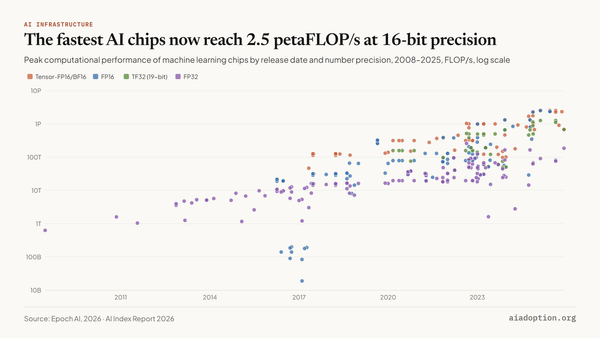 AI Chips2.5PFLOP/s: peak 16-bit performance of the fastest chips released in 2025 (2.5 quadrillion operations per second)The fastest AI chips now reach 2.5 petaFLOP/s at 16-bit precisionChart · CSVView →
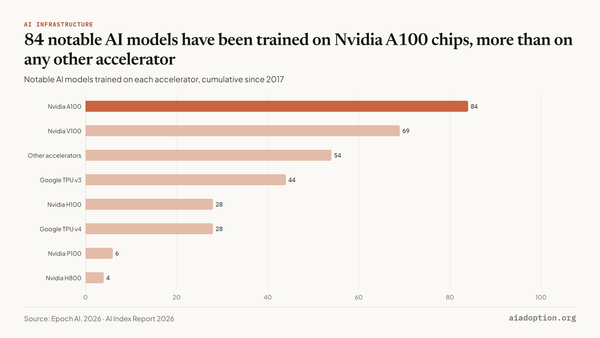 AI Chips84Notable AI models trained on Nvidia A100 chips since 2017 (V100: 69; H100: 28)84 notable AI models have been trained on Nvidia A100 chips, more than on any other acceleratorChart · CSVView →
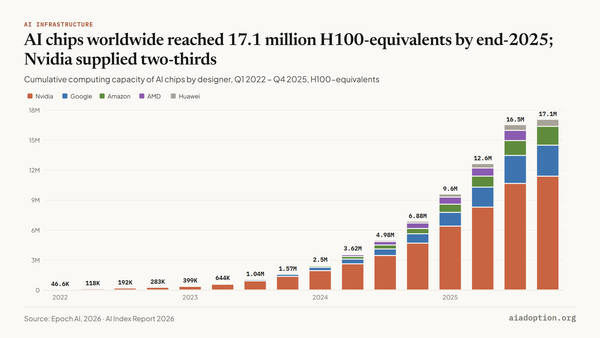 AI Chips17.1MH100-equivalents of AI computing capacity by Q4 2025, up from 0.28M in Q4 2022; Nvidia 66.7%AI chips worldwide reached 17.1 million H100-equivalents by end-2025; Nvidia supplied two-thirdsChart · CSVView →
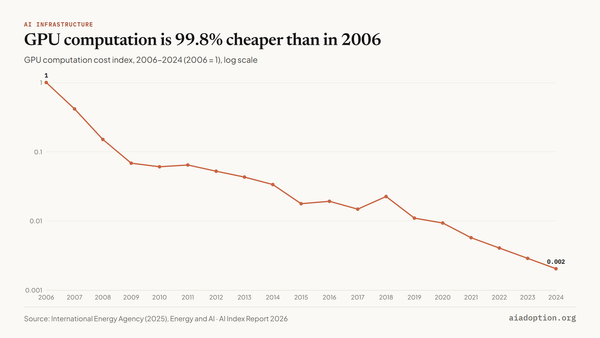 AI Chips0.002Cost of GPU computation in 2024 relative to 2006 (= 1): a fall of 99.8%GPU computation is 99.8% cheaper than in 2006Chart · CSVView →
02
AI Data Centres
AI data centres worldwide had about 29.6 GW of power capacity by the end of 2025, 2.2 times the 13.5 GW of a year earlier and close to New York state's peak demand. By count, the United States hosts 5,427 of the 11,614 data centres Cloudscene tracks, more than ten times Germany, the next largest with 529.
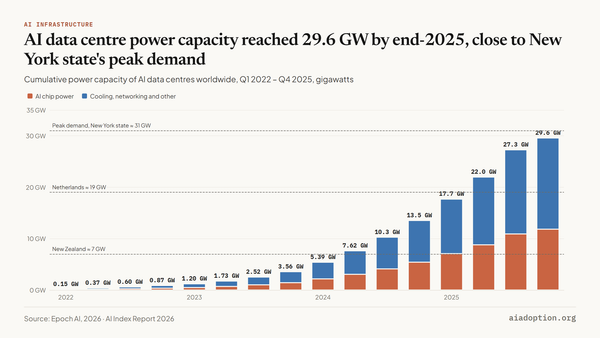 AI Data Centres29.6 GWGlobal AI data centre power capacity by Q4 2025, 2.2 times the 13.5 GW of a year earlierAI data centre power capacity reached 29.6 GW by end-2025, close to New York state's peak demandChart · CSVView →
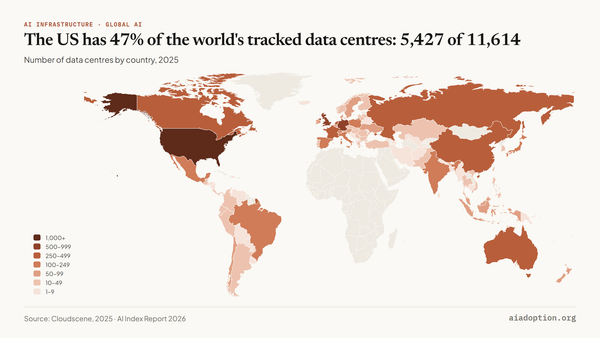 AI Data Centres47%US share of the 11,614 data centres Cloudscene tracks across 97 countries in 2025The US has 47% of the world's tracked data centres: 5,427 of 11,614Chart · CSVView →
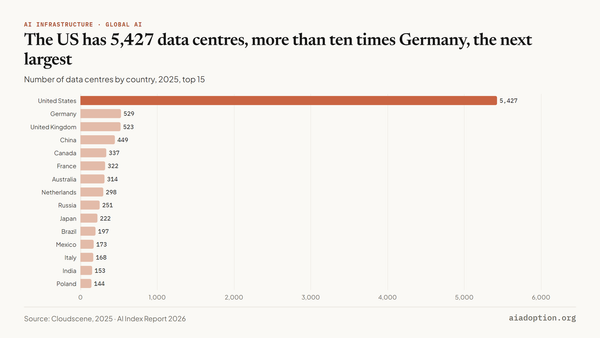 AI Data Centres10×US data centres (5,427) relative to Germany (529), the country with the next mostThe US has 5,427 data centres, more than ten times Germany, the next largestChart · CSVView →
03
AI Supercomputers
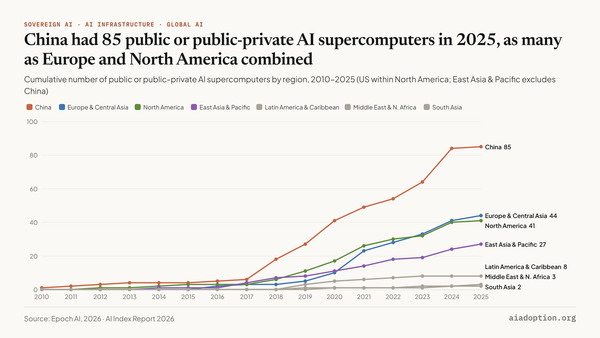
China had 85 public or public-private AI supercomputers by 2025, according to Epoch AI, as many as Europe and Central Asia (44) and North America (41) combined. China had 18 in 2018. Europe and Central Asia grew fastest, from 3 to 44, which the AI Index links to programmes such as the EuroHPC Joint Undertaking.
04
AI Energy Consumption
AI hardware shipped in 2023 and 2024 draws an estimated 9,357 MW once servers, cooling and networking are counted, more than the national electricity demand of Austria or Switzerland. The accelerator chips alone account for 5,235 MW, about half of it from Nvidia, even though the most efficient chips now deliver 2.5 trillion operations per second per watt.
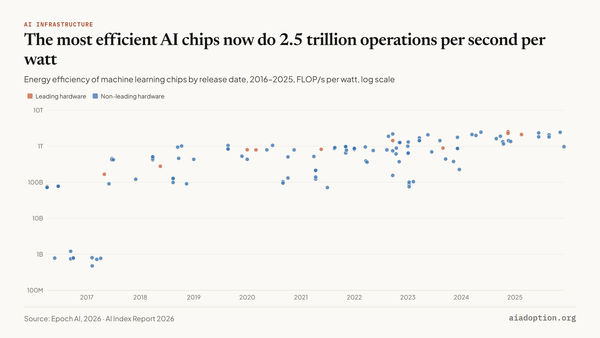 AI Energy Consumption2.5TFLOP/s per watt: the most efficient leading chip in the data (late 2024), against 74.8 billion for the leading chip of 2016The most efficient AI chips now do 2.5 trillion operations per second per wattChart · CSVView →
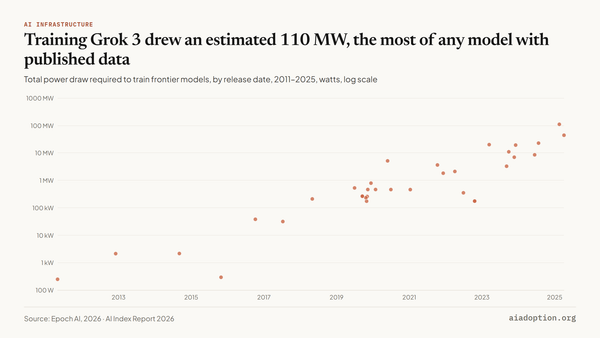 AI Energy Consumption110 MWEstimated power draw while training Grok 3 (Feb 2025); Llama 4 Behemoth needed about 44 MWTraining Grok 3 drew an estimated 110 MW, the most of any model with published dataChart · CSVView →
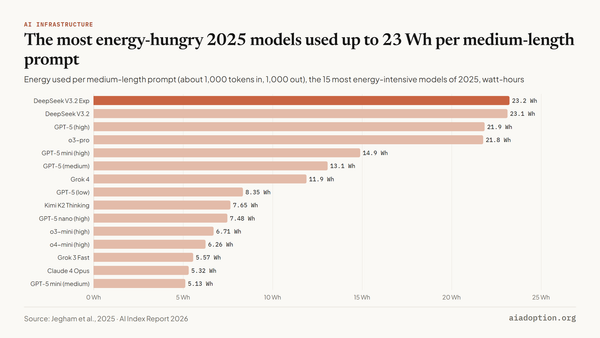 AI Energy Consumption23.2 WhEnergy per medium-length prompt for DeepSeek V3.2 Exp, the highest of the 2025 models measuredThe most energy-hungry 2025 models used up to 23 Wh per medium-length promptChart · CSVView →
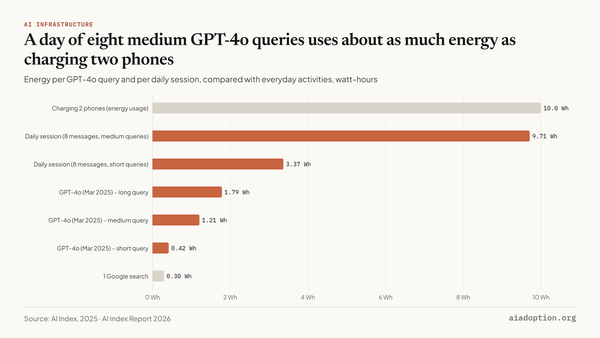 AI Energy Consumption1.21 WhEstimated energy for one medium-length GPT-4o query (March 2025), about four Google searchesA day of eight medium GPT-4o queries uses about as much energy as charging two phonesChart · CSVView →
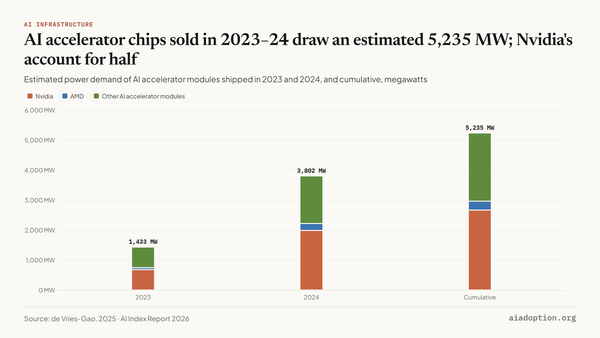 AI Energy Consumption5,235 MWEstimated power demand of AI accelerator modules shipped in 2023–2024; Nvidia 2,665 MWAI accelerator chips sold in 2023–24 draw an estimated 5,235 MW; Nvidia's account for halfChart · CSVView →
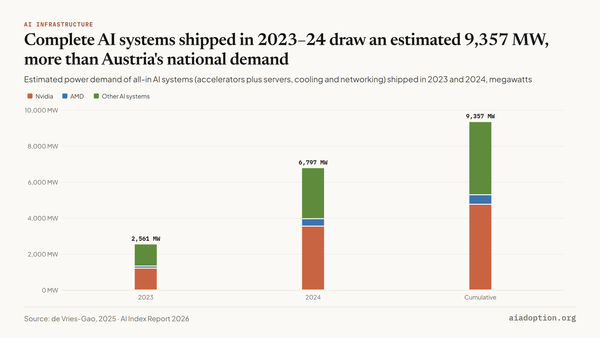 AI Energy Consumption9,357 MWEstimated power demand of complete AI systems shipped in 2023–2024, above the national demand of Austria (7.2 GW) or Finland (9.0 GW)Complete AI systems shipped in 2023–24 draw an estimated 9,357 MW, more than Austria's national demandChart · CSVView →
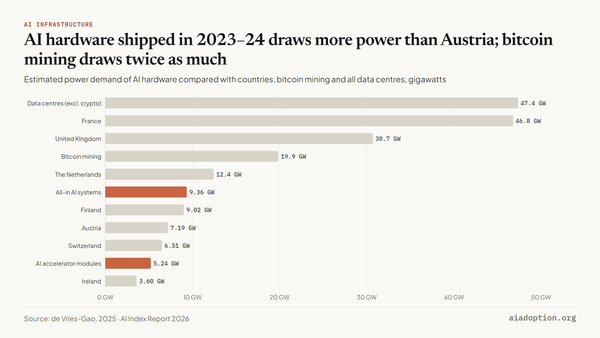 AI Energy Consumption9.4 GWPower demand of complete AI systems shipped in 2023–2024, above Austria (7.2 GW) and Finland (9.0 GW)AI hardware shipped in 2023–24 draws more power than Austria; bitcoin mining draws twice as muchChart · CSVView →
05
AI Carbon Emissions
Training Grok 4 emitted an estimated 72,816 tonnes of CO₂ equivalent in 2025, ahead of Grok 3 (59,200 tonnes) and far above GPT-4 (5,184 tonnes). Bigger models usually emit more, but not always: DeepSeek v3, with 671 billion parameters, produced about 597 tonnes, against 8,930 for Llama 3.1 405B.
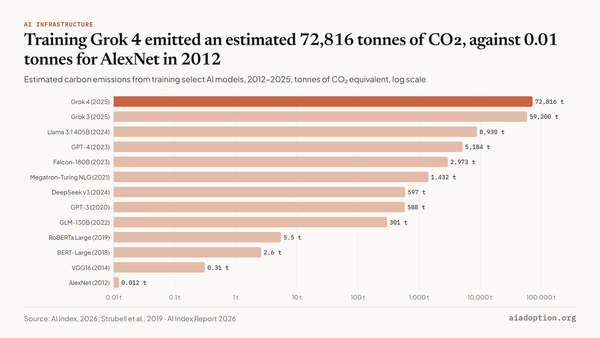 AI Carbon Emissions72,816 tEstimated CO₂-equivalent emissions from training Grok 4 (2025), more than 1,000 average cars' lifetime emissionsTraining Grok 4 emitted an estimated 72,816 tonnes of CO₂, against 0.01 tonnes for AlexNet in 2012Chart · CSVView →
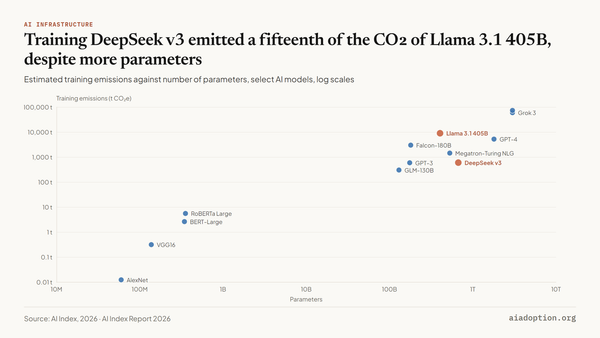 AI Carbon Emissions597 tEstimated training emissions of DeepSeek v3 (671B parameters), against 8,930 t for Llama 3.1 405B (405B)Training DeepSeek v3 emitted a fifteenth of the CO₂ of Llama 3.1 405B, despite more parametersChart · CSVView →
06
AI Water Use
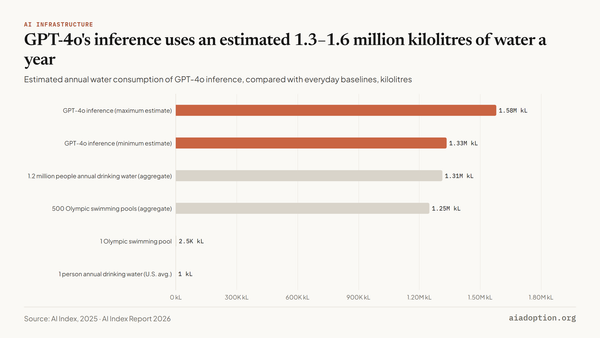
Running GPT-4o for its users consumes an estimated 1.33 to 1.58 million kilolitres of water a year, for the inference of a single model. At the high end, that is about 630 Olympic swimming pools, or more than the annual drinking water of 1.2 million people.
Related hubs
All 13 hubs →About the data: 18 interactive charts from the AI Index Report 2026 (Stanford HAI), using data from research partners credited on each chart. Each chart page explains what the chart shows, lists its key numbers, cites its source and links to the data as a CSV.