AI in Education
Who studies AI and computing, from US high schools to PhD programmes, how representative those students are, and how students use generative AI, from Stanford's AI Index Report 2026.
Work & Society · 30 charts · 9 topics
- Source
- Stanford AI Index Report 2026
- Charts
- 30 with CSV data
- Last checked
- 20 Oct 2026
- Data
- All CSVs (zip)
94,917Master's graduates in AI software-related fields at US institutions, 2024; 52,139 in 2022View chart →31.6%Share of new AI PhDs in the US and Canada who went into academia in 2024View chart →60%US public high schools teaching foundational computer science in 2024–25, unchangedView chart →254,800AP computer science exams taken in the US in 2024, up from 243,180 in 2023View chart →36%Women's share of US master's graduates in AI software-related fields, 2024View chart →95%University students in Indonesia who had used generative AI for their studies in 2025View chart →
The number of people graduating in AI-related fields in the US keeps rising. US institutions awarded 94,917 master's degrees in AI software-related fields in 2024, up 82% from 52,139 in 2022, and 67% of those graduates were non-residents. Among new AI PhDs in the US and Canada, 31.6% took academic jobs in 2024, up from 19.9% in 2022, while industry's share fell from 70.7% to 62.7%.
Read the full overview
Earlier in the pipeline, growth has stalled. 60% of US public high schools taught foundational computer science in 2024–25, the same as a year earlier and the first year without a rise in the series, and 91% of large schools offered it against 44% of small ones. US students took 254,800 AP computer science exams in 2024, 13 times as many as in 2007, while white students' share of those exams fell from 60.8% to 35.1%. Generative AI is already part of study: in Chegg's 2025 survey, 95% of university students in Indonesia and 67% in the US and UK had used it for their studies.
The page covers AI degrees, AI PhDs, computing faculty, computer science graduates by country, women in computer science, diversity in computer science, computer science in high schools, AP computer science and how students use AI. Women earned 36% of US master's degrees in AI software-related fields in 2024, and girls' share of US high school computer science enrolment was 0.68 of their share of all students.
The figures come from Stanford's AI Index Report 2026, which draws on US degree completions data (IPEDS), the Computing Research Association's Taulbee Survey, OECD graduate statistics, Code.org, the College Board and Chegg. Most of the data covers the US, or the US and Canada. The OECD comparisons leave out India, China and most of Africa, degree completions lag enrolment by several years, and school data counts computer science courses because there is little standardised data on AI courses.
AI Adoption · 2026AI Statistics: the pocket guide83Free for subscribersAll 83 key numbers on two pages, with sources.Every hub's headline numbers in one PDF, ready for a board paper or a slide.Get the guide
01
AI Degrees
US institutions awarded 94,917 master's degrees in AI software-related fields in 2024, up 82% from 52,139 in 2022, and 67% of those graduates were non-residents. Hardware-related fields moved the other way: bachelor's degrees fell 13% from their 2020 peak, to 96,150 in 2024.
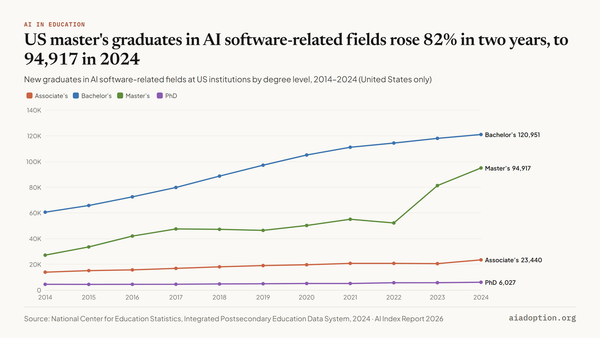 AI Degrees94,917Master's graduates in AI software-related fields at US institutions in 2024, up from 52,139 in 2022US master's graduates in AI software-related fields rose 82% in two years, to 94,917 in 2024Chart · CSVView →
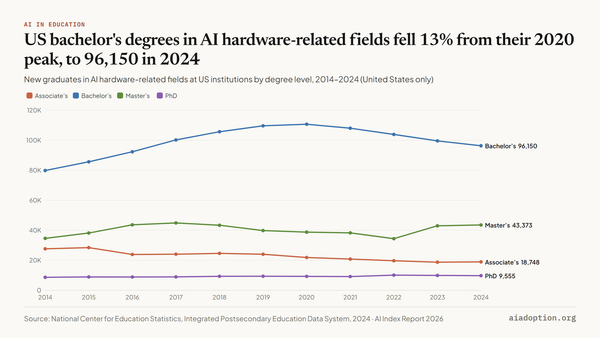 AI Degrees96,150Bachelor's graduates in AI hardware-related fields at US institutions in 2024, down from 110,511 in 2020US bachelor's degrees in AI hardware-related fields fell 13% from their 2020 peak, to 96,150 in 2024Chart · CSVView →
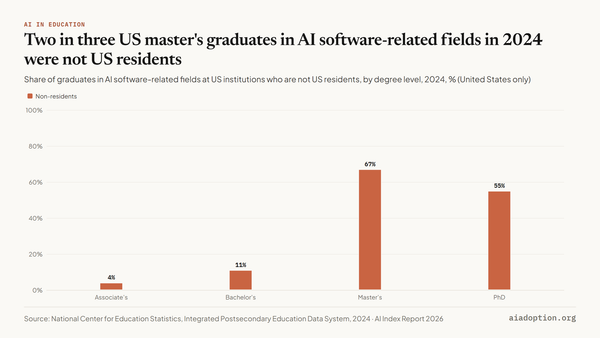 AI Degrees67%Share of master's graduates in AI software-related fields at US institutions who were non-residents, 2024; PhD 55%Two in three US master's graduates in AI software-related fields in 2024 were not US residentsChart · CSVView →
02
AI PhDs
442 new AI PhDs in the US and Canada took jobs in industry, academia or government in 2024, up 22% from 362 in 2022. Academia's share rose from 19.9% to 31.6% over those two years, while industry's share fell from 70.7% to 62.7%, its lowest since 2020.
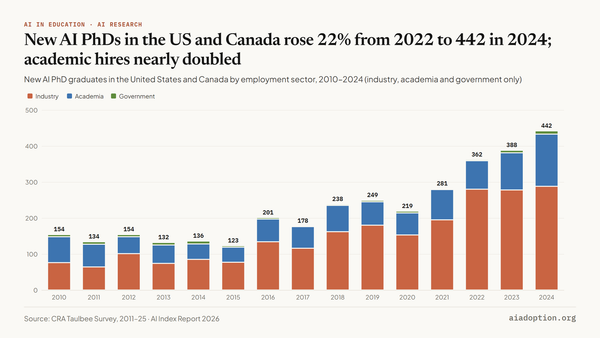 AI PhDs442New AI PhDs in the US and Canada who took jobs in industry, academia or government in 2024, up from 362 in 2022New AI PhDs in the US and Canada rose 22% from 2022 to 442 in 2024; academic hires nearly doubledChart · CSVView →
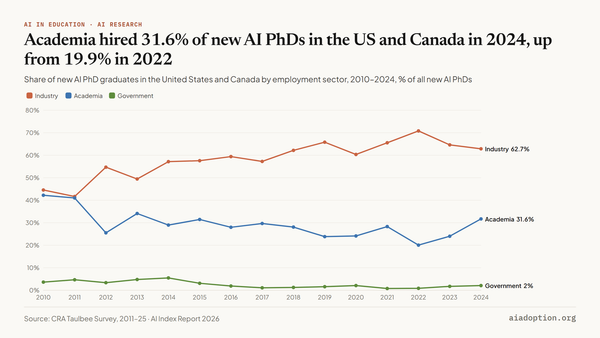 AI PhDs31.6%Share of new AI PhDs in the US and Canada who went into academia in 2024, up from 19.9% in 2022Academia hired 31.6% of new AI PhDs in the US and Canada in 2024, up from 19.9% in 2022Chart · CSVView →
03
Computing Faculty
The Computing Research Association counted 6,683 computer science, computer engineering and information faculty in the US and Canada in 2024–25 and projects 7,501 by 2026–27, up 12%. Asian women are the only group of women represented above parity, at 1.30 times their share of all US faculty; white women are at 0.35.
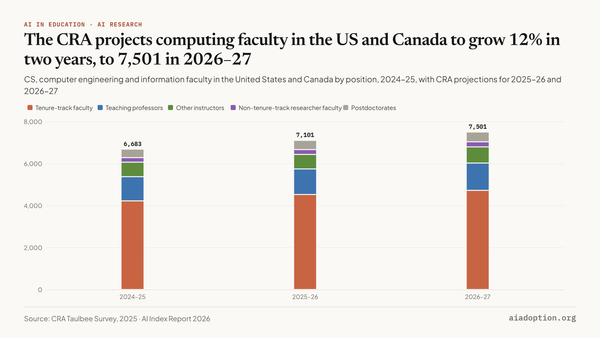 Computing Faculty7,501CS, CE and information faculty projected in the US and Canada for 2026–27, up from 6,683 in 2024–25The CRA projects computing faculty in the US and Canada to grow 12% in two years, to 7,501 in 2026–27Chart · CSVView →
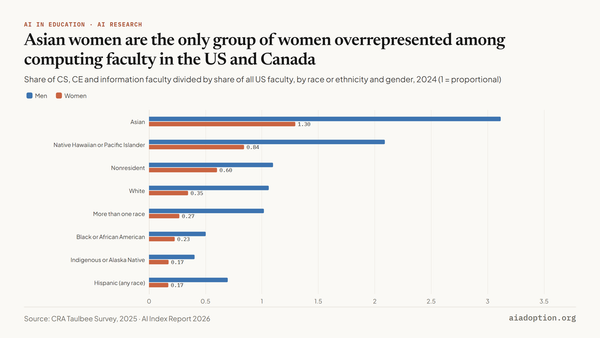 Computing Faculty1.30Asian women's share of CS, CE and information faculty relative to their share of all US faculty, 2024; white women 0.35Asian women are the only group of women overrepresented among computing faculty in the US and CanadaChart · CSVView →
04
Computer Science Graduates by Country
The US produced 122,814 ICT bachelor's graduates in 2023, 1.5 times Brazil (80,316), whose count rose 30% in a year against 5.5% in the US. At master's level the US had 86,301 graduates, 3.1 times the United Kingdom, and it awarded 2,874 ICT PhDs, 2.4 times the UK.
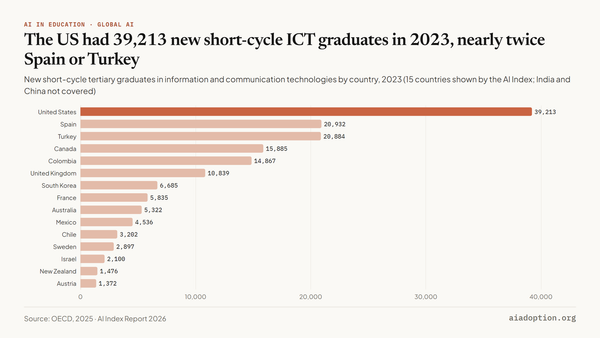 Computer Science Graduates by Country39,213New short-cycle ICT graduates in the US in 2023, about the level of an associate's degree, up 1.2% on 2022; Spain 20,932The US had 39,213 new short-cycle ICT graduates in 2023, nearly twice Spain or TurkeyChart · CSVView →
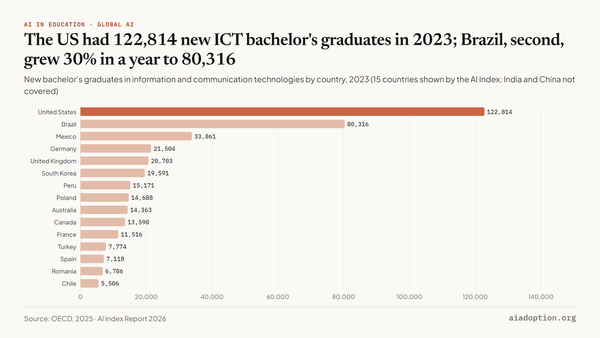 Computer Science Graduates by Country122,814New ICT bachelor's graduates in the US in 2023, up 5.5% on 2022; Brazil 80,316The US had 122,814 new ICT bachelor's graduates in 2023; Brazil, second, grew 30% in a year to 80,316Chart · CSVView →
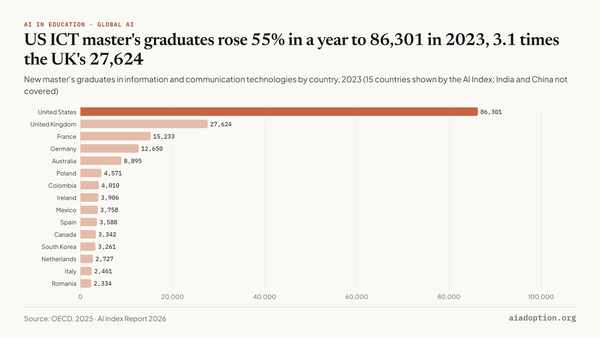 Computer Science Graduates by Country86,301New ICT master's graduates in the US in 2023, up from 55,706 in 2022; UK 27,624US ICT master's graduates rose 55% in a year to 86,301 in 2023, 3.1 times the UK's 27,624Chart · CSVView →
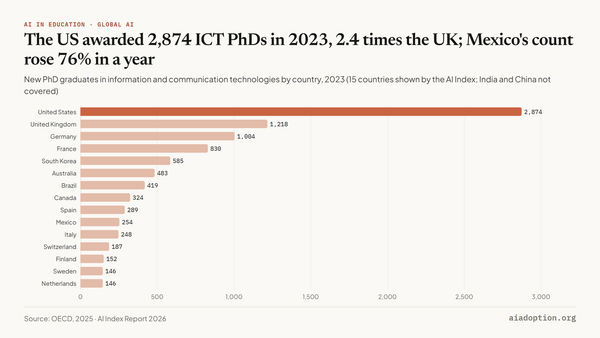 Computer Science Graduates by Country2,874New ICT PhD graduates in the US in 2023, up 4.2% on 2022; UK 1,218The US awarded 2,874 ICT PhDs in 2023, 2.4 times the UK; Mexico's count rose 76% in a yearChart · CSVView →
05
Women in Computer Science
Women earned 36% of US master's degrees in AI software-related fields in 2024, their highest share at any level, but only 27% of bachelor's degrees. Across 42 countries, women were 22% of new ICT bachelor's graduates in 2023 on average, from 12% in Chile to 40% in Sweden.
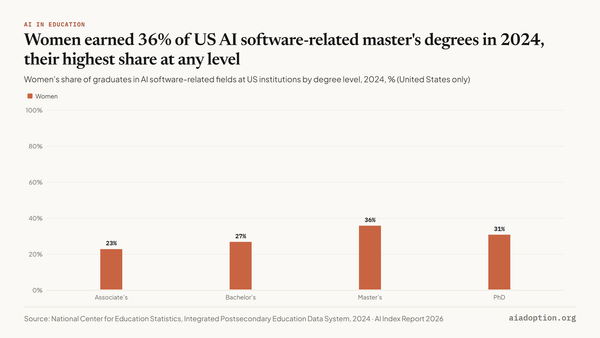 Women in Computer Science36%Women's share of master's graduates in AI software-related fields at US institutions, 2024; associate's 23%Women earned 36% of US AI software-related master's degrees in 2024, their highest share at any levelChart · CSVView →
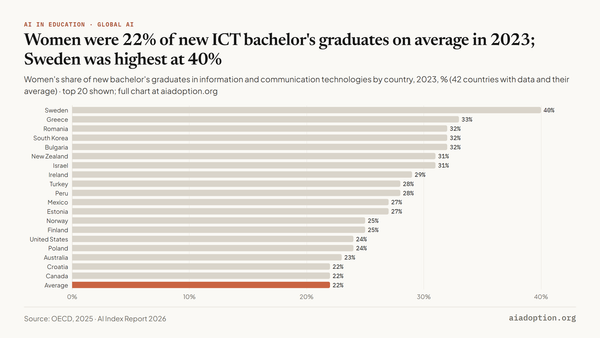 Women in Computer Science40%Women's share of new ICT bachelor's graduates in Sweden in 2023, the highest of 42 countries; average 22%Women were 22% of new ICT bachelor's graduates on average in 2023; Sweden was highest at 40%Chart · CSVView →
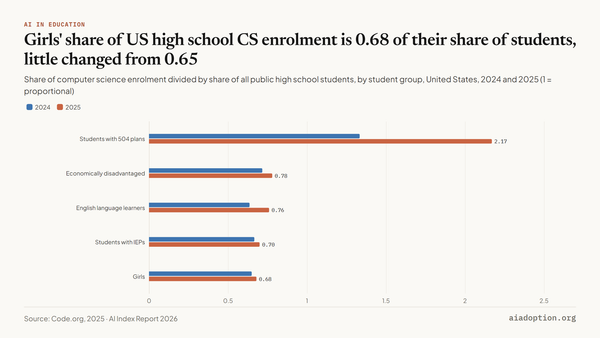 Women in Computer Science0.68Girls' share of US public high school CS enrolment relative to their share of all students, 2025 (1 = parity)Girls' share of US high school CS enrolment is 0.68 of their share of students, little changed from 0.65Chart · CSVView →
06
Diversity in Computer Science
Asian students' share of US master's degrees in AI software-related fields is 3.09 times their share of all master's degrees, while Black (0.61) and Hispanic (0.72) students are underrepresented. In high schools, 91% of Asian students can take foundational computer science at their school, against 70% of Native American students.
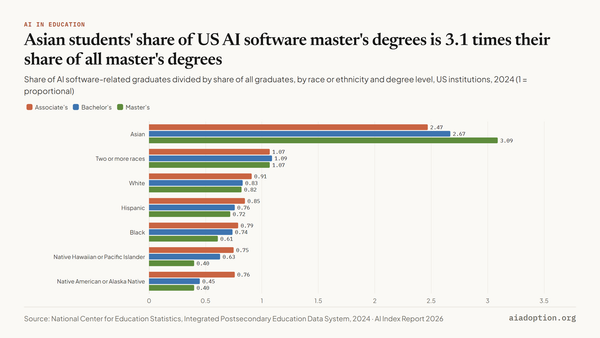 Diversity in Computer Science3.09Asian graduates' share of AI software-related master's degrees relative to their share of all US master's degrees, 2024Asian students' share of US AI software master's degrees is 3.1 times their share of all master's degreesChart · CSVView →
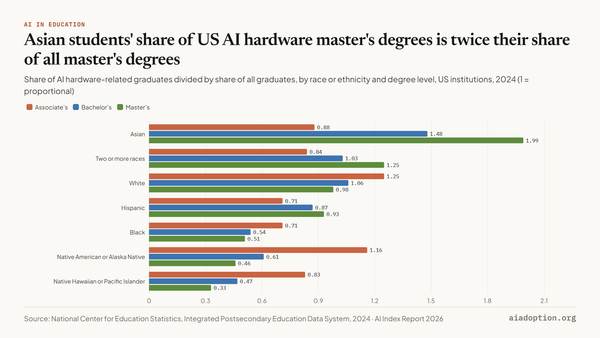 Diversity in Computer Science1.99Asian graduates' share of AI hardware-related master's degrees relative to their share of all US master's degrees, 2024Asian students' share of US AI hardware master's degrees is twice their share of all master's degreesChart · CSVView →
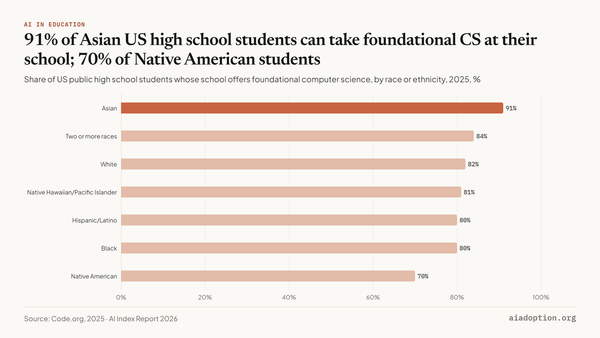 Diversity in Computer Science91%Asian US public high school students whose school offers foundational computer science, 2025; Native American 70%91% of Asian US high school students can take foundational CS at their school; 70% of Native American studentsChart · CSVView →
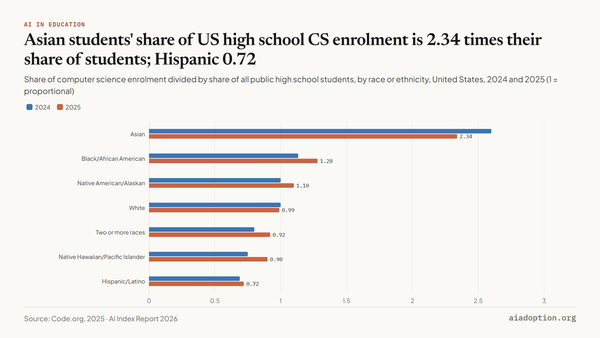 Diversity in Computer Science2.34Asian students' share of US public high school CS enrolment relative to their share of all students, 2025, down from 2.60Asian students' share of US high school CS enrolment is 2.34 times their share of students; Hispanic 0.72Chart · CSVView →
07
Computer Science in High Schools
60% of US public high schools taught foundational computer science in 2024–25, unchanged from a year earlier and up from 35% in 2017–18. Access varies by school: 91% of large schools offered it in 2025 against 44% of small ones, and every public high school in Arkansas and Maryland does.
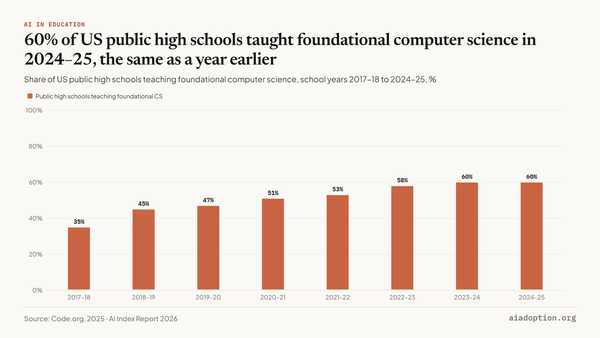 Computer Science in High Schools60%US public high schools teaching foundational computer science in 2024–25, unchanged from 2023–2460% of US public high schools taught foundational computer science in 2024–25, the same as a year earlierChart · CSVView →
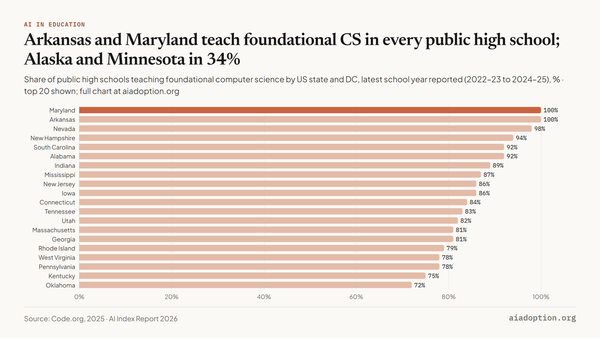 Computer Science in High Schools100%Public high schools teaching foundational computer science in Arkansas and Maryland, the highest of 50 states and DC; Alaska and Minnesota 34%Arkansas and Maryland teach foundational CS in every public high school; Alaska and Minnesota in 34%Chart · CSVView →
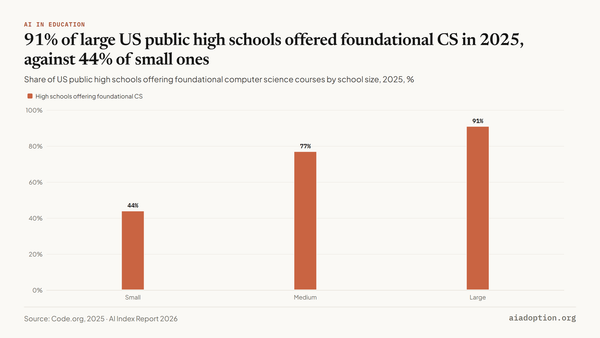 Computer Science in High Schools91%Large US public high schools offering foundational computer science in 2025; medium 77%, small 44%91% of large US public high schools offered foundational CS in 2025, against 44% of small onesChart · CSVView →
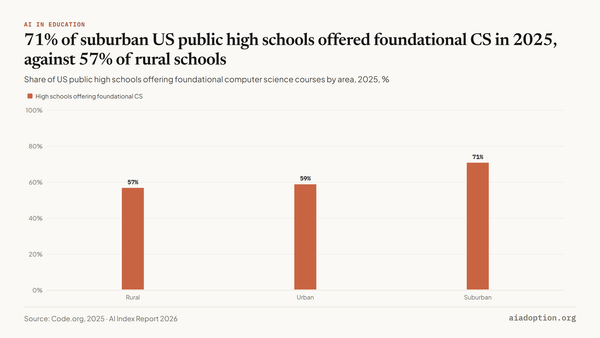 Computer Science in High Schools71%Suburban US public high schools offering foundational computer science in 2025; urban 59%, rural 57%71% of suburban US public high schools offered foundational CS in 2025, against 57% of rural schoolsChart · CSVView →
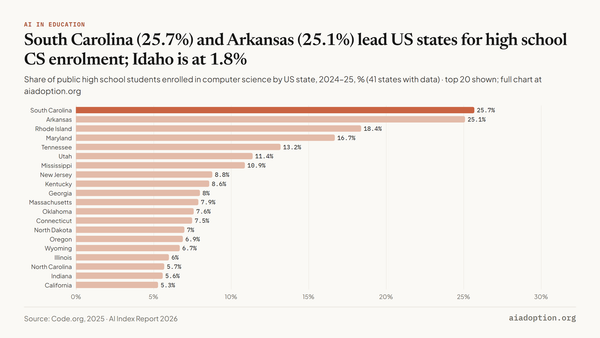 Computer Science in High Schools25.7%Share of South Carolina's public high school students enrolled in computer science in 2024–25, the highest of 41 states with dataSouth Carolina (25.7%) and Arkansas (25.1%) lead US states for high school CS enrolment; Idaho is at 1.8%Chart · CSVView →
08
AP Computer Science
US students took 254,800 AP computer science exams in 2024, up 4.8% on 2023 after 21% growth the year before, and 13 times the 2007 count. White students' share of exams fell from 60.8% in 2007 to 35.1% in 2024, while the Hispanic or Latino share rose from 6.7% to 18.3%.
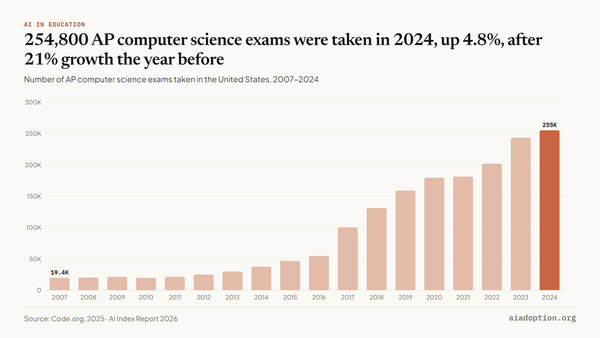 AP Computer Science254,800AP computer science exams taken in the US in 2024, up from 243,180 in 2023254,800 AP computer science exams were taken in 2024, up 4.8%, after 21% growth the year beforeChart · CSVView →
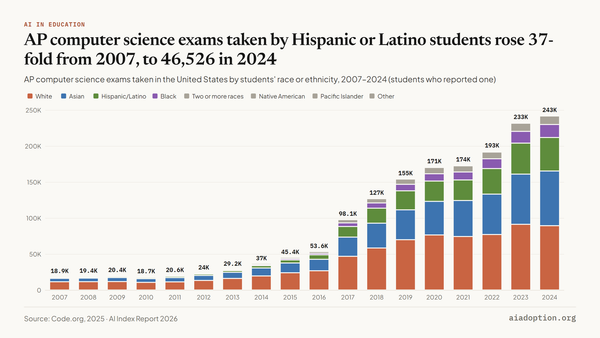 AP Computer Science46,526AP computer science exams taken by Hispanic or Latino students in 2024, up from 1,268 in 2007AP computer science exams taken by Hispanic or Latino students rose 37-fold from 2007, to 46,526 in 2024Chart · CSVView →
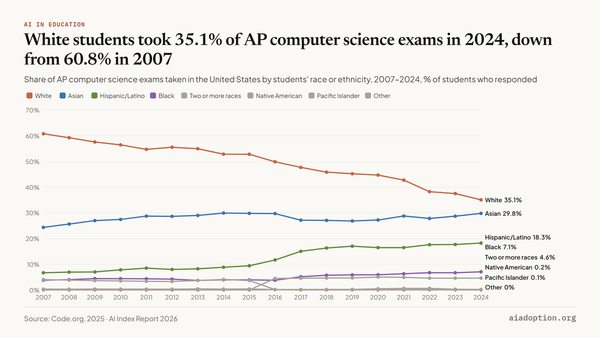 AP Computer Science35.1%White students' share of AP computer science exams in 2024, down from 60.8% in 2007White students took 35.1% of AP computer science exams in 2024, down from 60.8% in 2007Chart · CSVView →
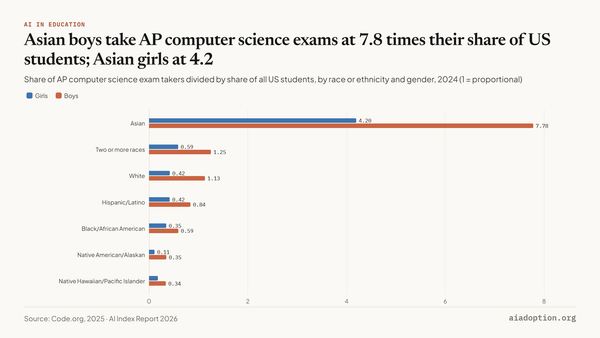 AP Computer Science7.78Asian boys' share of AP computer science exam takers relative to their share of US students, 2024; Asian girls 4.20Asian boys take AP computer science exams at 7.8 times their share of US students; Asian girls at 4.2Chart · CSVView →
09
How Students Use AI
In Chegg's 2025 survey, 95% of university students in Indonesia had used generative AI for their studies, against 67% in the US and UK. Understanding a concept is students' most common use, at 56%. Among US high school students surveyed by the College Board, 50.75% use it for research and finding sources.
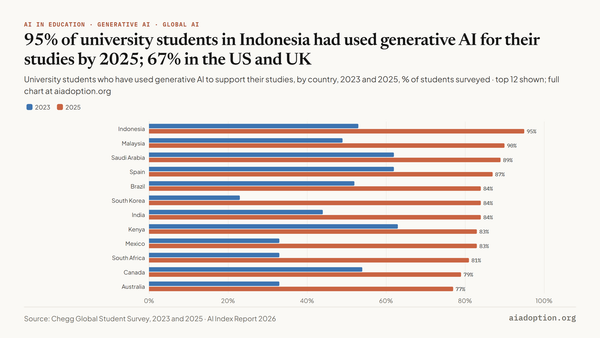 How Students Use AI95%University students in Indonesia who had used generative AI for their studies in 2025, up from 53% in 202395% of university students in Indonesia had used generative AI for their studies by 2025; 67% in the US and UKChart · CSVView →
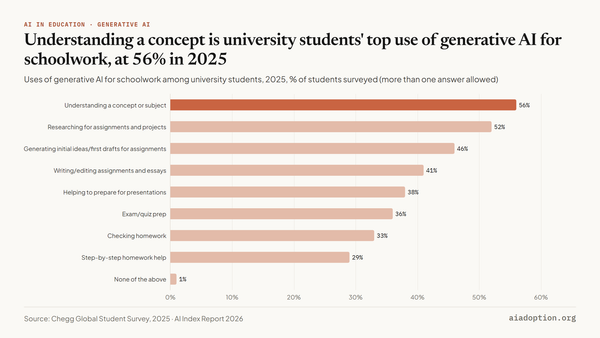 How Students Use AI56%University students who use generative AI to understand a concept or subject, the most common use in 2025; research 52%Understanding a concept is university students' top use of generative AI for schoolwork, at 56% in 2025Chart · CSVView →
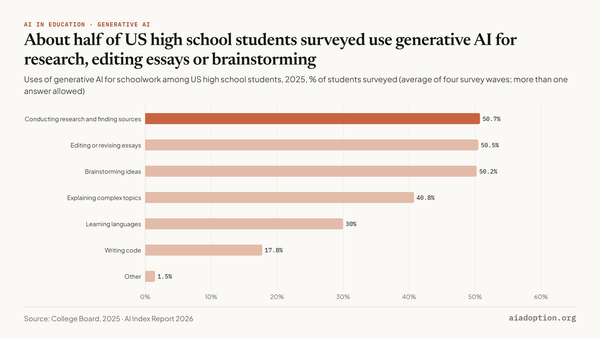 How Students Use AI50.75%US high school students surveyed who use generative AI for research and finding sources, 2025, the most common useAbout half of US high school students surveyed use generative AI for research, editing essays or brainstormingChart · CSVView →
Related hubs
All 13 hubs →About the data: 30 interactive charts from the AI Index Report 2026 (Stanford HAI), using data from research partners credited on each chart. Each chart page explains what the chart shows, lists its key numbers, cites its source and links to the data as a CSV.