AI Adoption
Charts on how organisations and people use AI, from business functions and AI agents to everyday use by country. 88% of McKinsey survey respondents said their organisation used AI in 2025.
Infrastructure & Industry · 16 charts · 6 topics
- Source
- Stanford AI Index Report 2026
- Charts
- 16 with CSV data
- Last checked
- 20 Oct 2026
- Data
- All CSVs (zip)
88%McKinsey survey respondents whose organisation used AI in 2025, up from 78% in 2024View chart →56%Respondents reporting cost decreases from analytical AI in software engineeringView chart →24%Highest share reporting AI agents in scaled use: software engineering in technologyView chart →53%US adults aged 18–64 using generative AI three years after ChatGPT's releaseView chart →64%AI diffusion in the United Arab Emirates, second half of 2025, highest of 30View chart →51.7%Share of new online articles that were AI-generated in May 2025, per GraphiteView chart →
Reported use of AI inside organisations kept rising in 2025, but most of it has not reached scale. In McKinsey's 2025 State of AI survey, 88% of respondents said their organisation used AI in at least one business function, up from 78% in 2024 and 20% in 2017, and 79% said it regularly used generative AI. AI agents are further behind: in every business function at least 66% of respondents reported no agent use, and the highest share reporting agents in scaled use was 24%, for software engineering in the technology sector.
Read the full overview
Among individuals, generative AI has spread faster than earlier technologies. Three years after ChatGPT's release, 53% of US adults aged 18–64 used it, against 20% for the personal computer at the same point. Across countries, the Microsoft AI Economy Institute puts AI adoption highest in the United Arab Emirates, at 64% in the second half of 2025; the United States ranked 24th of the 30 leading economies, at 28.3%. In a University of Melbourne and KPMG survey across 47 countries, 58% of employees used AI at work and 53% trusted it.
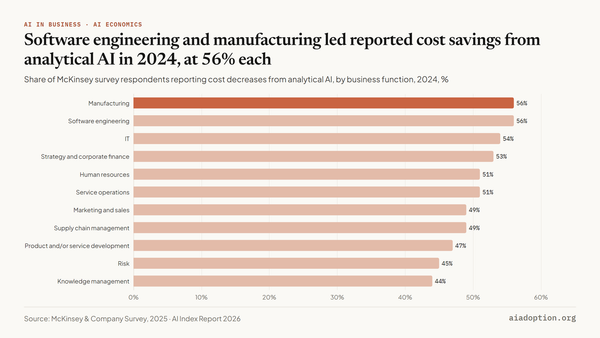
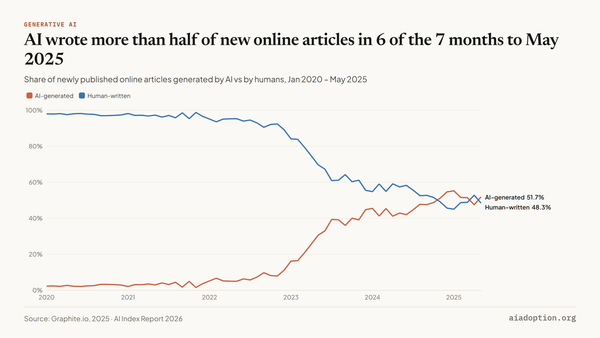
Reported savings are mostly small. 56% of McKinsey respondents said analytical AI cut costs in software engineering, but 35% saw those costs fall by less than 10%. In the Anthropic Economic Index, education tasks rose to 15% of sampled Claude conversations by November 2025, and Graphite classified 51.7% of new online articles in May 2025 as AI-generated.
The charts cover AI adoption in business, AI ROI, AI agent adoption, how many people use AI, what people use AI for and AI-generated content. The figures come from Stanford's AI Index Report 2026 and the surveys and studies it draws on, including McKinsey, Pew Research, the Microsoft AI Economy Institute, the University of Melbourne and KPMG, Anthropic and Graphite. Business figures are shares of survey respondents, not of companies, and the Claude data describes one company's users only.
AI Adoption · 2026AI Statistics: the pocket guide83Free for subscribersAll 83 key numbers on two pages, with sources.Every hub's headline numbers in one PDF, ready for a board paper or a slide.Get the guide
01
AI Adoption in Business
88% of respondents to McKinsey's 2025 State of AI survey said their organisation used AI in at least one business function, up from 78% in 2024 and 20% in 2017. Larger organisations are further along: 17% of respondents at organisations with $5B or more in revenue were still experimenting, against 39% at those under $100M.
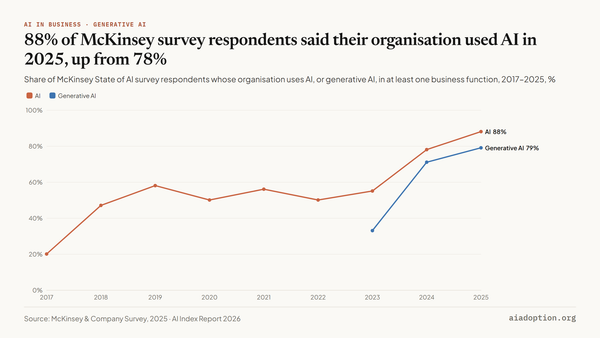 AI Adoption in Business88%Of McKinsey survey respondents said their organisation used AI in at least one business function in 2025, up from 78% in 202488% of McKinsey survey respondents said their organisation used AI in 2025, up from 78%Chart · CSVView →
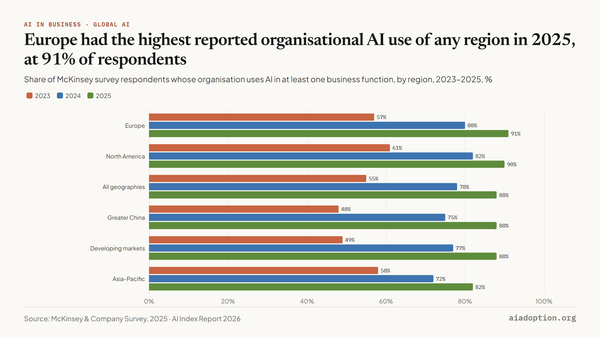 AI Adoption in Business91%Of McKinsey survey respondents in Europe said their organisation used AI in 2025, up from 80% in 2024 (all regions: 88%)Europe had the highest reported organisational AI use of any region in 2025, at 91% of respondentsChart · CSVView →
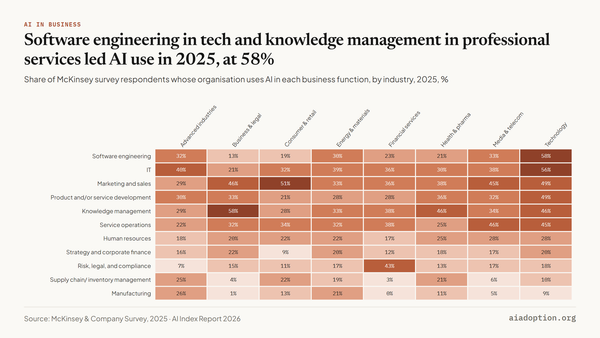 AI Adoption in Business58%Of respondents in technology said their organisation used AI in software engineering in 2025, the joint highest share in the chartSoftware engineering in tech and knowledge management in professional services led AI use in 2025, at 58%Chart · CSVView →
 AI Adoption in Business17%Of respondents at organisations with $5B or more in revenue said their AI use was at the experimenting stage in 2025 (under $100M: 39%)17% of respondents at $5B+ firms were still experimenting with AI in 2025, against 39% at the smallestChart · CSVView →
02
AI ROI
56% of McKinsey survey respondents reported that analytical AI decreased costs in software engineering in 2024, the same share as in manufacturing; knowledge management was lowest at 44%. Most savings were small: 35% saw software engineering costs fall by less than 10%. On revenue, marketing and sales led, with 67% reporting increases.
03
AI Agent Adoption
At least 66% of McKinsey survey respondents reported no AI agent use in each of 11 business functions in 2025, rising to 91% in manufacturing. Scaled use peaked at 24%, for software engineering in the technology sector. Security and risk concerns were the most cited obstacle to scaling agentic AI, named by 62% of organisations.
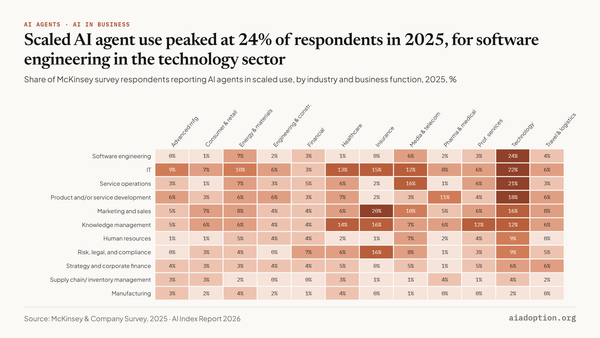 AI Agent Adoption24%Of respondents in technology reported AI agents in scaled use in software engineering in 2025, the highest share in the chartScaled AI agent use peaked at 24% of respondents in 2025, for software engineering in the technology sectorChart · CSVView →
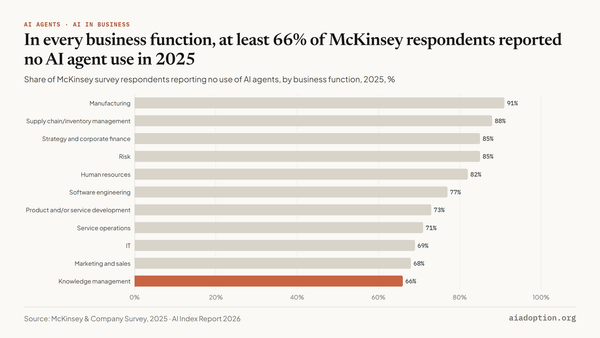 AI Agent Adoption66%Of respondents reported no AI agent use in knowledge management, the lowest share of 11 functions (manufacturing: 91%)In every business function, at least 66% of McKinsey respondents reported no AI agent use in 2025Chart · CSVView →
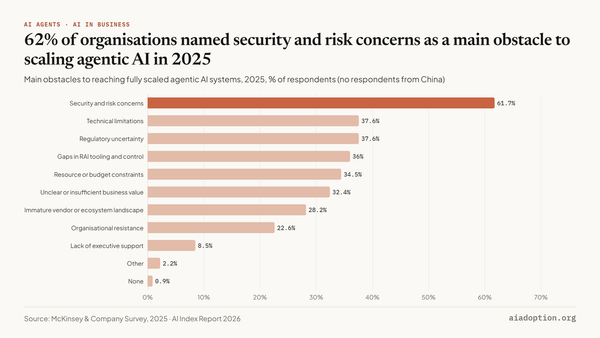 AI Agent Adoption62%Of organisations named security and risk concerns among the main obstacles to scaling agentic AI, ahead of technical limitations and regulatory uncertainty (38% each)62% of organisations named security and risk concerns as a main obstacle to scaling agentic AI in 2025Chart · CSVView →
04
How Many People Use AI?
53% of US adults aged 18–64 used generative AI three years after ChatGPT's release, against 20% for the personal computer and 30% for the internet at the same point. Adoption varies widely by country: the United Arab Emirates led at 64% in the second half of 2025, while the United States ranked 24th of 30, at 28.3%.
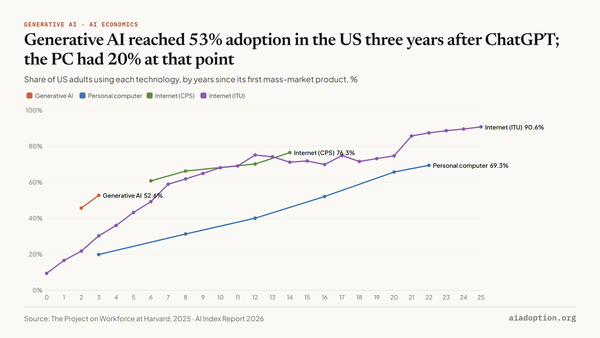 How Many People Use AI?53%Of US adults aged 18–64 used generative AI three years after ChatGPT's release (personal computer at three years: 20%)Generative AI reached 53% adoption in the US three years after ChatGPT; the PC had 20% at that pointChart · CSVView →
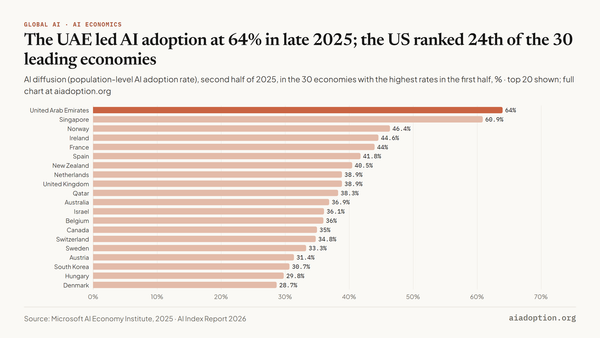 How Many People Use AI?64%AI diffusion in the United Arab Emirates in the second half of 2025, the highest of the 30 economies shown (US: 28.3%)The UAE led AI adoption at 64% in late 2025; the US ranked 24th of the 30 leading economiesChart · CSVView →
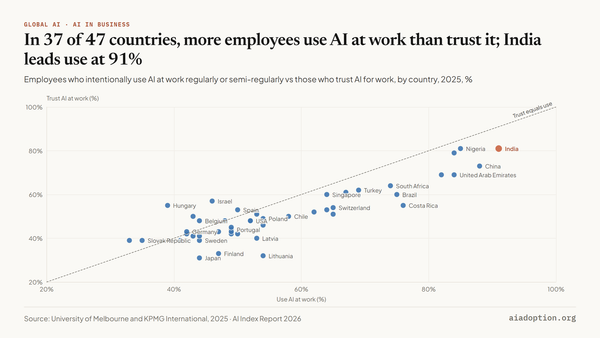 How Many People Use AI?37 of 47Countries where more employees use AI at work than trust it; in eight, trust is higher and two are levelIn 37 of 47 countries, more employees use AI at work than trust it; India leads use at 91%Chart · CSVView →
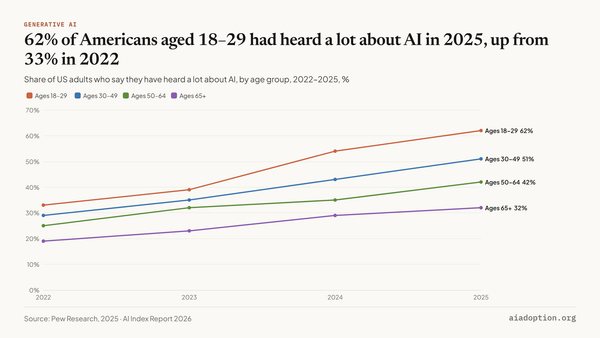 How Many People Use AI?62%Share of US adults aged 18–29 who had heard a lot about AI in 2025; 32% of those 65 and older62% of Americans aged 18–29 had heard a lot about AI in 2025, up from 33% in 2022Chart · CSVView →
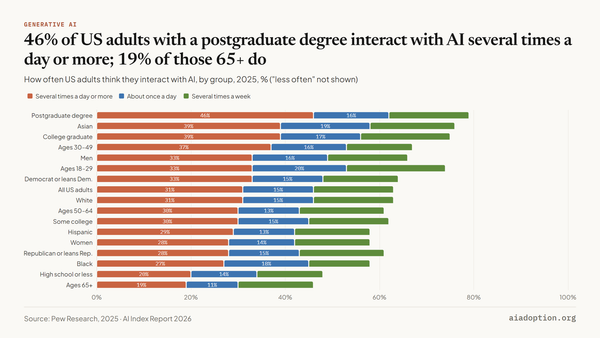 How Many People Use AI?46%Share of US adults with a postgraduate degree who interact with AI almost constantly or several times a day, 2025; 31% of all adults46% of US adults with a postgraduate degree interact with AI several times a day or more; 19% of those 65+ doChart · CSVView →
05
What People Use AI For
Educational instruction and library tasks rose to 15% of sampled Claude conversations in November 2025, from 9.6% in January, the largest gain of eight occupation groups in the Anthropic Economic Index. Computer and mathematical tasks remained the largest group, at 34%. Automation, where users have Claude complete a task, made up 45% of Claude.ai conversations.
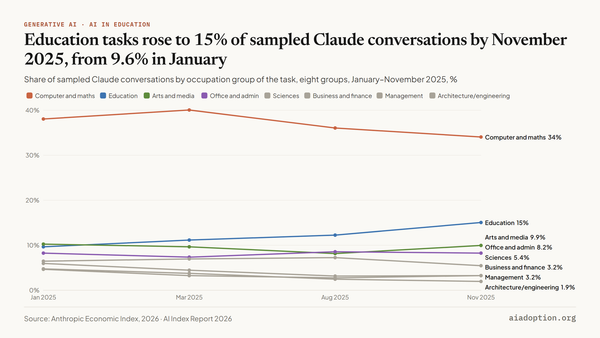 What People Use AI For15%Of sampled Claude conversations involved educational instruction and library tasks in November 2025, up from 9.6% in JanuaryEducation tasks rose to 15% of sampled Claude conversations by November 2025, from 9.6% in JanuaryChart · CSVView →
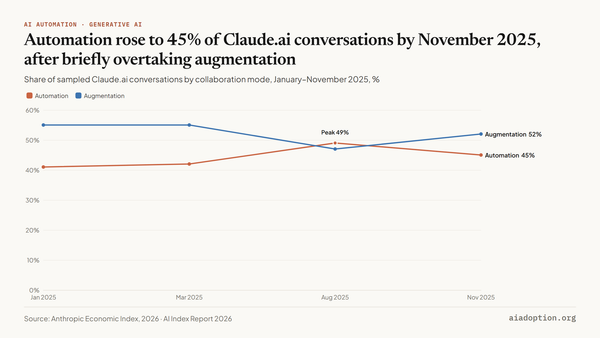 What People Use AI For45%Of sampled Claude.ai conversations were automation in November 2025, up from 41% in January (augmentation: 52%)Automation rose to 45% of Claude.ai conversations by November 2025, after briefly overtaking augmentationChart · CSVView →
06
AI-Generated Content
AI-generated articles made up 51.7% of newly published online articles in May 2025, according to Graphite, an SEO company, and more than half in 6 of the 7 months from November 2024. The AI-generated share was about 2% in January 2020 and peaked at 55.1% in January 2025.
Related hubs
All 13 hubs →About the data: 16 interactive charts from the AI Index Report 2026 (Stanford HAI), using data from research partners credited on each chart. Each chart page explains what the chart shows, lists its key numbers, cites its source and links to the data as a CSV.