AI in Healthcare
How AI is entering medicine: FDA device authorisations, research on drug discovery, proteins and genomics, clinical trials, patients' views and ethics, from Stanford's AI Index Report 2026.
Work & Society · 28 charts · 9 topics
- Source
- Stanford AI Index Report 2026
- Charts
- 28 with CSV data
- Last checked
- 20 Oct 2026
- Data
- All CSVs (zip)
258AI-enabled medical devices authorised by the FDA in 2025, up from 235 in 2024View chart →76.6%Radiology's share of AI-enabled devices authorised by the FDA to the end of 2025View chart →3,311Publications on AI for drug discovery in 2025, up from 2,100 in 2024View chart →64.9%AlphaFold 3's FoldBench accuracy, the highest of eight protein structure modelsView chart →536Papers reporting prospective trials of clinical imaging AI in 2025, up from 417View chart →2,378Medical AI publications that discussed ethics in 2025, 43.4% of the totalView chart →
AI-enabled medical devices are reaching the US market in growing numbers. The Food and Drug Administration (FDA) authorised 258 AI-enabled medical devices in 2025, up from 235 in 2024 and the most of any year, bringing the total since 1995 to 1,357. Radiology accounts for 1,039 of them (76.6%); outside radiology, authorisations rose from 7 in 2016 to 60 in 2025. GE Healthcare holds 93, the most of any company.
Read the full overview
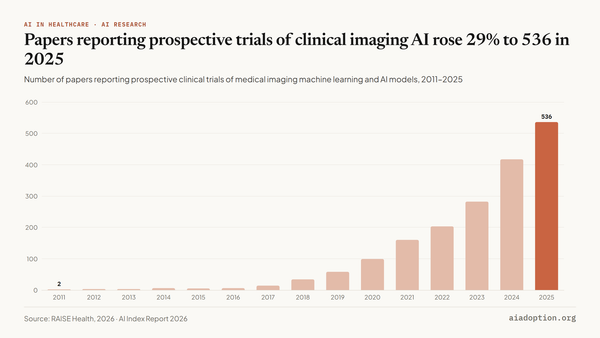
Research output is rising in most areas the AI Index tracks. Publications on AI for drug discovery rose 58% to 3,311 in 2025, AI-driven protein research publications rose 71% to 3,855, and papers reporting prospective trials of clinical imaging AI rose 29% to 536. Larger models do not always score higher: a 600-million-parameter E1 model scored 0.48 on ProteinGym against 0.41 for the 3-billion-parameter ESM-2, while AlphaFold 3 still leads FoldBench at 64.9%, ahead of every 2025 model in the data.
The page covers AI in drug discovery, AI protein models such as AlphaFold, AI in genomics and biomedical research, FDA AI-enabled medical devices, medical AI clinical trials, medical digital twins, patients and AI, medical AI ethics and AI in global health. In 2025, 2,378 medical AI publications discussed ethics, 43.4% of the total, while only 14 discussed biosecurity. Google showed an AI Overview on 92% of the symptom searches analysed.
The figures come from Stanford's AI Index Report 2026, which draws on the FDA's list of AI-enabled devices, publication counts by RAISE Health, patent data and published benchmark results. Most research figures are publication counts, which measure research activity rather than quality or clinical use. FDA figures cover the US only, and the 2025 patent count for medical digital twins is incomplete.
AI Adoption · 2026AI Statistics: the pocket guide83Free for subscribersAll 83 key numbers on two pages, with sources.Every hub's headline numbers in one PDF, ready for a board paper or a slide.Get the guide
01
AI in Drug Discovery
Publications on AI for drug discovery rose 58% to 3,311 in 2025, almost eight times the 431 of 2018. In Adaptyv Bio's 2025 Nipah virus binder challenge, 9.6% of 1,026 protein designs bound the target; Mosaic did best, with 8 of its 9 designs binding.
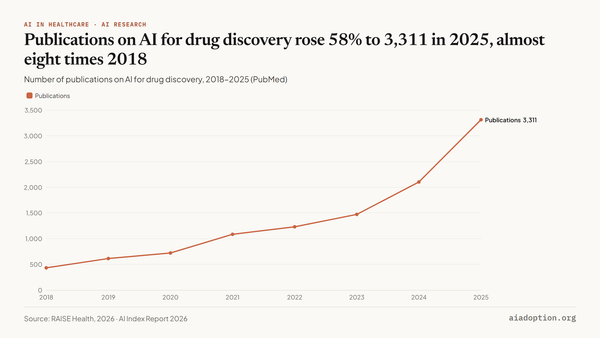 AI in Drug Discovery3,311Publications on AI for drug discovery in 2025, up from 2,100 in 2024Publications on AI for drug discovery rose 58% to 3,311 in 2025, almost eight times 2018Chart · CSVView →
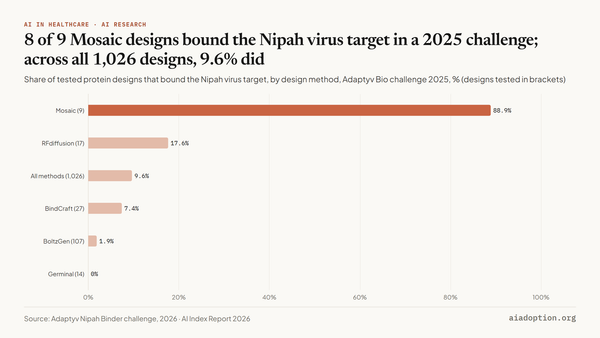 AI in Drug Discovery88.9%Share of Mosaic's 9 tested designs that bound the Nipah virus target, against 9.6% of all 1,026 designs8 of 9 Mosaic designs bound the Nipah virus target in a 2025 challenge; across all 1,026 designs, 9.6% didChart · CSVView →
02
AI Protein Models (AlphaFold)
AlphaFold 3, released in 2024 with 370 million parameters, still leads FoldBench at 64.9%; the best 2025 model, SeedFold, scored 63.1%. Publications on AI-driven protein research rose 71% to 3,855 in 2025, and a 600-million-parameter E1 model outscored the 3-billion-parameter ESM-2 on ProteinGym, 0.48 to 0.41.
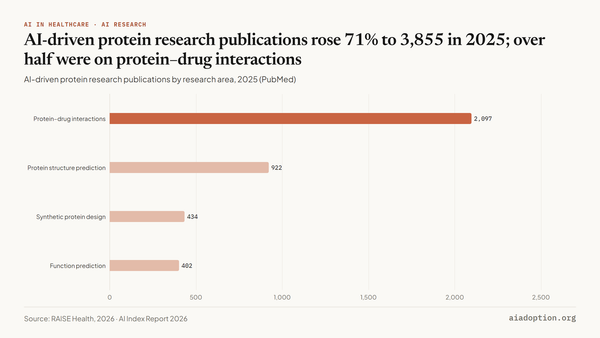 AI Protein Models (AlphaFold)3,855AI-driven protein research publications in 2025 across four areas, up 71% from 2,259 in 2024AI-driven protein research publications rose 71% to 3,855 in 2025; over half were on protein–drug interactionsChart · CSVView →
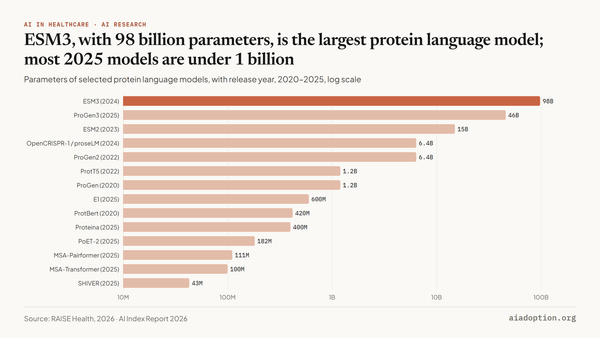 AI Protein Models (AlphaFold)98BParameters in ESM3 (2024), the most of 14 protein language models; the largest 2025 release, ProGen3, has 46BESM3, with 98 billion parameters, is the largest protein language model; most 2025 models are under 1 billionChart · CSVView →
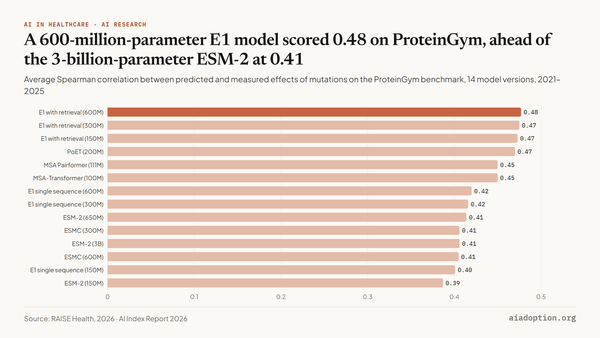 AI Protein Models (AlphaFold)0.48Average Spearman correlation on ProteinGym for E1 with retrieval (600M parameters, 2025); ESM-2 with 3B parameters scored 0.41A 600-million-parameter E1 model scored 0.48 on ProteinGym, ahead of the 3-billion-parameter ESM-2 at 0.41Chart · CSVView →
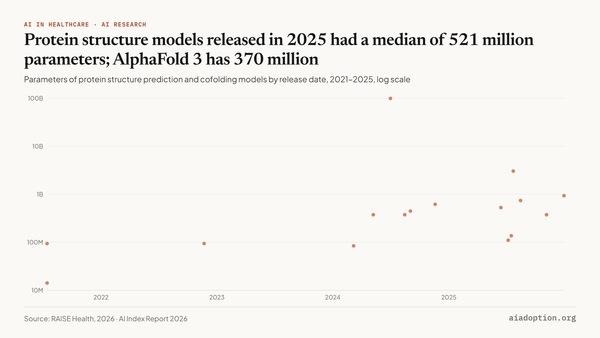 AI Protein Models (AlphaFold)521MMedian parameters of the seven protein structure prediction models released in 2025; AlphaFold 3 (2024) has 370MProtein structure models released in 2025 had a median of 521 million parameters; AlphaFold 3 has 370 millionChart · CSVView →
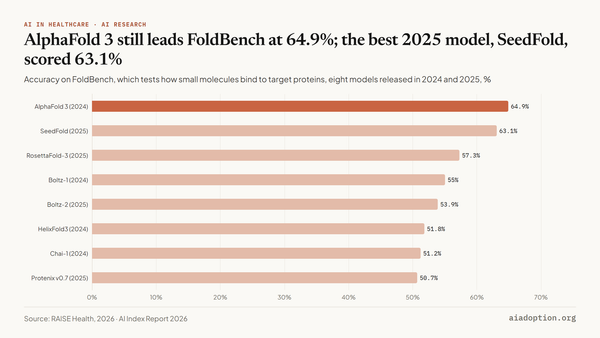 AI Protein Models (AlphaFold)64.9%AlphaFold 3's FoldBench accuracy (2024, 370M parameters), the highest of eight models; SeedFold (2025, 923M) scored 63.1%AlphaFold 3 still leads FoldBench at 64.9%; the best 2025 model, SeedFold, scored 63.1%Chart · CSVView →
03
AI in Genomics & Biomedical Research
Publications on multimodal biomedical AI rose 47% to 462 in 2025, from 2 in 2021. On variant effect prediction, the 200-million-parameter GPN-Star scored 0.75 AUPRC against 0.53 for Evo 2, which has 200 times as many parameters. Work on virtual cell models remains small, at 24 publications in 2025.
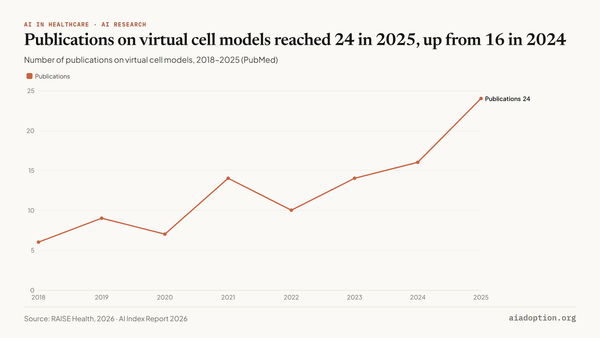 AI in Genomics & Biomedical Research24Publications on virtual cell models in 2025, up from 16 in 2024Publications on virtual cell models reached 24 in 2025, up from 16 in 2024Chart · CSVView →
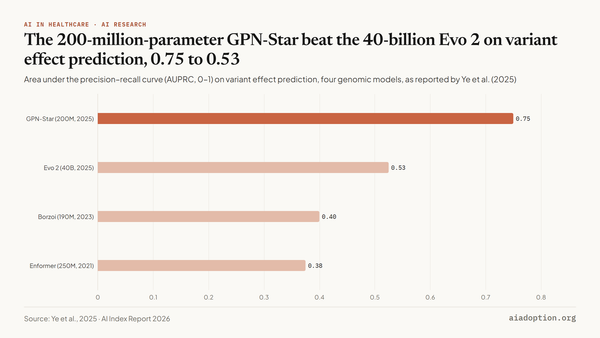 AI in Genomics & Biomedical Research0.75AUPRC on variant effect prediction for GPN-Star (200M parameters, 2025), against 0.53 for Evo 2 (40B)The 200-million-parameter GPN-Star beat the 40-billion Evo 2 on variant effect prediction, 0.75 to 0.53Chart · CSVView →
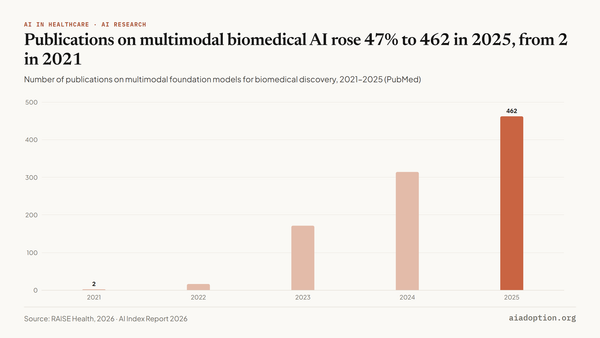 AI in Genomics & Biomedical Research462Publications on multimodal biomedical AI in 2025, up from 314 in 2024Publications on multimodal biomedical AI rose 47% to 462 in 2025, from 2 in 2021Chart · CSVView →
04
FDA AI-Enabled Medical Devices
The FDA authorised 258 AI-enabled medical devices in 2025, up from 235 in 2024, bringing the total since 1995 to 1,357. Radiology accounts for 1,039 of them (76.6%), with cardiovascular a distant second at 130. GE Healthcare holds 93 authorised devices, the most of any company, ahead of Siemens Healthineers' 82.
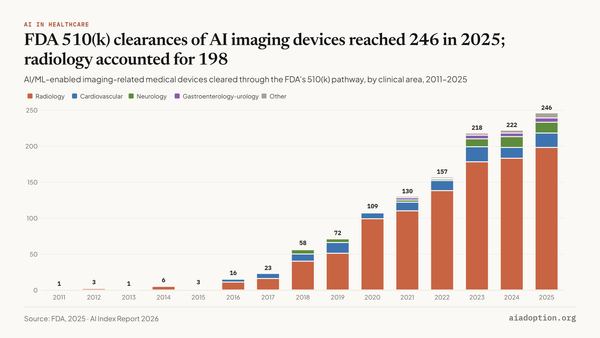 FDA AI-Enabled Medical Devices246AI-enabled imaging devices cleared through the FDA's 510(k) pathway in 2025, up from 222 in 2024FDA 510(k) clearances of AI imaging devices reached 246 in 2025; radiology accounted for 198Chart · CSVView →
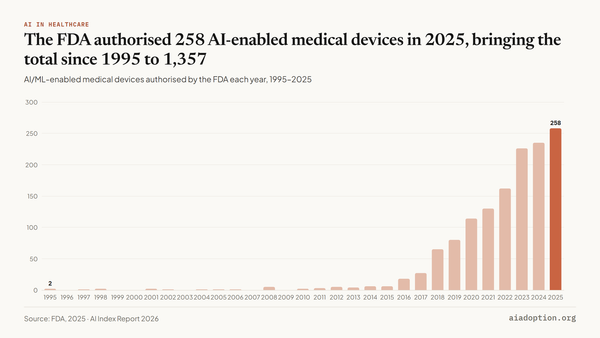 FDA AI-Enabled Medical Devices258AI-enabled medical devices authorised by the FDA in 2025, up from 235 in 2024; 1,357 in all since 1995The FDA authorised 258 AI-enabled medical devices in 2025, bringing the total since 1995 to 1,357Chart · CSVView →
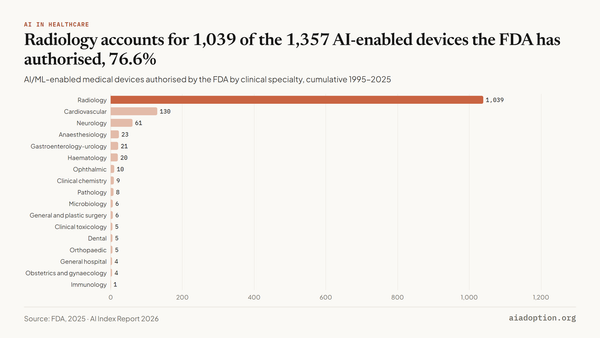 FDA AI-Enabled Medical Devices76.6%Radiology's share of the AI-enabled medical devices authorised by the FDA to the end of 2025; cardiovascular 9.6%, neurology 4.5%Radiology accounts for 1,039 of the 1,357 AI-enabled devices the FDA has authorised, 76.6%Chart · CSVView →
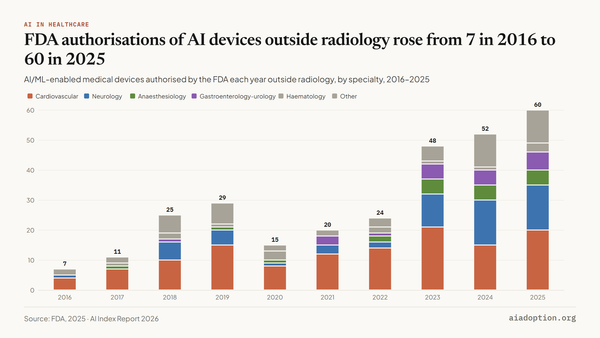 FDA AI-Enabled Medical Devices60AI-enabled devices outside radiology authorised by the FDA in 2025, up from 7 in 2016; radiology had 198FDA authorisations of AI devices outside radiology rose from 7 in 2016 to 60 in 2025Chart · CSVView →
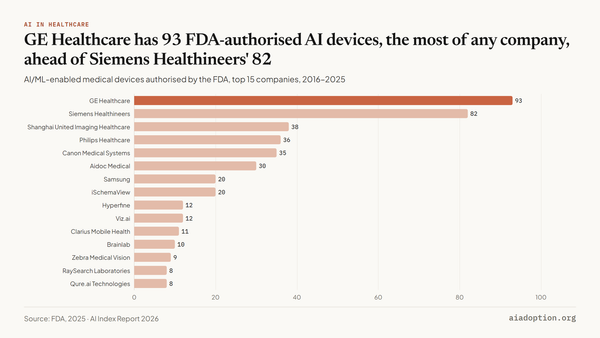 FDA AI-Enabled Medical Devices93AI-enabled devices authorised by the FDA for GE Healthcare, the most of any company; Siemens Healthineers has 82GE Healthcare has 93 FDA-authorised AI devices, the most of any company, ahead of Siemens Healthineers' 82Chart · CSVView →
05
Medical AI Clinical Trials
Papers reporting prospective clinical trials of medical imaging AI reached 536 in 2025, up 29% from 417 in 2024 and more than nine times the 58 of 2019. Prospective trials test a model on patients as care happens rather than on past records; a paper count is not a count of distinct trials.
06
Medical Digital Twins
Publications on medical digital twins, computer models of individual patients that update over time, reached 372 in 2025, 2.1 times the 176 of 2024. Patent filings on healthcare digital twins reached 4,926 in 2024, up from 30 in 2016; the 2025 count of 4,087 is incomplete.
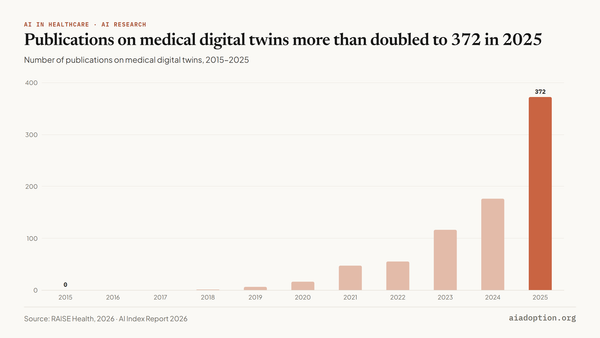 Medical Digital Twins372Publications on medical digital twins in 2025, up from 176 in 2024Publications on medical digital twins more than doubled to 372 in 2025Chart · CSVView →
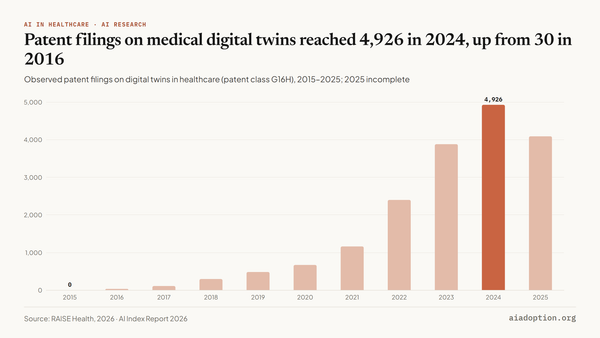 Medical Digital Twins4,926Observed patent filings on healthcare digital twins in 2024, up from 30 in 2016; the 2025 count (4,087) is incompletePatent filings on medical digital twins reached 4,926 in 2024, up from 30 in 2016Chart · CSVView →
07
Patients & AI
Google showed an AI Overview on 92% of the symptom searches and common health questions RAISE Health analysed, and on 84% of condition searches. Research on how patients see AI in healthcare reached 102 publications in 2025, 11 times 2020; the US produced 62 of the 204 studies, more than twice the UK's 27.
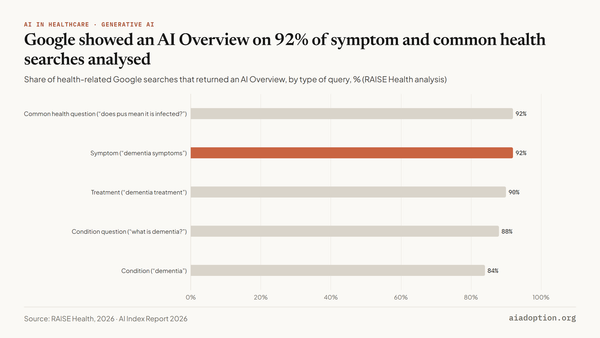 Patients & AI92%Share of symptom searches, and of common health questions, that returned an AI Overview; condition searches 84%Google showed an AI Overview on 92% of symptom and common health searches analysedChart · CSVView →
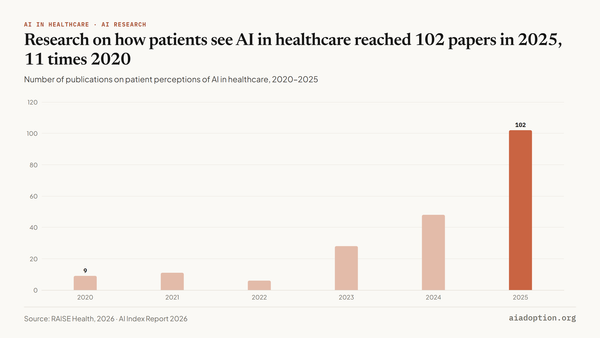 Patients & AI102Publications on patient perceptions of AI in healthcare in 2025, up from 9 in 2020Research on how patients see AI in healthcare reached 102 papers in 2025, 11 times 2020Chart · CSVView →
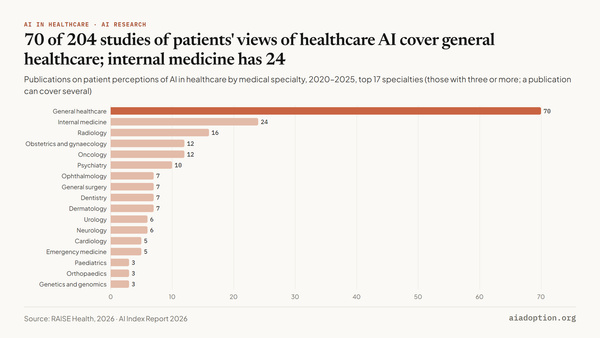 Patients & AI70Publications on general healthcare, of 204 on patient perceptions of AI; internal medicine 24, radiology 1670 of 204 studies of patients' views of healthcare AI cover general healthcare; internal medicine has 24Chart · CSVView →
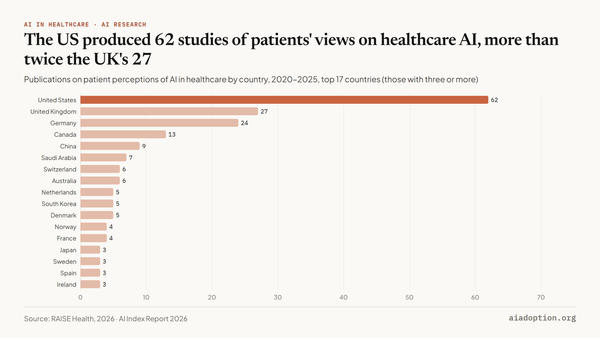 Patients & AI62Publications from the United States, of 204 on patient perceptions of AI in healthcare; United Kingdom 27, Germany 24The US produced 62 studies of patients' views on healthcare AI, more than twice the UK's 27Chart · CSVView →
08
Medical AI Ethics
In 2025, 2,378 medical AI publications discussed ethics, 43.4% of all 5,477 medical AI papers and 2.1 times the 2024 count. Governance was the most discussed ethics topic, in 1,228 publications, ahead of algorithmic (896) and societal concerns (874). Only 14 publications discussed biosecurity.
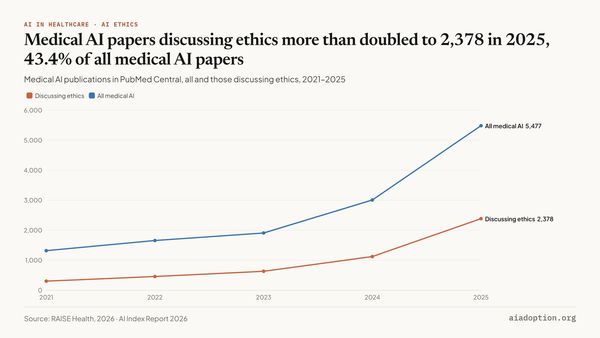 Medical AI Ethics2,378Medical AI publications that discussed ethics in 2025, 43.4% of the 5,477 medical AI publicationsMedical AI papers discussing ethics more than doubled to 2,378 in 2025, 43.4% of all medical AI papersChart · CSVView →
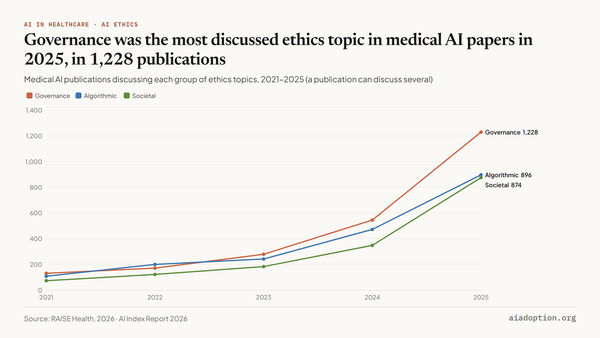 Medical AI Ethics1,228Medical AI publications discussing governance in 2025, up from 544 in 2024; algorithmic 896, societal 874Governance was the most discussed ethics topic in medical AI papers in 2025, in 1,228 publicationsChart · CSVView →
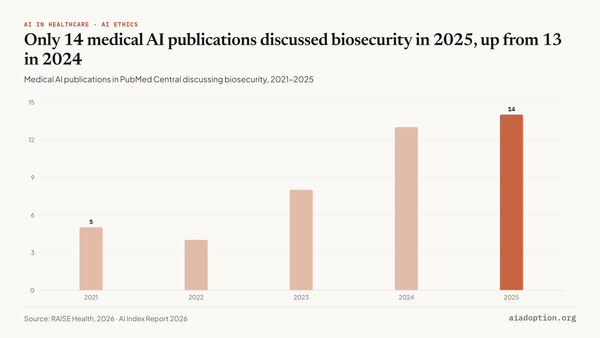 Medical AI Ethics14Medical AI publications that discussed biosecurity in 2025, against 2,378 that discussed ethicsOnly 14 medical AI publications discussed biosecurity in 2025, up from 13 in 2024Chart · CSVView →
09
AI in Global Health
100 of the 193 medical AI publications on global health in 2025 discussed ethics, 51.8%, against 43.4% across all medical AI. East Asia produced 25 of these papers, overtaking Europe (23). Unlike the field as a whole, societal concerns such as equity and access led, in 54 publications, ahead of governance (43).
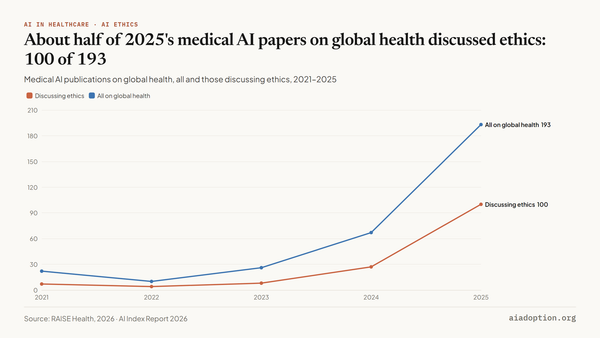 AI in Global Health100Medical AI publications on global health that discussed ethics in 2025, of 193 on global health (51.8%)About half of 2025's medical AI papers on global health discussed ethics: 100 of 193Chart · CSVView →
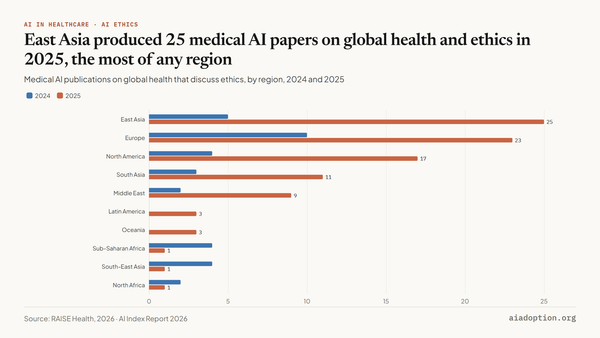 AI in Global Health25Medical AI publications on global health and ethics from East Asia in 2025, up from 5; Europe 23, North America 17East Asia produced 25 medical AI papers on global health and ethics in 2025, the most of any regionChart · CSVView →
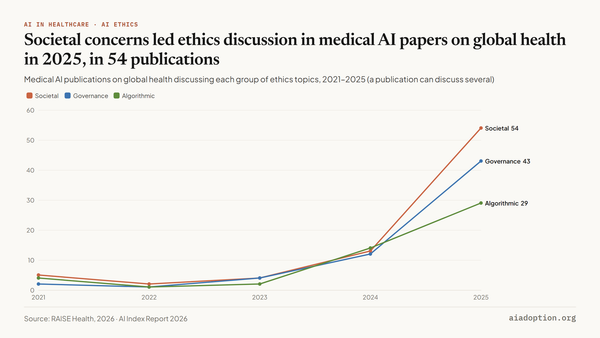 AI in Global Health54Medical AI publications on global health discussing societal concerns in 2025; governance 43, algorithmic 29Societal concerns led ethics discussion in medical AI papers on global health in 2025, in 54 publicationsChart · CSVView →
Related hubs
All 13 hubs →About the data: 28 interactive charts from the AI Index Report 2026 (Stanford HAI), using data from RAISE Health, Adaptyv Nipah Binder challenge, Ye et al. and FDA. Each chart page explains what the chart shows, lists its key numbers, cites its source and links to the data as a CSV.