Public Opinion on AI
How adults in more than 30 countries see AI: its benefits and drawbacks, its effect on daily life and jobs, where AI experts and the public disagree, and whom people trust to regulate it.
Work & Society · 22 charts · 7 topics
- Source
- Stanford AI Index Report 2026
- Charts
- 22 with CSV data
- Last checked
- 20 Oct 2026
- Data
- All CSVs (zip)
59%Adults in 30 countries seeing more benefits than drawbacks in AI products, 2025View chart →64%Canadians saying AI products make them nervous, against 31% excited, 2025View chart →50 ptsGap between US AI experts (73%) and US adults (23%) expecting AI to improve jobsView chart →64%US adults expecting AI to mean fewer jobs over the next 20 years, Pew, 2024View chart →52%Adults in 21 countries at least somewhat excited about using AI for companionshipView chart →31%US adults trusting their government to regulate AI, lowest of 30 countries, 2025View chart →
Survey data on AI show optimism and unease rising together. On Ipsos's global average across 30 countries, 59% of adults said in 2025 that products and services using AI have more benefits than drawbacks, up from 52% in 2022. Over the same period, the share saying AI products make them nervous rose from 39% to 52%, and 79% agreed that products using AI should have to disclose it.
Read the full overview
Views differ widely by country. China is highest on benefits at 86.9%, while Canada (40%) and the United States (42%) are among the lowest. In Canada, 64% say AI products make them nervous and 31% excited, the widest gap of 31 countries. Trust in government to regulate AI follows a similar split: 54% on Ipsos's global average, from 81% in Singapore to 31% in the United States, the lowest of 30 countries.
AI experts and the public also part ways. In Pew Research surveys, 73% of US AI experts expect AI to improve how people do their jobs over the next 20 years, against 23% of US adults, and 64% of US adults expect AI to mean fewer jobs. Across 30 countries, 61% of adults expect AI to change how they do their job within five years, while 37% think it likely to replace their job.
The charts cover global opinion on AI, excitement against nervousness, AI's expected impact on daily life, public views on AI and jobs, AI experts against the public, AI companions, and public views on AI regulation. They come from Stanford's AI Index Report 2026, which draws on surveys by Ipsos, Pew Research, the Forecasting Research Institute, Elon University and the Civic Health and Institutions Project (CHIP50). The set of countries Ipsos surveys changes from year to year, so changes over time partly reflect who was asked. The expert-versus-public comparisons cover the United States only, and the state-level data covers 39 states.
AI Adoption · 2026AI Statistics: the pocket guide83Free for subscribersAll 83 key numbers on two pages, with sources.Every hub's headline numbers in one PDF, ready for a board paper or a slide.Get the guide
01
Global Opinion on AI
In 2025, 59% of adults across the 30 countries Ipsos surveyed said AI products and services have more benefits than drawbacks, up from 52% in 2022. The share rose in 20 of the 26 countries surveyed in both years, led by Germany, up 12 percentage points to 49%, while China remains highest at 86.9%.
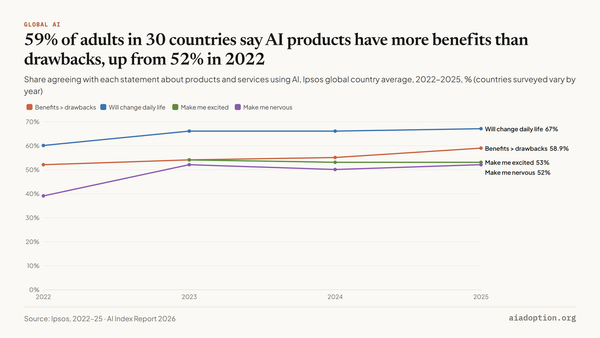 Global Opinion on AI59%Share of adults saying AI products and services have more benefits than drawbacks, Ipsos global average, 2025; 52% in 202259% of adults in 30 countries say AI products have more benefits than drawbacks, up from 52% in 2022Chart · CSVView →
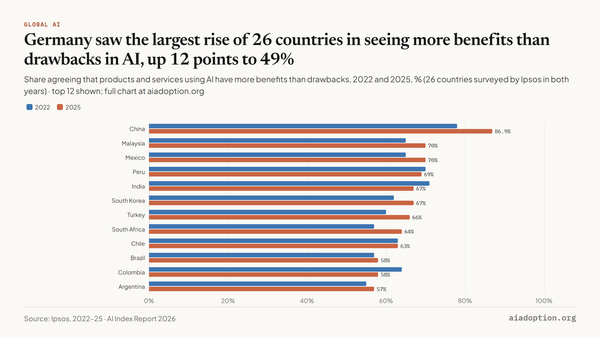 Global Opinion on AI49%Share in Germany agreeing that AI products have more benefits than drawbacks in 2025, up 12 points from 37% in 2022, the largest rise of 26 countriesGermany saw the largest rise of 26 countries in seeing more benefits than drawbacks in AI, up 12 points to 49%Chart · CSVView →
02
AI Excitement vs Nervousness
Nervousness about AI products outweighs excitement in 15 of 31 countries, led by Canada, where 64% are nervous and 31% excited, a gap of 33 percentage points. China shows the reverse pattern, with 84% excited and 40% nervous. Between 2024 and 2025, nervousness rose most in India, by 14 points.
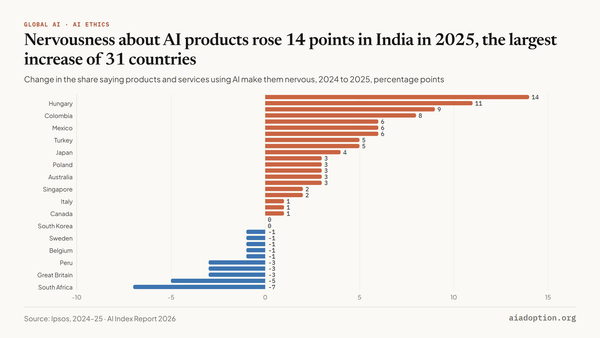 AI Excitement vs Nervousness+14 ptsRise in the share of adults in India saying AI products make them nervous, 2024 to 2025, the largest of 31 countries; the global average rose 3 pointsNervousness about AI products rose 14 points in India in 2025, the largest increase of 31 countriesChart · CSVView →
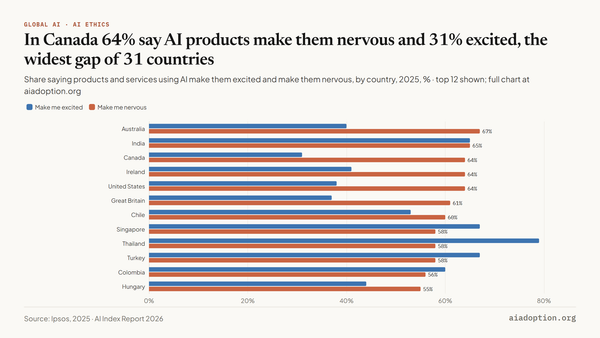 AI Excitement vs Nervousness33 ptsGap between the share of Canadians who say AI products make them nervous (64%) and the share excited (31%), 2025, the widest of 31 countriesIn Canada 64% say AI products make them nervous and 31% excited, the widest gap of 31 countriesChart · CSVView →
03
AI's Expected Impact on Daily Life
On Ipsos's global average, 67% of adults expect AI products to profoundly change their daily life within three to five years, rising to 89% in China; Great Britain is lowest at 52%. The most common expected benefit is saving time (56%), though Americans are less hopeful than the global average in all seven areas asked about.
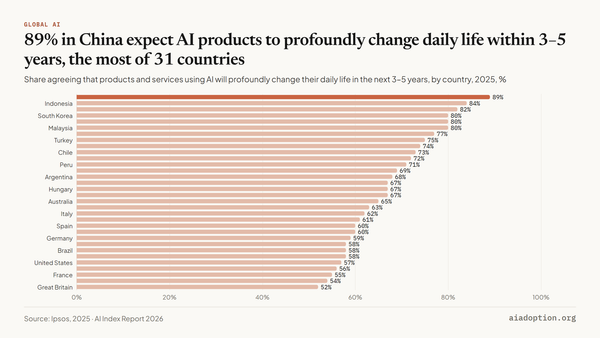 AI's Expected Impact on Daily Life89%Share in China expecting AI products and services to profoundly change their daily life in the next 3–5 years, 2025; global average 67%89% in China expect AI products to profoundly change daily life within 3–5 years, the most of 31 countriesChart · CSVView →
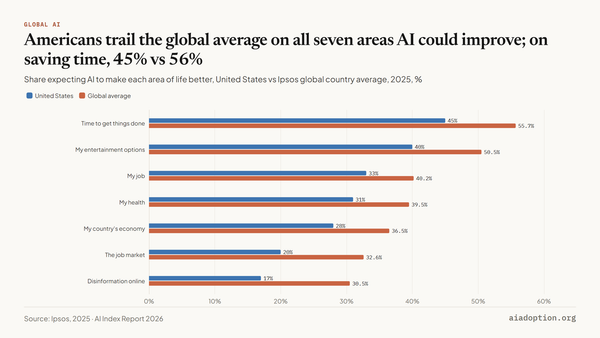 AI's Expected Impact on Daily Life56%Share expecting AI to cut the time it takes them to get things done, Ipsos global average, 2025, the highest of seven areas; United States 45%Americans trail the global average on all seven areas AI could improve; on saving time, 45% vs 56%Chart · CSVView →
04
Public Views on AI and Jobs
In 2025, 61% of adults in 30 countries said AI was likely to change how they do their job within five years, while 37% thought it likely to replace their job. In the United States, Pew found that 64% of adults expect AI to mean fewer jobs over 20 years, against 39% of AI experts.
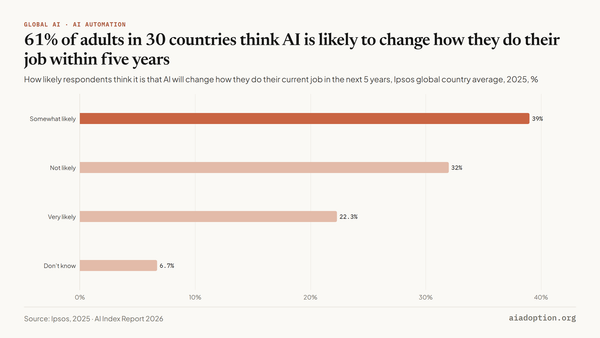 Public Views on AI and Jobs61%Share saying AI is very (22.3%) or somewhat (39%) likely to change how they do their job in the next five years, Ipsos global average, 2025; 60% in 202461% of adults in 30 countries think AI is likely to change how they do their job within five yearsChart · CSVView →
 Public Views on AI and Jobs40%Share expecting AI to make their own job better, Ipsos global average, 2025, against 33% for the job market as a wholeOn Ipsos's global average, 40% expect AI to improve their own job but only 33% the job marketChart · CSVView →
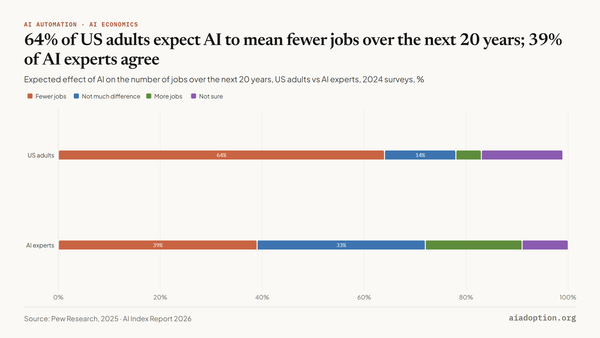 Public Views on AI and Jobs64%Share of US adults who expect AI to lead to fewer jobs over the next 20 years; 5% expect more jobs64% of US adults expect AI to mean fewer jobs over the next 20 years; 39% of AI experts agreeChart · CSVView →
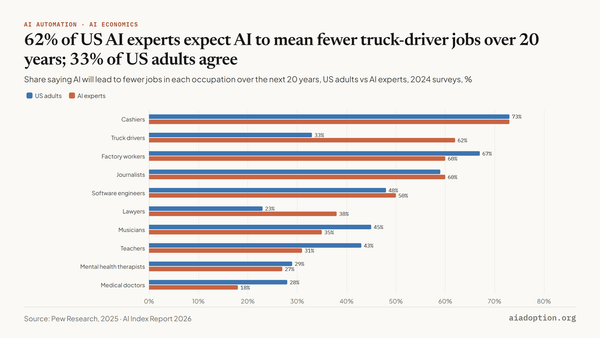 Public Views on AI and Jobs29 ptsGap between AI experts (62%) and US adults (33%) expecting AI to mean fewer truck-driver jobs over 20 years, the widest of 10 occupations62% of US AI experts expect AI to mean fewer truck-driver jobs over 20 years; 33% of US adults agreeChart · CSVView →
05
AI Experts vs the Public
US AI experts are more positive than US adults in all 10 areas Pew asked about. The widest gap is on how people do their jobs: 73% of experts expect a positive impact over 20 years, against 23% of adults. In a separate panel, experts expect AI to assist 18.2% of US work hours by 2030; the public says 10%.
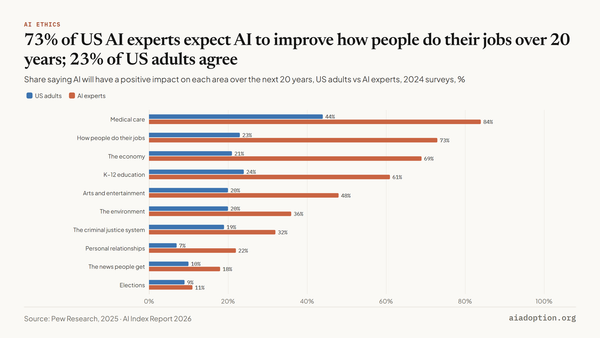 AI Experts vs the Public50 ptsGap between AI experts (73%) and US adults (23%) expecting AI to have a positive impact on how people do their jobs, the widest of 10 areas73% of US AI experts expect AI to improve how people do their jobs over 20 years; 23% of US adults agreeChart · CSVView →
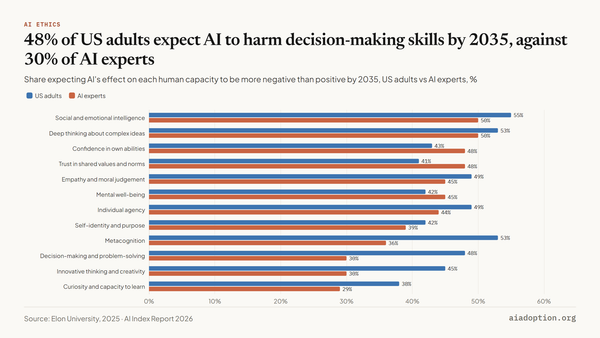 AI Experts vs the Public18 ptsGap between US adults (48%) and AI experts (30%) expecting AI to harm decision-making and problem-solving by 2035, the widest of 12 capacities48% of US adults expect AI to harm decision-making skills by 2035, against 30% of AI expertsChart · CSVView →
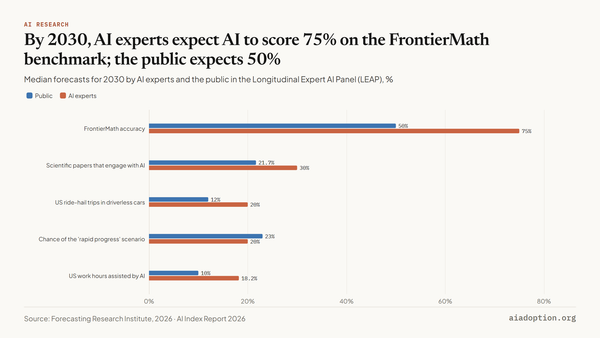 AI Experts vs the Public25 ptsGap between the median 2030 forecasts of AI experts (75%) and the public (50%) for AI accuracy on FrontierMath, the widest of five forecasts shownBy 2030, AI experts expect AI to score 75% on the FrontierMath benchmark; the public expects 50%Chart · CSVView →
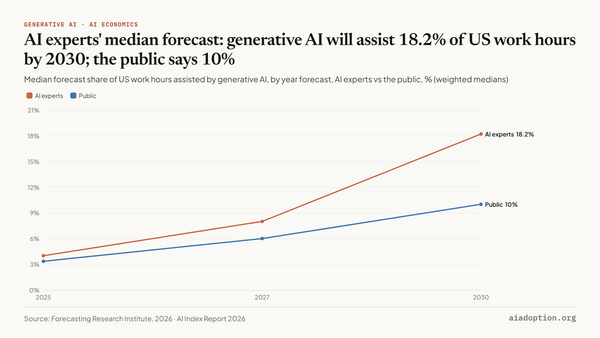 AI Experts vs the Public18.2%Median AI expert forecast of the share of US work hours assisted by generative AI in 2030; the public's median is 10%AI experts' median forecast: generative AI will assist 18.2% of US work hours by 2030; the public says 10%Chart · CSVView →
06
AI Companions
Across 21 countries, 52% of adults say they are at least somewhat excited about using AI for companionship, from 83% in India to 25% in the United States, the lowest. The median AI expert forecast is that 30% of US adults will use AI for companionship daily by 2040; the public's median is 20%.
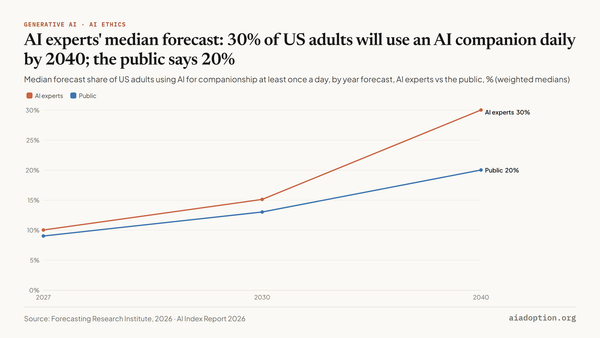 AI Companions30%Median AI expert forecast of the share of US adults using AI for companionship daily in 2040; the public's median is 20%AI experts' median forecast: 30% of US adults will use an AI companion daily by 2040; the public says 20%Chart · CSVView →
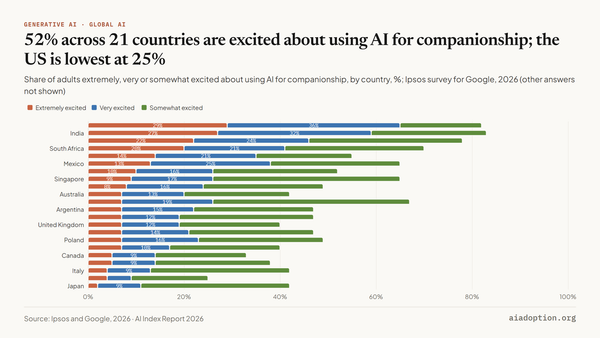 AI Companions25%Share of US adults at least somewhat excited about using AI for companionship (4% extremely, 5% very, 16% somewhat), the lowest of 21 countries; average 52%52% across 21 countries are excited about using AI for companionship; the US is lowest at 25%Chart · CSVView →
07
Public Views on AI Regulation
On Ipsos's global average, 54% of adults trust their government to regulate AI responsibly, from 81% in Singapore to 31% in the United States, the lowest of 30 countries. Across 25 countries, Pew found a median 53% trust the EU to regulate AI effectively, against 37% for the US and 27% for China.
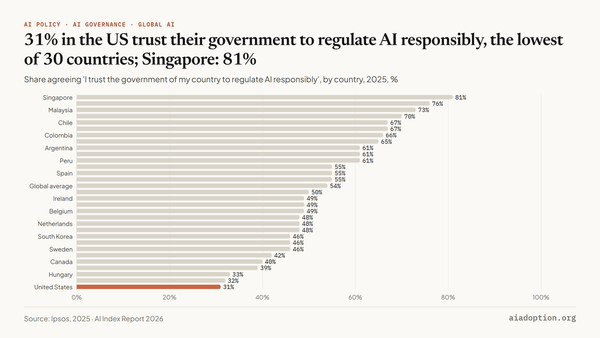 Public Views on AI Regulation31%Share of adults in the US who trust their government to regulate AI responsibly, 2025, the lowest of 30 countries; global average 54%31% in the US trust their government to regulate AI responsibly, the lowest of 30 countries; Singapore: 81%Chart · CSVView →
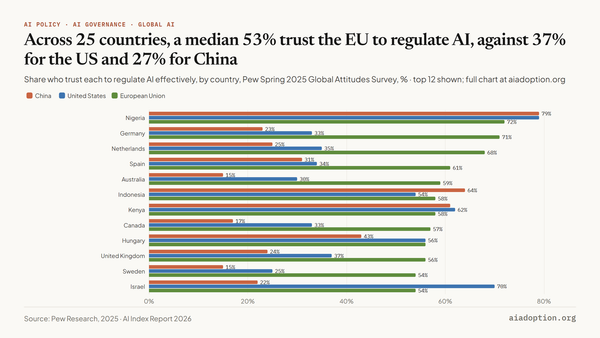 Public Views on AI Regulation53%Median share across 25 countries who trust the EU to regulate AI effectively, 2025; United States 37%, China 27%Across 25 countries, a median 53% trust the EU to regulate AI, against 37% for the US and 27% for ChinaChart · CSVView →
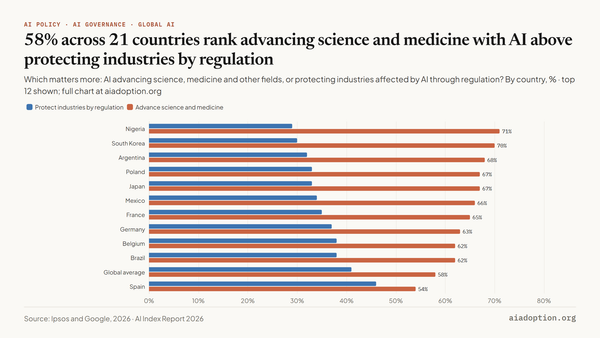 Public Views on AI Regulation58%Share prioritising AI advances in science, medicine and other fields over protecting industries through regulation (41%), average of 21 countries58% across 21 countries rank advancing science and medicine with AI above protecting industries by regulationChart · CSVView →
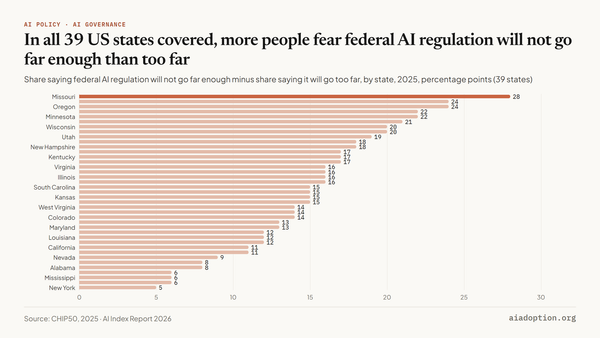 Public Views on AI Regulation28 ptsNet concern in Missouri, the highest of 39 states: 48% say federal AI regulation will not go far enough and 20% too far; New York is lowest at 5 pointsIn all 39 US states covered, more people fear federal AI regulation will not go far enough than too farChart · CSVView →
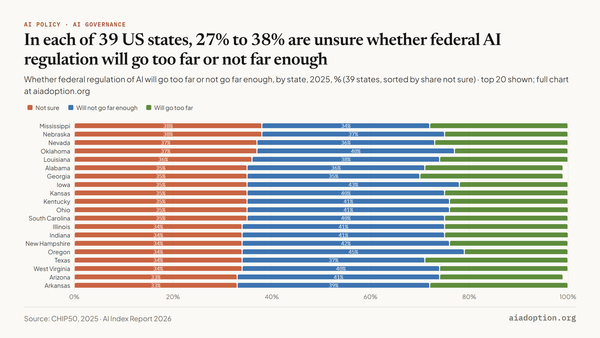 Public Views on AI Regulation38%Share in Nebraska and Mississippi who are not sure whether federal AI regulation will go too far or not far enough, the highest of 39 states; Pennsylvania is lowest at 27%In each of 39 US states, 27% to 38% are unsure whether federal AI regulation will go too far or not far enoughChart · CSVView →
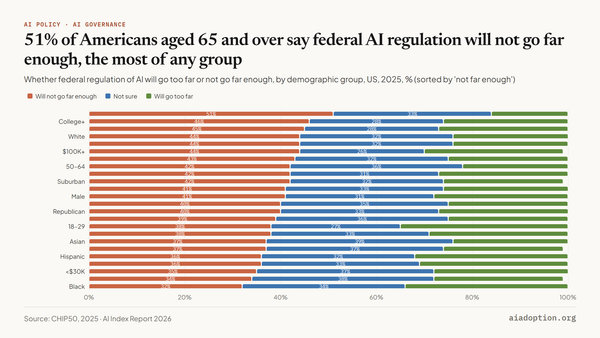 Public Views on AI Regulation51%Of US adults aged 65 and over say federal AI regulation will not go far enough, against 41% of all adults and 38% of those aged 18–2951% of Americans aged 65 and over say federal AI regulation will not go far enough, the most of any groupChart · CSVView →
Related hubs
All 13 hubs →About the data: 22 interactive charts from the AI Index Report 2026 (Stanford HAI), using data from research partners credited on each chart. Each chart page explains what the chart shows, lists its key numbers, cites its source and links to the data as a CSV.