28 pts
#1 of 39
Net concern in Missouri, the highest of 39 states: 48% say federal AI regulation will not go far enough and 20% too far; New York is lowest at 5 points
What the chart shows
The Civic Health and Institutions Project (CHIP50) asked people in each state whether federal regulation of AI will go too far or not far enough, or whether they are not sure. In all 39 states in the data, more said not far enough. The net gap is widest in Missouri (28 points), then Oregon and Washington (24 each).
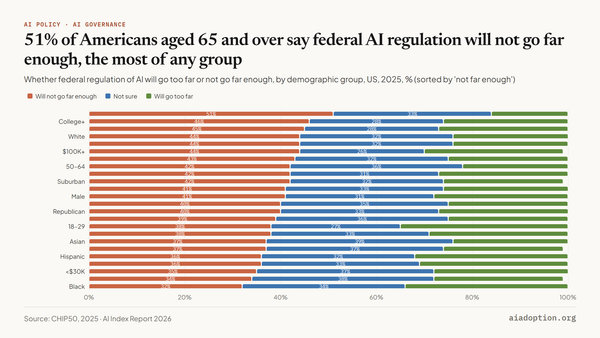
It is narrowest in New York (5 points), where 36% say not far enough and 31% too far, followed by Georgia, Mississippi and Tennessee (6 each). Nationally, 41% say federal regulation will not go far enough and 27% that it will go too far.
Key numbers
| Measure | Value |
|---|---|
| Missouri | 28 |
| Oregon | 24 |
| Washington | 24 |
| Georgia | 6 |
| Tennessee | 6 |
| New York | 5 |
How to read it
- CHIP50 (Civic Health and Institutions Project) survey, 2025. The data covers 39 states; Alaska, Delaware, Hawaii, Idaho, Maine, Montana, North Dakota, Rhode Island, South Dakota, Vermont and Wyoming are not in it.
- Net concern is ‘not go far enough’ minus ‘go too far’, in percentage points; it matches the state shares in the companion chart. The national shares (41% and 27%) are from the AI Index’s demographic data file.
- The AI Index text says concern about too little regulation outweighs concern about too much across all 50 states; the data covers 39.
Source: CHIP50, 2025, via the AI Index Report 2026 (Stanford HAI), figure 9.3.4: Net concern for not enough vs. too much AI regulation by US state, 2025. Chart and text by AI Adoption.
Numbers checked against the published data on 20 October 2026.
Download the data (CSV) · Cite this chart
Numbers checked against the published data on 20 October 2026.
Download the data (CSV) · Cite this chart


Discussion