67%
share of master's graduates in AI software-related fields at US institutions who were non-residents, 2024; PhD 55%
What the chart shows
Most graduate degrees in AI software-related fields at US institutions go to students who are not US residents: 67% of master’s graduates and 55% of PhD graduates in 2024. At undergraduate level the pattern reverses, with non-residents making up 11% of bachelor’s and 4% of associate’s graduates.
Put the other way, US residents earned 33% of these master’s degrees and 45% of the PhDs. The AI Index expects the number of non-resident graduates to fall in coming years, citing revoked student visas and federal policy discouraging international enrolment.
Key numbers
| Measure | Value |
|---|---|
| Master's, non-residents | 67% |
| PhD, non-residents | 55% |
| Bachelor's, non-residents | 11% |
| Associate's, non-residents | 4% |
| Master's, US residents | 33% |
How to read it
- Non-residents are graduates who are in the US on a visa or temporary basis, as IPEDS records them. Values are whole percentages of 2024 graduates.
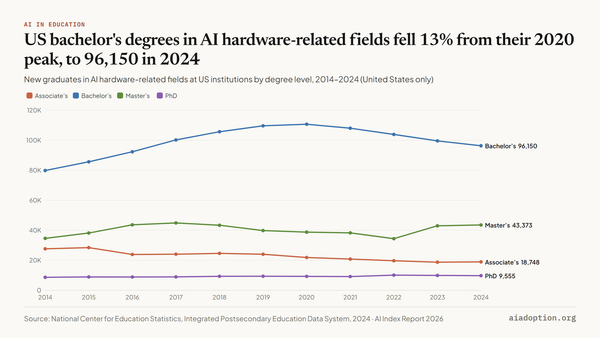
- In AI hardware-related fields non-residents were 2% of associate’s, 7% of bachelor’s, 53% of master’s and 56% of PhD graduates (the report’s second panel, not charted separately).
- US institutions only.
Source: National Center for Education Statistics, Integrated Postsecondary Education Data System, 2024, via the AI Index Report 2026 (Stanford HAI), figure 7.2.5: AI-related postsecondary graduates in the United States by residency, 2024 (AI software–related). Chart and text by AI Adoption.
Numbers checked against the published data on 20 October 2026.
Download the data (CSV) · Cite this chart
Numbers checked against the published data on 20 October 2026.
Download the data (CSV) · Cite this chart


Discussion