AI Energy Consumption
Estimates of AI's energy use at three scales: one query, one training run and all AI hardware shipped. One medium-length GPT-4o query uses about 1.21 Wh; training Grok 3 drew an estimated 110 MW.
Infrastructure & Industry · 10 charts · 3 topics
- Source
- Stanford AI Index Report 2026
- Charts
- 10 with CSV data
- Last checked
- 19 Oct 2026
- Data
- All CSVs (zip)
1.21 WhEstimated energy for one medium-length GPT-4o query, about four Google searchesView chart →110 MWEstimated power draw while training Grok 3 (Feb 2025), the most with published dataView chart →9.4 GWPower demand of complete AI systems shipped in 2023–2024, above Austria (7.2 GW)View chart →2.5TFLOP/s per watt of the most efficient leading AI chip, about 33 times 2016'sView chart →72,816 tEstimated CO₂-equivalent emissions from training Grok 4 (2025)View chart →1.58M kLUpper estimate of GPT-4o's annual inference water useView chart →
AI's energy use can be measured at three scales: a single query, a training run and the hardware fleet as a whole. One medium-length GPT-4o query uses an estimated 1.21 Wh, around four Google searches, while the most energy-intensive 2025 models measured used up to 23.2 Wh for a prompt of similar length. Settings matter too: GPT-5 used 21.9 Wh at high reasoning effort and 8.4 Wh at low.
Read the full overview
Training runs draw far more power. Grok 3 drew an estimated 110 MW while training, the most of any model with published data, against about 246 W for a 2011 model. Across the fleet, complete AI systems shipped in 2023 and 2024 draw an estimated 9.4 GW, more than Austria's national demand, while bitcoin mining draws 19.9 GW. The most efficient chips deliver about 2.5 trillion operations per second per watt, roughly 33 times the leading chip of 2016, but models have grown faster than chips have become more efficient.
Estimated training emissions rise from 0.01 tonnes of CO₂ equivalent for AlexNet in 2012 to 72,816 tonnes for Grok 4, and GPT-4o's inference is estimated to use up to 1.58 million kilolitres of water a year. The figures come from Stanford's AI Index Report 2026 and the studies it cites, including Jegham et al. (2025) for per-prompt energy. Nearly all are estimates built from public information, not measured power.
AI Adoption · 2026AI Statistics: the pocket guide83Free for subscribersAll 83 key numbers on two pages, with sources.Every hub's headline numbers in one PDF, ready for a board paper or a slide.Get the guide
01
AI Energy Consumption
One medium-length GPT-4o query uses an estimated 1.21 Wh, about four Google searches, and a day of eight such queries uses about as much energy as charging two phones. Training is on another scale: Grok 3 drew an estimated 110 MW while training, against about 246 W for a 2011 model in the data.
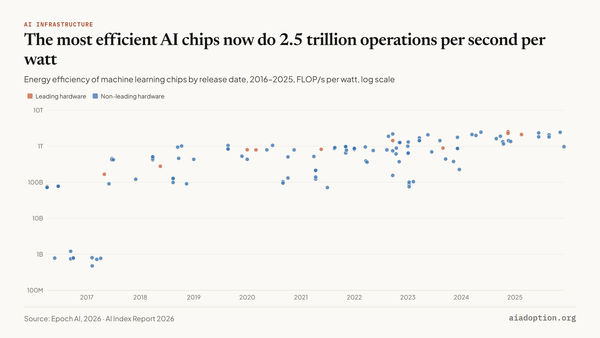 AI Energy Consumption2.5TFLOP/s per watt: the most efficient leading chip in the data (late 2024), against 74.8 billion for the leading chip of 2016The most efficient AI chips now do 2.5 trillion operations per second per wattChart · CSVView →
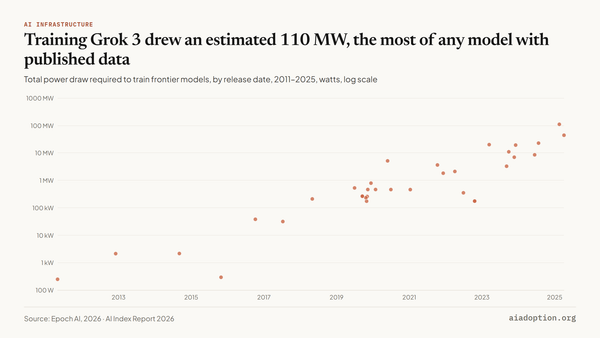 AI Energy Consumption110 MWEstimated power draw while training Grok 3 (Feb 2025); Llama 4 Behemoth needed about 44 MWTraining Grok 3 drew an estimated 110 MW, the most of any model with published dataChart · CSVView →
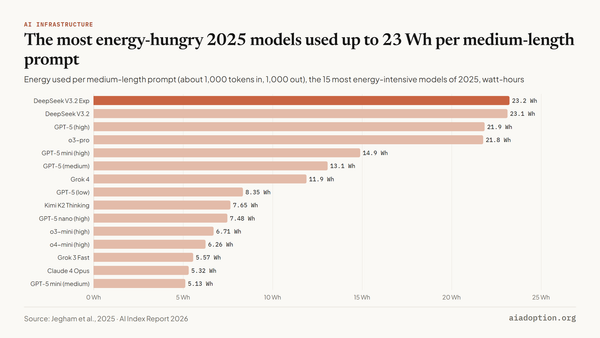 AI Energy Consumption23.2 WhEnergy per medium-length prompt for DeepSeek V3.2 Exp, the highest of the 2025 models measuredThe most energy-hungry 2025 models used up to 23 Wh per medium-length promptChart · CSVView →
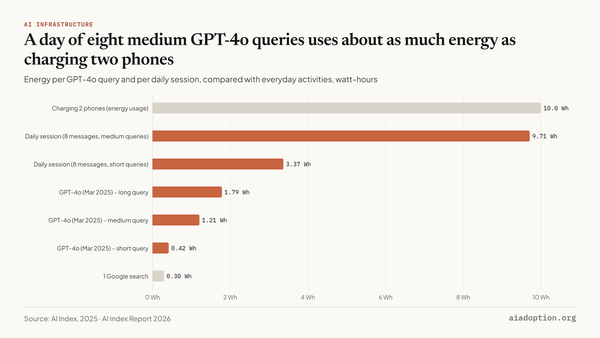 AI Energy Consumption1.21 WhEstimated energy for one medium-length GPT-4o query (March 2025), about four Google searchesA day of eight medium GPT-4o queries uses about as much energy as charging two phonesChart · CSVView →
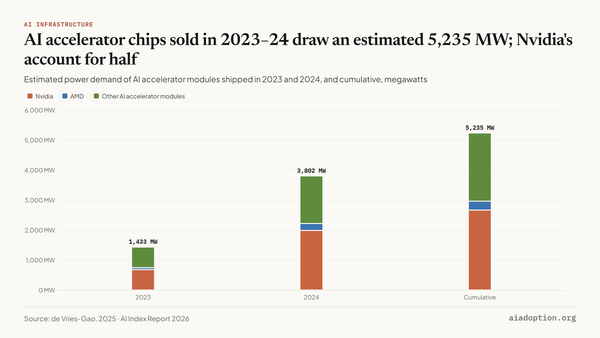 AI Energy Consumption5,235 MWEstimated power demand of AI accelerator modules shipped in 2023–2024; Nvidia 2,665 MWAI accelerator chips sold in 2023–24 draw an estimated 5,235 MW; Nvidia's account for halfChart · CSVView →
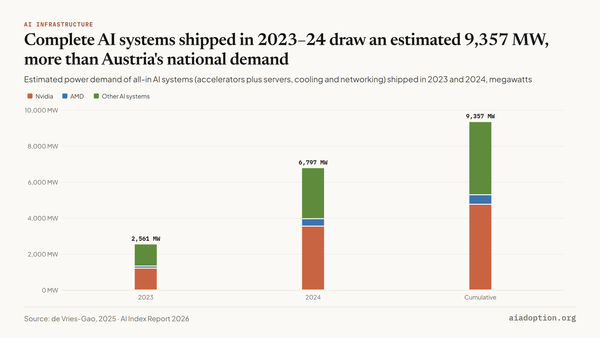 AI Energy Consumption9,357 MWEstimated power demand of complete AI systems shipped in 2023–2024, above the national demand of Austria (7.2 GW) or Finland (9.0 GW)Complete AI systems shipped in 2023–24 draw an estimated 9,357 MW, more than Austria's national demandChart · CSVView →
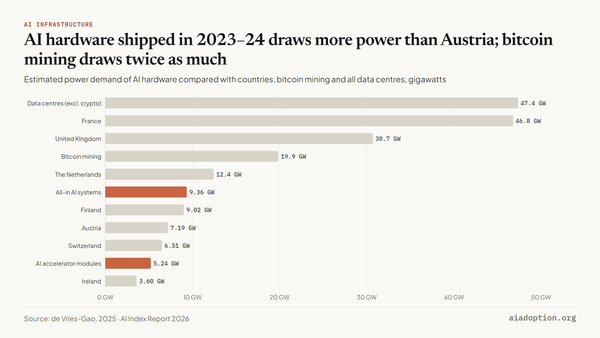 AI Energy Consumption9.4 GWPower demand of complete AI systems shipped in 2023–2024, above Austria (7.2 GW) and Finland (9.0 GW)AI hardware shipped in 2023–24 draws more power than Austria; bitcoin mining draws twice as muchChart · CSVView →
02
AI Carbon Emissions
Estimated training emissions have grown from 0.01 tonnes of CO₂ equivalent for AlexNet in 2012 to 72,816 tonnes for Grok 4 in 2025, more than the lifetime emissions of 1,000 average cars. Model size is not the only factor: hardware efficiency, training time and the carbon intensity of local electricity all shift the total.
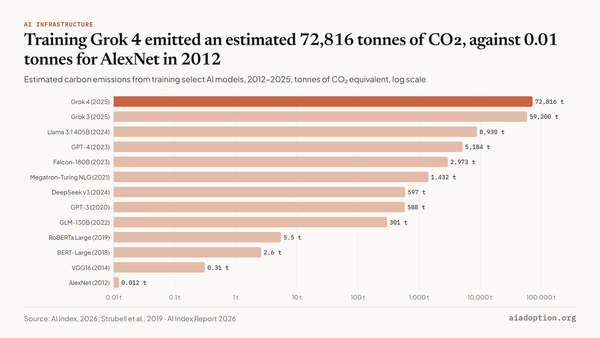 AI Carbon Emissions72,816 tEstimated CO₂-equivalent emissions from training Grok 4 (2025), more than 1,000 average cars' lifetime emissionsTraining Grok 4 emitted an estimated 72,816 tonnes of CO₂, against 0.01 tonnes for AlexNet in 2012Chart · CSVView →
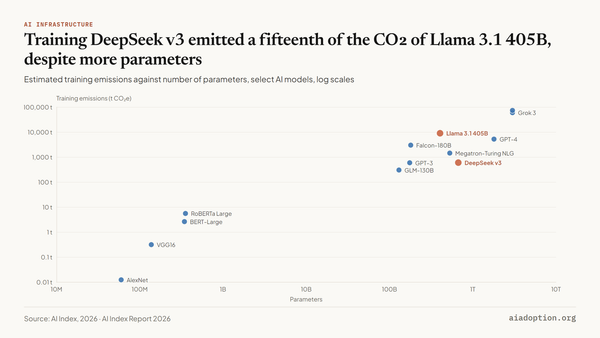 AI Carbon Emissions597 tEstimated training emissions of DeepSeek v3 (671B parameters), against 8,930 t for Llama 3.1 405B (405B)Training DeepSeek v3 emitted a fifteenth of the CO₂ of Llama 3.1 405B, despite more parametersChart · CSVView →
03
AI Water Use
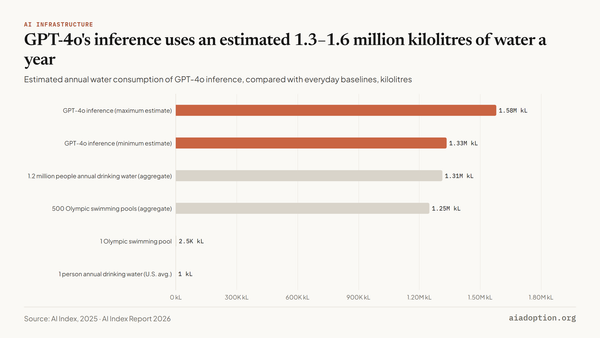
GPT-4o's inference alone is estimated to use 1.33 to 1.58 million kilolitres of water a year. The upper estimate exceeds the annual drinking water of 1.2 million people, 1.31 million kilolitres. It is the only water estimate in this data, and it covers answering queries with one model, not training.
Related hubs
All 13 hubs →About the data: 10 interactive charts from the AI Index Report 2026 (Stanford HAI), using data from Epoch AI, Jegham et al., de Vries-Gao and Strubell et al.. Each chart page explains what the chart shows, lists its key numbers, cites its source and links to the data as a CSV.